Hassan Rouhani, Iran's newly elected president, will have to contend with a laundry list of economic problems as he takes an oath in parliament on August 3.
Iran's economy is suffering from crippling sanctions, a depreciating currency and inflation that has soared 32%.
All the six candidates that had contested the elections had promised to resolve economic issues, but they had been tiptoeing around Iran's confrontation with the West regarding the nuclear issue, which has wrecked its economy, its standing in the international community and brought nothing but hardship to its people.
In the end, Rouhani secured more than 50% votes, as more than 18 million Iranians chose a reformist over more hardline politicians.
"I said it is good for centrifuges to operate, but it is also important that the country operates as well and the wheels of industry are turning," Rouhani had said during the election campaign, suggesting that he will try to strike a balance between Iran's nuclear ambitions and the needs of the economy.
Indeed, Iran's economy has been hit hard by the sanctions. The US Department of Energy estimates that restrictions imposed by the United States and European Union have particularly reduced Tehran's ability to finance the economy.
"Iran's 2012 net estimated oil export revenue, at USD 69 billion, was significantly lower than the USD 95 billion total generated in 2011," the department estimates.
"The US and EU measures prohibited large-scale investment in the country's oil and gas sector, and cut off its access to European and US sources of financial transactions."
In addition, sanctions imposed on the Central Bank of Iran and a Western ban on insuring Iranian oil carriers further limited Tehran's ability to sell its crude. According to some estimates, 30 million barrels of oil was sloshing around in floating storage by the end of May.
OIL OUTPUT DROPS
Meanwhile, Iranian oil production fell by as much as 700,000 barrels per day last year, and Tehran lost its ranking as OPEC's second largest producer to Iraq.
There has been a recent blip in Iranian oil production because of six-month waivers for a number of countries that import heavily from Iran, but analysts don't expect it to last for long.
The US has granted waivers to Malaysia, Singapore, South Africa, Sri Lanka, Turkey and Taiwan, apart from Japan and 10 EU countries.
The short-term surge of Iranian oil exports has jumped from 835,000 bpd in April to 1.39 million bpd in May.
"At the same time, the US Congress announced plans to strengthen sanctions against Iran in a bid to choke off Iranian crude oil exports further and deny Tehran funds to develop its nuclear program," said the International Energy Agency in its latest monthly report.
"In addition, the Obama Administration on [June 3] issued an executive order imposing sanctions on financial institutions that transact trades in the Iranian rial," said the IEA. "Lawmakers in Congress also hope to pass legislation this summer that could further limit Iran's access to its foreign currency accounts, which are largely held in euros."
All these pressures mean Iran's economy is expected to contract 1.8% in 2013, although lower than the 3% shrinkage in the previous year, according to the Economist Intelligence Unit.
"High inflation and the volatility of the rial will depress private consumption (the largest component of GDP) and we expect it to contract by around 4% in 2013/14," said the EIU.
"Automotive sales, as an indication, were reportedly down by around 40% in 2012. Private consumers are increasingly turning to investing in property, raising concerns of an asset price bubble. Industry will be hard hit by the impact of sanctions, as foreign counterparties will be wary of trading with Iran, curbing the supply or raising the price of imported spare parts and raw materials."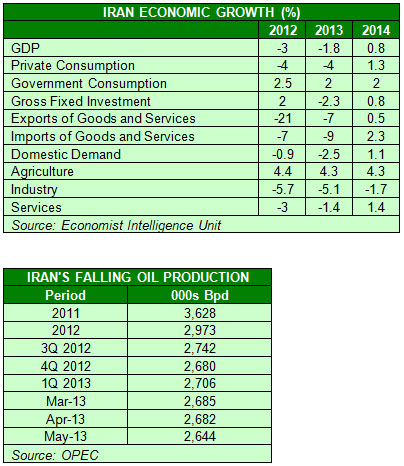
NEW CHAPTER
The Iranian authorities were hoping that the current election do not follow the precedent of the previous ones which saw massive protests and major clampdown by the regime to suppress dissent.
In fact, Iranians rejoiced at the election of Rouhani, who they believe will pursue a more moderate stance.
"What I truly wish is for moderation to return to the country," Rouhani had said in an interview. "This is my only wish. Extremism pains me greatly. We have suffered many blows as a result of extremism."
The election will also allow Iran to turn over a new leaf after the tumultuous presidency of Mahmoud Ahmadinejad which led to an escalation of futile rhetoric against Western powers and heightened tensions over the nuclear program.
At home, Ahmadinejad pursued populist policies, although his subsidy reduction program did earn him praise from the International Monetary Fund.
"Ahmadinejad is the author of many of Iran's woes, and his odd combination of assertiveness, ignorance, and populism created a perfect storm of irresponsible management for Iran's economy at the worst possible moment," said Suzanne Maloney, senior fellow at Brookings Institute in a note.
Ahmadinejad was also responsible for accelerating the participation of the Islamic Revolutionary Guards Corp. (IRGC) and the Basij military by awarding a number of contracts to companies linked IRGC, appointing a number of IRGC members to key government positions.
In addition IRGC and Basij-affiliated investors also received preferential loans rates and financing.
"Increasing international and Western sanctions have served both as a rationale for the economic empowerment of the IRGC and as an excuse for it," wrote Prof. Nader Habibi, a professor of the Economics of the Middle East at Brandeis University.
"This empowerment will have a long-term impact on the distribution of economic opportunities in Iran and on Iran's economic efficiency. It will be very difficult for future political leaders to scale back the economic reach of the IRGC and the Basij, just as it has proven very challenging for governments to reduce the economic activity of the military in Egypt, Indonesia, and many other developing countries."
NUCLEAR ISSUE
One way the new president can fix the economy is to resolve the nuclear program standoff with Western governments, but that is the one issue that he will have little control over.
Nuclear program are directly controlled by Ayatollah Khamenei, and his next moves will be crucial in helping Iran navigate through the crisis.
Rouhani has clearly struck a reconciliatory tone: "It seems that extremists on both sides are determined to maintain the state of hostility and hatred between the two states, but logic says that there should be a change of direction in order to turn a new page in this unstable relationship and minimize the state of hostility and mistrust between the two countries."
Apart from the sanctions, Iran is facing intense pressure from Israel who has threatened to attack the country. In addition, the United States decision to arm Syrian opposition is a body blow to the Iranian regime, which has been supporting president Bashar Al Assad fight against rebel forces.
The election may provide the regime to save face and allow Khamenei to pursue a less confrontational policy via a more compliant president.
"But Khamenei's consolidation of power and the election of a loyal president are likely to make Iran more intransigent on the nuclear program," wrote Alireza Nader, an analyst with Rand Corporation in a report in a pre-election review.
"Khamenei is wedded to a policy of 'resistance' against the United States. Increasingly harsh sanctions in the absence of a serious US push for diplomacy could further persuade him that the United States and its allies intend to collapse his regime rather than reshape Iran's nuclear calculations; this would make Khamenei and his new president more likely to dig in rather than concede on the nuclear issue."
© alifarabia.com 2013