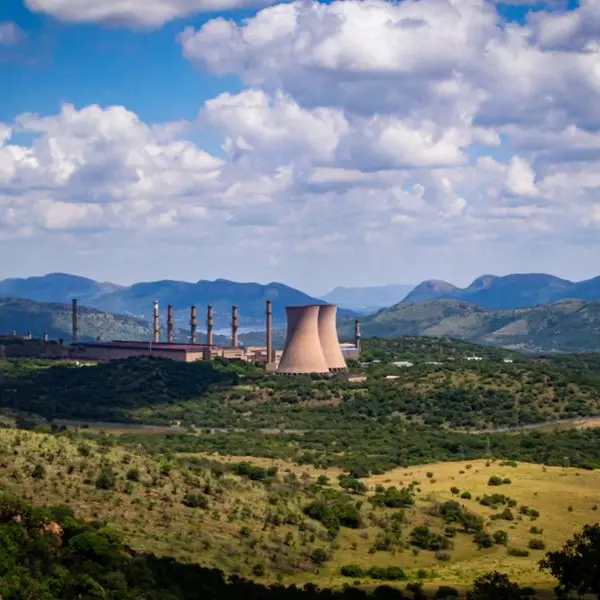
South Africa has been a 'standout' performer in attracting renewable energy investment, according to a new report by the United Nations Environment Programme (UNEP).
It saw investments worth USD 4.8 billion in its renewable energy sector last year, although this is down from the USD 5.7 billion attracted in the previous year.
Around USD 3 billion of the investments in the country were directed at solar, while another USD 1.9 billion were invested in wind power.
South African utility company Eskom's USD 818 million Upington solar thermal plant was the biggest financing deal in the country, with a capacity of 100 megawatt (MW). Another USD 412 million were spent on the Cennergi Amakhala Emoyeni wind farm, with capacity of 134MW.
"Solar thermal, in fact, found South Africa to be its most active market in 2013," UNEP said in its 'Global Trends In Renewable Energy Investment in 2014' report.
"The range of technologies, which attracted more than USD 10 billion worth of investment worldwide in 2011, mainly in the US and Spain, was reduced to a handful of new project financings last year - two of them in South Africa and one each in China, Oman and Chile."
Solar and wind could make up 10% of South Africa's energy mix by 2020. Last year, the South African government awarded 17 new contracts for solar and wind projects, which should help the country achieve its ambitious target.
Other African states did not enjoy a fraction of the funds invested in South Africa.
"Morocco, which had been a significant investor in the previous year with USD 1.9 billion, reached a pause in its financing activity for wind and solar in 2013. Kenya saw investment of USD 249 million, up from USD 226 million in 2012, but well below 2010's peak of USD 1.7 billion," UNEP noted. "Financial close on its flagship Lake Turkana wind project remained tantalizingly just out of reach."
Overall, the Middle East and Africa region accounted for USD 9 billion of investments in the renewable energy sector.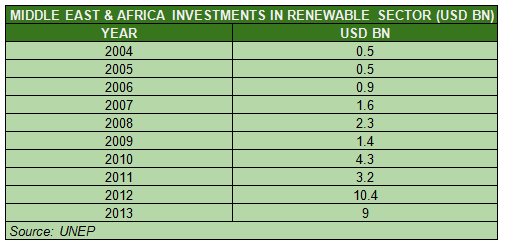
COST CHALLENGES
While proponents of renewable energy highlight the eco-friendliness of wind and power, in many places the sector is handicapped by poor economics, lack of infrastructure and the availability of cheaper resources such as coal and natural gas.
But Ban Ki-Moon, the United Nations' Secretary General, believes the cost structures for renewables are changing.
In the Middle East and Africa, "countries are installing projects that produce electricity at costs per megawatt-hour that challenge conventional power sources, often with no subsidy support," Moon said in his foreword to the report.
Global investments in renewable energy fell 14% in 2013 compared to 2012 to reach USD 214 billion, but UNEP believes it is due to lower cost of solar photovoltaic systems.
"Investment in wind was relatively resilient in 2013, falling just 1% to USD 80 billion, while that in solar tumbled 20% to USD 114 billion," UNEP noted.
"Biofuels saw a 26% drop in investment to USD 5 billion, the lowest for nine years, while biomass and waste-to-energy fell 28% to USD 8 billion, and small hydro-electric (projects of less than 50mw) declined 16% to USD 5 billion."
While investment in new capacity was down, renewable power (excluding large hydro) raised its share of total world electricity generation from 7.8% to 8.5%. 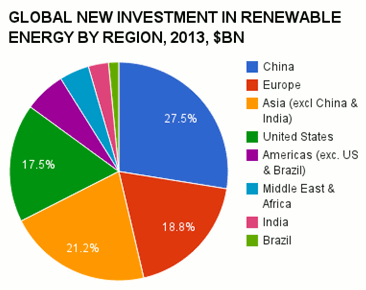
INVESTMENTS ON THE RISE
Although venture capital and private equity investment remained on the sidelines in 2013, public markets tripled their investment in renewable energy and helped clean energy stocks rise 54% during the year.
Crucially, many of the new projects are not supported by subsidies, which are making them attractive for many developing nations.
In many places in the Middle East and Africa, renewable power projects are being built at cost-per-megawatt hours that are lower than those of fossil fuels.
In Jordan, a consortium of investors led by International Finance Corporation provided USD 221 million to build a 117MW wind farm in the country's south west region.
"The Tafila wind farm is expected to produce electricity at a price up to 25% less than that of thermal power," the IFC said.
In Rwanda, a joint venture between Scatec Solar and Norfund of Norway is financing a solar photovoltaic plant in a village.
Smaller nations that depend on crude oil and natural gas may be ideal locations for smaller wind and solar power projects, as it helps them move away from costly diesel plants and leaves a softer carbon footprint on the environment.
"In isolated areas, such as mining sites and islands, gensets [diesel generators] may be in use with electricity prices well above USD 250 per MWH, and wind can be competitive at USD 85 to USD 90 per MWH," UNEP noted.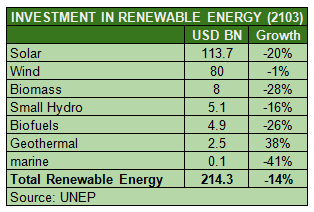
RENEWABLE VS FOSSIL FUELS
As elsewhere in the world, renewable energy and fossil fuels are fighting tooth and nail for dominance in emerging markets.
Many African nations such as Tanzania, Kenya and Mozambique have made fossil fuels a crucial pillar of their export strategy as well as domestic production.
Indeed, recent advances in shale extracting technology and billions poured in Africa's natural gas and crude oil resources has compelled many nations to ignore renewable energy.
Renewable energies are also struggling in many advanced nations that had spent billions on renewable sector earlier in the decade.
Countries such as Germany, which had pursued aggressive plans to cut carbon emission and switched to renewable energies, are now seeing record consumption of coal as their green energy projects have not been successful.
In addition, the high costs of renewable energy have made the European Union at a comparative disadvantage to the US, which pursued shale oil and gas development during the same period.
Renewable energy still has a long way to go before it can replace fossil fuels. Indeed, no serious projection of world energy demand sees oil and natural gas and even coal being displaced by solar and wind power any time soon.
As African nations look to build their power grids, they need to be mindful that they develop renewable energy, not just for the sake of developing green technologies, but only if it makes economic sense and when cheaper alternatives do not exist.
A more likely scenario in Africa, and across the world, is that renewable energy would be complementary energy sources to fossil fuels rather than a replacement.
The feature was produced by alifarabia.com exclusively for zawya.com.
© Zawya 2014