Saudi Aramco's decision to proceed with the 400,000 barrels per day Jazan Refinery is part of a trend of turning the Middle East into a beehive of global refining activity.
The USD7-billion refinery and terminal project, which will create 5,000 much-needed jobs, is part of the sprawling Jazan City in the south-west of the country, and is expected to be completed by 2016.
Once operational, the refinery will be capable of processing heavy and medium crudes to manufacture approximately 75,000 bpd of gasoline, 250,000 bpd of ultra-low-sulfur diesel, and 80,000 bpd of vacuum residual, which will be sent to an adjacent new power block. In addition, products at Jazan will also include LPG, sulfur, asphalt, and more than 1 million tons per year of benzene and para-xylene, Aramco said on its website.
Meanwhile, Saudi Aramco and French partner Total are building a USD14-billion Jubail refinery, slated for completion in 2013. Set to be one of the world's largest refineries, the plant will process heavy crude to produce 700,000 tonnes per year paraxylene, 140,000 tonnes per year of benzene and 200,000 tonnes per year of polymer grade propylene.
The project is divided into 15 packages and includes construction of distillation and hydro-treating facilities, a conversion unit, a sulphur and a mine saltwater treatment unit, an aromatics plant and a coker unit, according to Zawya Projects Monitor data.
The International Energy Agency (IEA) believes global refinery growth will be led by countries 'East of Suez' - in Asia, the Middle East and former Soviet Union.
"Distillate demand is also expected to growth much faster than that for other products, so that gasoil and diesel by the end of the forecast period will account for the largest share by far of the demand barrel - a challenge for refiners and end-users alike," said the agency.
Apart from Saudi Arabia, Iraq's refinery potential is huge. Zawya projects data shows at least four major refinery expansions being planned valued at USD22-billion.
"Among OPEC producers, Iraq stands out as its production capacity is expected to enter a new growth phase, which may continue even beyond the forecast period," notes the IEA. "These new supply sources are expected to more than offset decline rates and outages elsewhere as well as the continued impact of international sanctions of Iran."
Iraq's key refineries all need 'urgent' upgrading, but remain hamstrung by lack of investment. The EIA notes that apart from a 40,0000 bpd refinery in Erbil, Kurdistan much of the capacity has come in the form of small units, which have fallen short of rising Iraqi demand for products such as gasoline.
"In addition to projects aimed at upgrading and de-bottlenecking the existing refineries, design work is at various stages for large projects in Karbala (140,000 bpd), Nassiriyah (300,000 bpd), Kirkuk (150,000 bpd) and Missan (150,000) that would increase refinery capacity by almost 750,000 bpd."
Other key refinery projects in the region include the USD10-billion Ruwais Refinery Expansion in the UAE, the USD6-billion Duqm Refinery and Petrochemical Complex in Oman, and Bahrain's Sitrah Refinery Upgrade and Expansion, also valued at USD6-billion.
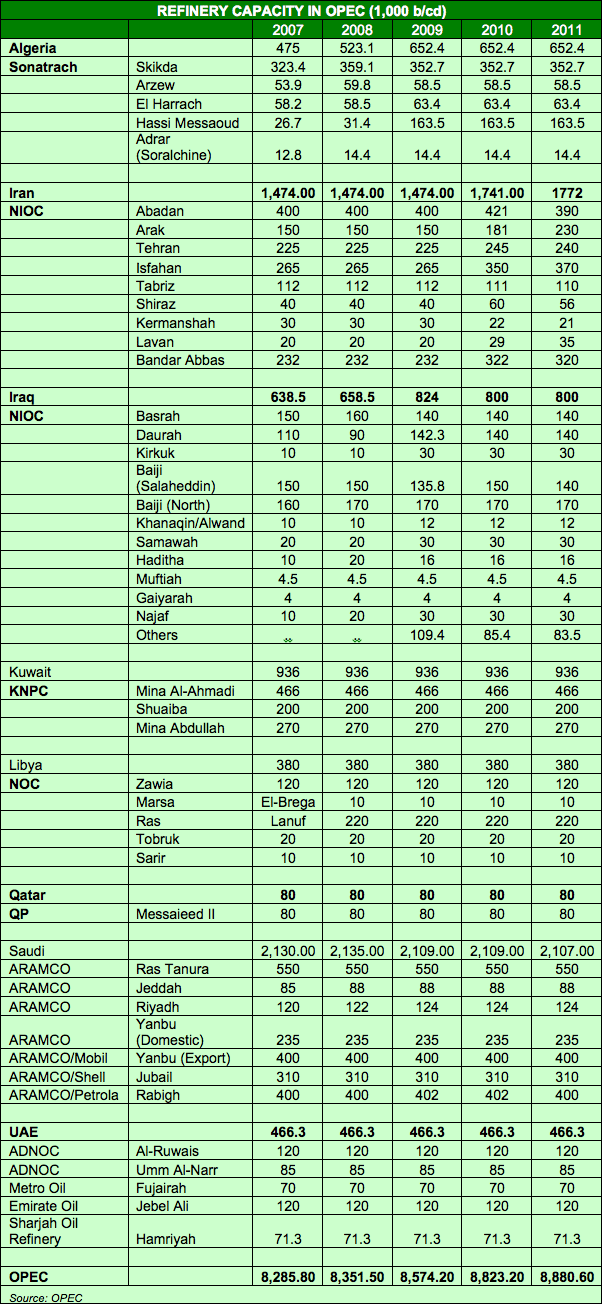
But two of the region's largest projects are taking place in Kuwait, according to Zawya Projects Monitor data. The Mina Al Ahmadi Refinery expansion combined with the Clean Fuel Project, will boost refinery capacity to 1.4 million bpd and cost around USD18-billion.
Kuwait is also looking to develop the USD15-billion Al Zour Refinery with a 615,000 bpd. The project has been delayed on various occasions, but latest reports suggest the government may issue the engineering and procurement contract by the first quarter of 2013.
GLOBAL REFINERY DOWNTURN
Refiners in the United States, Canada and the European Union are struggling, especially in comparison to emerging markets. Big Oil has reduced refining capacity in mature markets across Europe and North American East Coast, and instead looking at opportunities closer to markets which are either closer to energy-hungry Asian markets or their own domestic demand is rising.
"In line with contracting demand, refinery utilization rates in many OECD countries have dropped in recent years, mainly in Europe where refineries have suffered from poor economic performance due to weak margins in the Atlantic Basin," noted OPEC in a September report.
"In 2011, OECD gasoline demand was particularly disappointing, dropping by 3% from the 5-year average to almost 14 mb/d, with US consumption falling to 8.4 mb/d in January, the lowest level in years."
While mature markets are suffering from lack of economic growth, lower oil and petroleum products demand, the opposite is true in emerging markets such as the Middle East.
All the Middle East oil exporters are consuming more of their own crude production, and are looking to produce petroleum products domestically to generate jobs, reduce imports and maintain their high subsidies on gasoline.
Oil consumption within the Middle East has been growing by around 2.7% annually driven by transportation and industrial sector, according to OPEC.
"Gasoline, diesel, and fuel oil are the most consumed products within the region. The top consuming countries are Saudi Arabia (2.8 mb/d) and Iran (1.8 mb/d). Saudi oil demand increased by 0.09 mb/d in July y-o-y. Diesel grew the most, which is related to industrial use since some power plants within the kingdom operate on diesel. It is forecast that the Middle East will consume 7.8 mb/d in 2012, representing growth of 0.2 mb/d y-o-y."
© alifarabia.com 2012