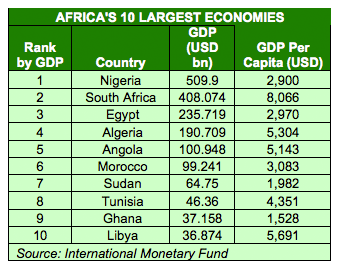
GDP is nothing but a number. After a two-year delay, Nigeria has finally rebased its gross domestic product and emerged as Africa's largest economy ahead of South Africa, which had long held the title.
The updated GDP figure means Nigeria has jumped 12 places to become the 26th largest economy in the world, with GDP of USD 509.9 billion. The International Monetary Fund and the African Development Bank have endorsed the new numbers.
In addition, Nigeria's GDP per capita also rose to around USD 3,000, compared with USD 1,600 earlier -- 126th largest in the world. Fifteen African states have better GDP per capita figures than Nigeria.
The dramatic increase in GDP was largely due to services, which increased more than threefold in nominal terms, wrote Yvonne Mhango, analyst at Renaissance Capital.
"Services' share of GDP jumped to 53%, vs 29% previously. This is partly due to the surge in telecoms' contribution, to 9% of GDP, vs 1% previously, and the emergence of a new sector, 'Nollywood' (1.2% of GDP). As we expected, agriculture's share declined to 22% (vs 35%). The threefold increase in manufacturing/GDP, to 7% (vs 2%), was countered by the fall in oil and gas/GDP to 14% (vs 33%), which explains the decline of industry/GDP to 25% (vs 36%)."
'MORE ROOM TO BORROW'
The Renaissance analyst notes that the West African country's fiscal position looks stronger under the new metrics, with the budget deficit/GDP and public debt/GDP for 2013 falling to 1% (vs 1.8% previously) and 11% (vs 20%), respectively.
This means the government has more room to borrow, which is positive for infrastructure development.
The GDP rebasing also implies a drop in fiscal revenue/GDP to 14% (vs 26%) - significantly lower than the Sub-Saharan Africa (SSA) average of 26%, which will draw attention to Nigeria's narrow revenue base outside the oil sector.
"We think this may compel more aggressive revenue mobilization, possibly implying upside risk to taxes," Renaissance's Mhango said. "Higher GDP also led to a drop in the current account surplus to 5% of GDP, vs 9% previously. We think this means Nigeria's external position is not as strong as the old GDP series suggested. This is negative, especially given the USD 11 billion year-on-year drop in foreign exchange reserves."
Tony Elumelu, chairman of Heirs Holdings and founder of The Tony Elumelu Foundation tweeted that the country's "rebasing exercise revealed what a lot of us have known for a while now - that Nigeria is Africa's largest economy."
The new results show that the Nigerian economy is more diversified than previously reported, and the structure of the Nigerian economy has also changed significantly, according Reuben Abati, a special adviser on media and publicity to president Goodluck Jonathan of Nigeria.
"Previously, agriculture comprised 33% of GDP, whereas services accounted for 26% of GDP, Abati said.
"With the new GDP results, agriculture now accounts for 22% of GDP, while the services sector has increased to 51% of GDP. The services sector covers activities such as: transportation, information and communications, arts and entertainment, financial and insurance services, real estate, public administration, education and health services."
NO IMPLICATION: FITCH
Nigeria's status as the continent's largest economy will boost investor sentiment and that is likely to support the sovereign credit profile over the longer term, but will have "no automatic implications" for Nigeria's BB-/Stable sovereign rating, according to Fitch Ratings.
Indeed, the GDP uplift puts some other key metrics in a poorer light, according to Fitch, noting that last year's current account surplus shrinks to 4.1% of GDP.
"Foreign direct investment drops to less than 1% of GDP, among the lowest in the region, "Fitch said.
"Broad money - a proxy for financial market development and banking sector penetration - also declines, from one-third of GDP to less than one-fifth of GDP," said," Richard Fox, Fitch's senior director, Sovereigns said in a note.
A number of other developmental indicators included in the UN's Human Development Index - such as education and health outcomes - are unchanged, as are relatively weak World Bank governance and business environment indicators, Fitch said.
MAJOR ISSUES AHEAD
News of Nigeria's rising to become Africa's largest economy is cold comfort for many in this country of nearly 176 million people. As much as 60% of the country's population lives below the poverty line, despite rapid increases in the Nigerian economy. That figure stood at 52% a decade ago.
"Despite significant job creation, unemployment and poverty are high and social indicators lag those of peers," the International Monetary Fund said in a report on the country in March.
"Continued weaknesses in labor markets, access to electricity, cost of doing business, and small and medium enterprises' access to finance have prevented a transition to a more robust and inclusive growth path."
And while Nigerians can have bragging rights over South Africans, the country has only 10% of its southern counterparts' power capacity. South Africa's GDP per capita - a key metric -- is more than three times that of Nigeria.
The West African country's growth is also focused in the southern regions and concentrated in the oil sector, which accounts for 80% of government revenues and 95% of its foreign income.
Joblessness among young Nigerians -- which make up more than 60% of the population -- stands at 24%.
Investors also remain concerned about the lack of accountability and corruption in the public sector. In January, the government suspended Nigeria's central bank governor Lamido Sanusi after he blamed state-owned oil company for not reporting billions of dollars.
"The former governor's removal is just one of many events that appeared to have dented investor confidence in Nigeria as this coincided with Fed tapering and the flight of capital out of riskier EM markets," wrote Ridle Markus, analyst at Barclays Capital. "We believe that Sanusi's suspension brought forward the risk of devaluation as the former governor resisted devaluing the naira."
The economy is likely to maintain growth by 7.3% this year, compared to 6.6% in 2013, although much of it would depend on hydrocarbon revenues, and the governments' ability to reduce the theft of oil.
REFORMS NEEDED
But millions of Nigerians continue to suffer daily power outages, and don't have access to healthcare, education and infrastructure that would help them get ahead in life.
Nigeria's newfound status may also compel the authorities to push for greater reforms as they attract greater interest from international investors, lured by the size of the economy and untapped economic sectors.
For Nigeria to emerge as a true economic powerhouse, the country will need to create grounds for inclusive growth that lifts the prospects of Nigerians, not just the economic data.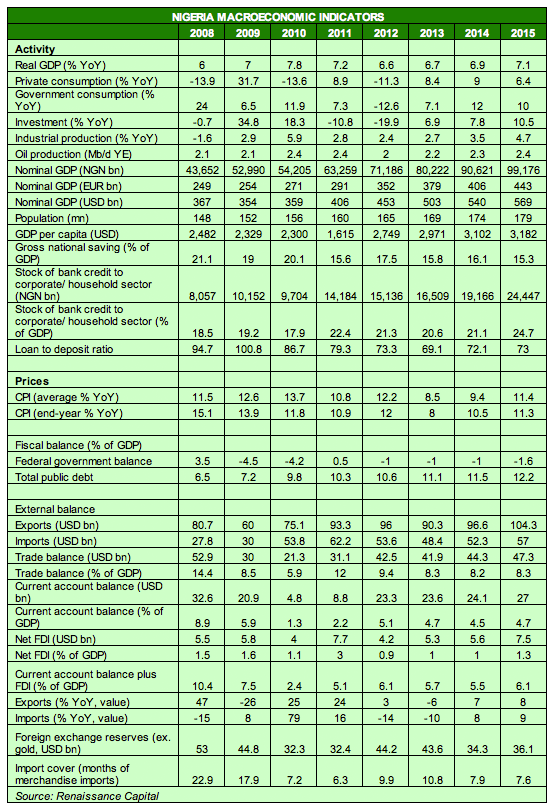
The feature was produced by alifarabia.com exclusively for zawya.com.
© Zawya 2014