As Qatar gears up to award projects worth USD 34 billion this year, the country will need to ensure that it tackles three key risks, according to Standard Chartered Bank, outlined below:
1. INFLATION
Inflation edged up to 2.8% year-on-year in October 2013, due to higher food prices. Food, beverage and tobacco prices, which account for 13% of the CPI basket, rose 2.6% year-on-year.
The rent, fuel and energy segment, which carries a third of the weight in the inflation index, rose 6.2% year-on-year in October. Entertainment, recreation and culture index also rose 4.5% compared with the same period last year.
"We expect the further pickup in population growth to drive consumer demand and push inflation up moderately to 3.8% in 2014," said Qatar National Bank in a report.
Land prices are also soaring, with Qatar's real estate prices rising 109% from July 2009 to May 2013, QNB data shows.
"Inflation is a key challenge for the economy in 2014, in our view," wrote Shady Shaher, an analyst at Standard Chartered Bank in a note. "Rents are likely to be a key driver and we expect them to begin rising next year. We believe this will be driven by the size of the project pipeline in Qatar, which will require an inflow of expatriate employees, generating a new pool of tenants."
Rising population may also inflame the inflation rate. Qatar's population rose by an astonishing 12.1% year-on-year by November to reach 2.07 million.
The population growth has been driven by the large increase in infrastructure spending as the country embarks on a near-decade long preparation for the 2022 FIFA World Cup.
QNB expects the bigger population to lead to higher economic growth by boosting aggregate demand and investment in housing and services.
However, Samba Bank analysts argue that a huge portion of the population are construction workers who will remain largely confined to labor camps, spending little and remitting most of their wages.
"Other, more senior, expatriates will integrate more fully into the local economy and this will continue to provide a strong impetus to consumption growth over the medium term."
Finally, the other main element of inflation is external factors.
"Qatar imports virtually all of its food and consumer goods, so the change in global commodities prices will have a direct bearing on the CPI," Samba said.
"We believe that the US dollar will strengthen over the next year or two, largely thanks to the withdrawal of quantitative easing and a comparatively strong US economic and fiscal performance. With the Qatari riyal remaining pegged to the dollar, this should keep a lid on import prices and confine the overall pick up in Qatari inflation to under 4%."
2. STREAMLINING MAJOR PROJECTS
Standard Chartered estimates Qatar awarded projects valued at USD 24 billion last year, as development plans picked up steam. Last May, the authorities awarded the USD 8 billion metro project, which would be a crucial infrastructure development that will underpin the country's major 2022 commitment.
"We expect project spending to remain strong in 2014," Standard Chartered's Shaher wrote. "Under Qatar's national development strategy, an estimated USD 183 billion of investment is planned between 2011 and 2016. We forecast that at least another USD 34 billion will be awarded in 2014 for key infrastructure projects. We expect private-sector growth dynamics to pick up significantly on the back of this."
QNB expects Qatar's GDP to rocket to 6.8% this year from 6.2% in 2013, mainly driven by large infrastructure projects, such as the Lusail real estate development, the new Doha Port, the new Hamad International Airport and the Doha Metro Rail project.
"The key driver of growth will therefore continue to be the non-hydrocarbon sector which is expected to grow from 42% of nominal GDP in 2012 to more than 50% by 2015," QNB said.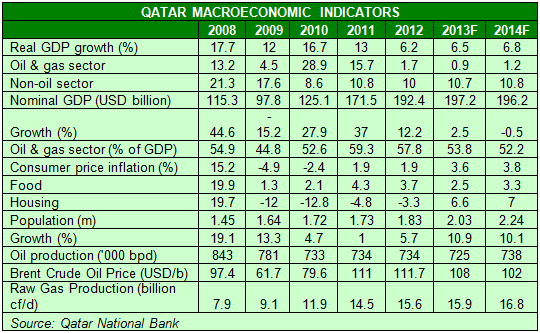
3. MONITORING CAPITAL PROJECT TO ENSURE THERE IS NO WASTAGE OR CORRUPTION
Probably one of the most problematic issues facing the country is whether it becomes a victim of its own success, and the rush of development projects could lead to oversight, corruption and wastage - or plain overheating.
QNB is dismissive of the risk: "There are some concerns of economic overheating arising from the infrastructure program," the bank said. "Those concerns can be alleviated by considering the latest GDP data for the construction sector, which indicates that pricing for building materials are falling. This leads to the conclusion that there is no excess demand for building materials and no shortage in supply that could lead to potential bottlenecks in the implementation of those programs."
However some non-government organizations have already highlighted the plight of unpaid migrant construction workers, including allegations of forced labor and poor working conditions, in the rush to finish projects
"It is simply inexcusable in one of the richest countries in the world, that so many migrant workers are being ruthlessly exploited, deprived of their pay and left struggling to survive," said Salil Shetty, secretary general of Amnesty International.
Qatar can ill-afford such scandals and will need to move quickly to ensure that 2022 World Cup is remembered for the country's generous hospitality rather than worker abuse.
Given Qatar's history of raising its game and punching above its weights, analysts believe the country can manage the three major risks. Qatari emir Sheikh Tamim bin Hamad bin Khalifa Al Thani himself identified these three areas as key challenges in a speech last year.
"In our view, all three risks identified by the emir are in line with Qatar's key near-term challenges. The fact that they have been identified at the highest level of leadership reflects a very proactive policy approach in terms of Qatar's growth in 2014,' said Standard Chartered's Shaher.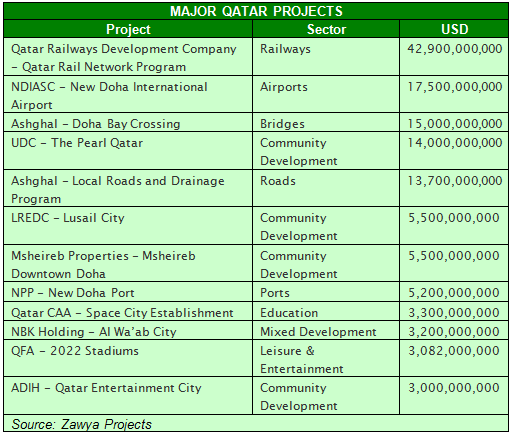
© alifarabia.com 2014