Thousands of Foreign Companies vying to win Qatar Projects
After the success of Qatar in the bid to host FIFA World Cup in 2022, the State started to make all efforts for the development of its infrastructure. It allocated more than 40% of its annual budget of the current financial year for infrastructure expansion projects, where the value of all infrastructure projects, whether in the planning stages, or currently underway, exceeds USD 66 billion. Some studies have estimated the volume of expenditure on these projects, during the next five years, at USD 135 billion.
The foreign companies willing to participate in the infrastructure projects of Qatar are estimated by thousands, as around 2,000 companies around the world, including local companies, submitted their offers for the railway project alone.
Investments Volume
A study conducted by the Emirates Industrial Bank concerning infrastructure in the Gulf Cooperation Council (GCC) countries, noted that the volume of Qatari investments in infrastructure projects within five years, from 2010 to 2015, may reach USD 135 billion, representing approximately 13.7% of the total expected Gulf investments amounting to USD 985 billion, as shown in Table 1. 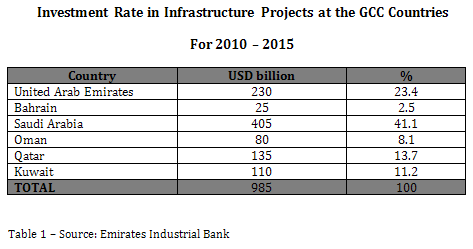
The study also confirmed that the huge investments in the Gulf infrastructure during the coming years will provide beneficial investment opportunities for the private sector activities, which will contribute, in addition to the Government investments, in increasing the growth rates and accelerating the diversification in the income sources of the GCC countries, as a natural result of the strong bases expected to be added to their infrastructure during this decade.
Another study conducted by Qatar Investment Fund in October 2011, pointed out that the total value of the current infrastructure projects planned until 2025, is of USD 185 billion. The first phase of Doha International Airport is expected to be completed by the end of 2011 at a cost of USD 10 billion, in addition to the expansion of the residential projects and the construction of new units, as shown in Table 2. 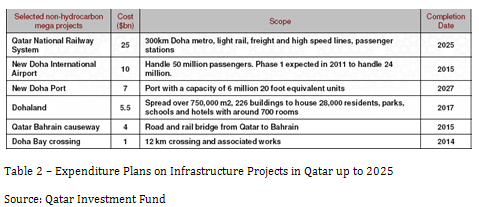
Saleh Muradweij, Executive Director of Drake & Scull International, one of the companies operating in infrastructure in Qatar, stated that Qatar has seen unprecedented economic growth in the recent years. Several key factors such as the appropriate investment climate, strong Government support and the success of Qatar in the bid to host FIFA World Cup 2022, had contributed in adding significant impetus to the State's growth plans, and the current summit contributed in highlighting the opportunities in the Qatari construction sector.
According to a study by the General Secretariat for Development Planning (GSDP), the Public Works Authority of Qatar seeks, through its plan for the coming years, to build a modern and advanced roads network of international standards and specifications and construct bridges and tunnels to facilitate transport, in addition to a rail network, which will take five years to be completed. The rail network alone is expected to cost around USD 25 billion, and will be implemented by a specialized German company.
Moreover, the project of the New Doha International Airport will include the longest runway in the world, at a cost exceeding USD 14 billion, where, after completion, the total capacity of the airport will reach 50 million passengers per year; as well as the project of building the New Doha Port, at a cost up to USD 5 billion. This project is in full swing as it is expected to be completed within 3 years.
The infrastructure projects include as well the largest tunnel project in the world that will be constructed in Doha within the coming years. It is a vehicles' tunnel of 12 kilometers long, connecting New Doha International Airport to West Bay, as shown in Figure 1, citing the Qatari Urban Planning Department. 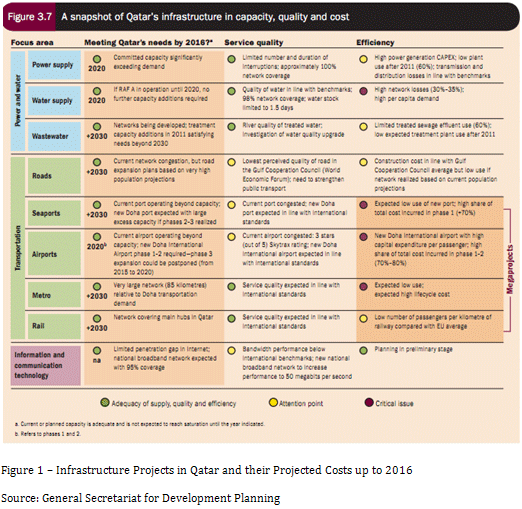
New Contracts
A report issued earlier this month by Al Mazaya Holding Co., pointed out that the plans of the State of Qatar in awarding contracts for the construction and development of the facilities and playgrounds intended to host the FIFA World Cup 2022, will lead to more investments and large-scale contracts in the country that has one of the highest per capita incomes in the world. Furthermore, the report stated that this will make a significant boom in the economic sectors, particularly the real estate sector, i.e. the construction, building and development fields, pointing out that the condition requiring the physical presence of companies in Qatar will give new impetus to the local economy with its various sectors.
The report predicted that these plans will pave the way to the awarding of contracts worth USD 100 billion over the next four years. It also considered that the continuation of offering contracts for New Doha Port and New Doha International Airport, as well as the studies of the railway project and other projects in sanitation and infrastructure, will create the basic infrastructure that will attract more real estate projects in the coming years, in order to complete the projects of which the development and disbursement are borne by the Government of Qatar.
The report added that more than 40% of the Government's annual budget for the current financial year is allocated for the infrastructure expansion projects, with the awarding of contracts to the Qatari private sector in order to create more job opportunities and to optimize employment, where the total value of the infrastructure projects, whether in the planning stages, or currently underway, exceeds USD 66 billion. The major infrastructure projects contribute as well in the completion of "Qatar National Vision 2030" program, aiming at promoting initiatives for sustainable architecture in the construction sector.
In this context, Al Mazaya report stated some expectations that the construction sector in Qatar will attract contracts worth more than USD 22 billion for 2012, i.e. more than the contracts awarded in 2010, valued at USD 20.21 billion. This increase in the value of new contracts in the construction sector will reflect the emergence of Qatar as a distinguished investment and trade destination in the Middle East.
Strong Competition
Mohammed Bin Ahmed Al Obaidly, Board member of Qatar Chamber of Commerce and Industry and Secretary General of the Business Council, noted that the foreign companies willing to participate in the infrastructure projects of Qatar are estimated by thousands, as around 2,000 companies around the world, including local companies, submitted their offers for the railway project alone.
He added that the Qatari private sector does not have reservations about opening the gate for Gulf companies to operate at 100% in the local market. He indicated that USD 200 billion will be spent on infrastructure projects in the coming period, and a budget of USD 15 billion is allocated annually for the roads projects alone, adding that Qatar has become the focus of the world's attention.
The report of Al Mazaya Holding Co. stated as well that the large-scale projects that the companies are vying to win, led to a sharp rise in the demand for real estate, residential units, offices and others. Some specialized reports estimated that the demand for residential units in Qatar will remain very high in the near future, as Qatar has to build more than 58,000 additional units in 2012 and more than 157,000 in 2016.
It added that the Qatari Government allocated tens of billions for investment in the real estate and facilities sector (in addition to other economic sectors). The private sector (Qatari and foreign) also seeks to pump huge investments to be financed by the Qatari banking sector that is reinforced by a previous decision issued by Qatar Central Bank in mid-August, to reduce interest on loans. This decision will reduce the lending cost by banks and financial institutions, which will allow more borrowing from banks and will support the State's plans to stimulate investment in the local market in the various sectors, including the real estate sector.
© Zawya 2011