The UAE is the most prosperous Middle East state and among the 30 most prosperous countries in the world, according to the latest edition of the annual Legatum Institute Survey.
The survey looks beyond GDP per capita data to cast a wider definition of prosperity, which includes social capital, effective governance, human rights and liberties, health, opportunity, security, and overall quality of life.
Norway emerges as the most prosperous country in the world, as it has done over the past four editions of the survey. Similarly, neighbouring Scandinavian country Denmark retains its second position, while neighbouring Sweden was ranked third - completing Nordic dominance over the survey.
For all their riches, UAE was the only country among Gulf states to make it to the Top 30. Kuwait was 38th most prosperous, while Saudi Arabia was 52nd, a far cry from its status as a G20 nation.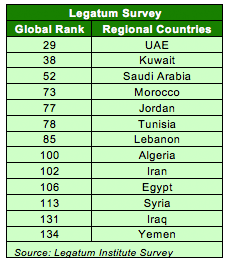
"Despite differences across the region, most countries have improved their performance in the entrepreneurship and opportunity (E&O) sub-index over the last three years," says Legatum Institute in the survey.
"This parallels a global improvement in the E&O sub-index in recent years, which has been caused, in part, by increasing levels of communications technology such as mobile banking. This has allowed more aspiring entrepreneurs to launch their own businesses. The MENA region has seen the second largest improvement in this sub-index behind Asia."
Decreases in business start-up costs also helped some countries. Start-up costs have decreased throughout the region with the exceptions of Algeria, and Yemen, where they remain mostly unchanged.
"A significant improvement has been experienced by Egypt where business start-up costs decreased from almost 16% of GNI per capita in 2009 to 6% in 2012."
SOCIAL CAPITAL
Fittingly, the region fared poorly in 'Social Capital', i.e. social cohesion, reciprocity, and trust in a society, reflecting the great political and social disturbances in the Middle East and new decision makers which were viewed with great suspicion by the people.
"The decline has been most pronounced in countries such as Tunisia, Syria, and Yemen. Syria, for example, has dropped 30 positions in the Social Capital rankings since 2010 to rank 131st in the 2012 Index. Similarly, Tunisia has dropped 32 positions in Social Capital to 122nd in the 2012 Index.
"Yet, even countries where the Arab Spring was of less consequence have also declined. Saudi Arabia, for example, dropped 21 positions and now ranks 43rd in the Social Capital sub-index."
Jordan, Kuwait and the UAE fared most favourably in the category, while Syria, and Iran - where more than 40% of the population report that they cannot rely on relatives and friends - fared the worst.
In Tunisia, the percentage of the population that believe they can rely on friends and family for help has dropped from 88% in 2010 to 71% in the 2012 Index. During the same period, Yemen declined from 76% to 66%, well below the global average, the survey noted.
Qatar, Bahrain and Oman were not featured in the survey.
The Legatum Survey echoes the recent Doing Business survey from the World Bank.
Of the 17 Arab countries measured by the World Bank, 14 saw their rankings fall, with seven states posting a double-digit decline in their rankings.
The UAE was the region's most improved economy in terms of regulation, rising seven places to clinch 26th most business-friendly country in the world, beating the likes of Switzerland, Netherlands, France and Spain.
In the Legatum Survey, the UAE beat China, Italy, Chile, Brazil and Mexico, however the authors of the survey do point out that data collected for the country might not be representative of the entire population.
GLOBAL SURVEY
Globally, the USA dropped out of the top 10 most prosperous nations, highlighting the great economic turbulence that has rocked the country since the 2008 global financial crisis.
The United States was pulled down primarily due a dramatic decline in the entrepreneurship and opportunity sub-index.
"This fall is driven by a decline in the number of U.S. citizens who believe that hard work will get them ahead and a decrease in ICT exports."
Other key highlights from the global survey:
* Hong Kong, Singapore, and Taiwan all rank in the top ten for the economy and in the top 20 overall. Further, Asia receives the second highest inflow of foreign direct investment as a percentage of GDP.
* Vietnam, Thailand, Indonesia, and Malaysia are the rising countries nipping at the heels of the regional leaders, notes the survey. Indonesia, for example, has experienced the largest increase in prosperity, globally, since 2009, moving up 26 positions to 63rd.
* 27 out of the top 30 countries in the index are democracies.
* Another key finding is tolerance is key to growth. The Prosperity Index finds that in countries where tolerance levels are high, prosperity flourishes.
ALSO READ
Arab Countries In Transition
Doing Business In Middle East
© alifarabia.com 2012