Government expenditure has risen 45%, taxes 28% and subsidies 79% since the Egyptian revolution, according to a new report.
Egypt's economy has struggled since a popular revolution ousted Hosni Mubarak's 30-year rule. After a tumultuous political transition, the Muslim Brotherhood's Mohamed Morsi was elected president in June 2012, only to be deposed by the army just over a year later.
As the political pendulum has swung wildly over the past three years, much-needed economic reforms have taken a back seat.
"A series of tax reforms was in the pipeline - including the introduction of VAT as well as sales-tax increases on steel, cement, mobile services, cigarettes, and tobacco - but a public outcry prompted the government to defer these measures," said Aarthi Chandrasekaran, analyst at NBK Capital.
"The recent change in the political climate has put the reforms on the back burner for the foreseeable future, in our view."
Meanwhile, government expenditure have soared, with subsidies accounting for the biggest chunk of expenditure (39%), followed by salaries and wages (25%) and interest payments (22%).
"Subsidies have increased by 79% since the outbreak of the revolution (as at March 2013 vs. December 2010 using rolling 12-month observations) and remain a key driver of the surge in government expenditure during the post-revolution period," said the NBK analyst.
Tourism revenues have also taken a major hit as tourists stayed away. Revenues were down 12% in December of last year compared to the post-revolution months, as occupancy rates fell.
Tourism receipts have recovered since then, rising 14% to reach USD 8.1 billion in the first five months of the year, compared to the same period last year.
Tourist nights have also increased by 14.1% to 114.6 million nights during the period compared to 100.4 million nights in the comparable period.
"The number of tourist arrivals during the study period has reached 9.2 million tourists, compared to 8.2 million tourists in the same period of last year," the Ministry of Finance said in its latest report.
It is too early to tell how the July 3 dismissal of the Morsi government will impact the tourism sector over the next few months.
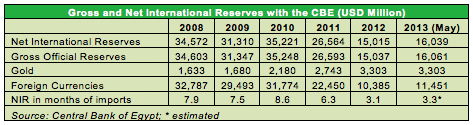
EGYPT'S FISCAL POSITION IS STRETCHED
The fiscal position is not getting any better for Egypt, as the authorities look to navigate the country out of the political crisis.
"Recently released data from the Ministry of Finance show that over the first 11 months of the fiscal year, the budget deficit widened to 12% of full FY GDP on the back of weak revenue outturns and brisk expenditure growth," wrote Jean-Michel Saliba, analyst at Bank of America Merrill Lynch.
"At just 68% of target, revenue outturns have particularly disappointed versus
FY13 budget projections," said Saliba.
Non-tax revenues also appear far short of the full-year target (at just 51%), while tax revenues were 14% higher year-or-year, yet were 77% of the FY13 target.
Meanwhile, spending remained brisk on acute social pressures and elevated interest payments, growing by 19.6% year-on-year to date.
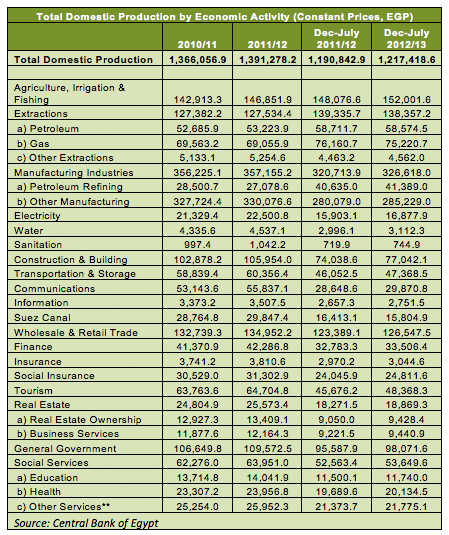
2014 BUDGET
With the political climate heating up, there is little time for the authorities to focus on setting ambitious revenue and expenditure goals in the new budget that was adopted by the Shura Council before it was disbanded.
The new budget expects a fiscal deficit of 9.1% of GDP or EGP 186 billion, which is essentially flat in nominal terms compared to the last fiscal. Primary deficit of EGP 4 billion is 0.2% of GDP, or significantly lower than last year.
However, total expenditures are expected to rise 17% compared to the previous budget, with interest rate costs rising 31%. The wage bill will also soar 23%, while investments will grow by a paltry 8%. Fortunately, energy subsidies will remain flat compared to last year.
The authorities expect revenues to rise 27%, with higher tax revenues (34%) and non-tax revenues (13%) posting robust growth.
"The flagship proposals in the FY14 budget, which pencil in a total of 3.8% of GDP in revenue-raising and expenditure-saving measures, are likely to fall short of targets due to ambitious targets, timeline slippage and likely revision by the incoming economic administration, in our view," said BAML's Saliba.
Egypt's economy has been propped up by timely intervention from Gulf states that have pledged USD 12 billion to help navigate the post-Morsi crisis.
But the country will need more than financial aid to pull through.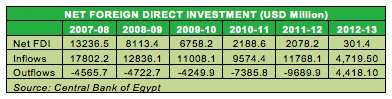
"Economic activity remains dampened due to various factors such as a) ongoing political deadlock; b) limited FDI; c) rising inflation; and d) companies being in wait-and-see mode with respect to new investments and expansion plans," said NBK's Chandrasekaran.
"Additionally, the IMF projects Egypt's real GDP to grow by 2.2% in 2013, before improving to 3.2% in 2014; however we view that the downside risk (revision of estimates) to GDP estimates will rise if the political crisis deepens."
Although the army is in control and Muslim Brotherhood in retreat, it would be a mistake to press forward forcefully, without including the party in the new political dialogue.
"Indeed, it is a price the army and the coalition that supports it should know well, for it is one Morsi and his allies just paid," said the International Crisis Group. "By taking advantage of a favorable balance of power and rushing to create a new political order that essentially marginalized losers, they put the country's stability at risk and hope of a return to normalcy out of reach. Only this time around, the cost of failure could well include political violence at a level not experienced by Egypt since the early 1990s."
© alifarabia.com 2013