While OPEC may not take action at its meeting on December 12, most analysts expect the group to cut production in the new year or face depressed crude prices.
The Organization of Petroleum Exporting Countries may choose to hold fire at their latest meeting in Vienna on December 12, but it may be forced to cut production in the New Year, analysts say.
Most OPEC officials have hinted that they are content with current production arrangements, which signals there is little appetite among the group for cuts.
Officals from Saudi Arabia have remarked on multiple occasions that they believe $100 is a fair price for a barrel of oil. The Brent was trading at $107.02 at close on Friday, December 7.
Meanwhile, OPEC Secretary General Abdallah El-Badri said in November he does not expect output cuts this time around.
However, the group's meeting next year may have a different tone.
"The oversupply imbalance this year has been largely masked by non-recurring storage demand," says John Gerdes, an analyst at investment bank Canaccord Genuity. "As this demand fades, OPEC is likely to find it necessary to withdraw excess supply over the next year to maintain market balance in '13/'14."
OPEC output growth is largely an Iraq story, while non-OPEC production is dominated by U.S. and Canadian oil growth.
"Overall, oil demand growth is predicated on the healthy economic expansion/ industrialization among developing countries partly offset by modest economic growth and increasing efficiency standards among developed countries," says Mr. Gerdes. 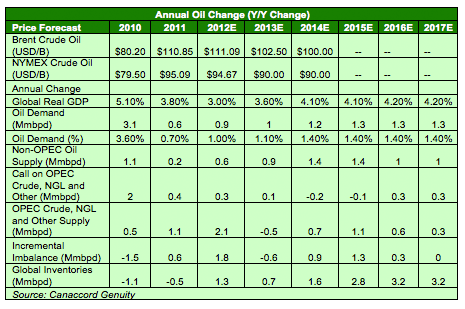
"The call on OPEC should decline in 2013 largely due to robust growth in non-OPEC supply (primarily coming from US/Canada) and the resumption of Libyan output."
Peter Tretzakian, chief energy economist at ARC Financial Corp. says OPEC will be more worried about rising Iraqi production, compared to the much-discussed U.S. shale oil surge.
While Iraq's rising production had been offset by reduced Iran and Libyan output, that may change as Libya is expected to return to full production and Iran arrests decline in its output.
"Surely Iraq's 700,000 barrels per day surge in output over the past 12 months will be at the top of the secretary general Abdullah Al-Badri's discussion agenda next week," said Mr. Tretzakian in a note to clients. "A back-of-the-napkin calculation at a Vienna café would note to him that North Dakota's current run-rate production growth, while worrisome, pales by comparison at only 200,000 bpd.
Most analysts believe there is little reason crude prices should rise next year. In fact, much of the risk is on the downside.
Even OPEC's latest monthly report notes sentiment in crude oil markets has weakened internationally, as the global economic slowdown has triggered a pessimistic demand outlook, coupled with substantial US crude oil stockbuilds, outweighed supply concerns due to geopolitical factors.
Even if the U.S. resolves its fiscal cliff crisis, it may not boost oil prices too much as it will be offset by rising crude production in non-OPEC territories. Meanwhile, Europe is hardly going to jump into top gear over the next few years, and its slowing economy will likely offset growth in emerging economies.
"Growth will eventually resume, but it's not likely to happen with any vigour next year, which is an ominous backdrop to an industry that's been accustomed to seeing consumption routinely expand by over 1 million barrels per day every year," notes Mr. Tretzakian.
In fact, oil prices are being held up by geopolitical risks, rather than any economic catalyst.
MIDDLE EAST RISK PREMIUM
The Middle East risk premium is estimated to be between $10-$20 per barrel. But oil traders seem to be reducing their net long crude oil positions from the record highs seen during the last quarter.
"If we are right that Middle East risks will fade over the coming year, oil prices should drop by at least $10 and perhaps as much as $20 per barrel," says Julian Jessop, chief economist at Capital Economics.
Mr. Jessop forecasts Brent crude will fall from more than $110 to as low as $85 by the middle of 2013, although it may require three things to occur.
Namely:
1) concessions by Iran on its nuclear programme that reduce tensions with the West;
2 persistent weakness in the global economy, and further appreciation in the US dollar; and
3) a renewed escalation of the crisis in the euro-zone would help with the last two.
"However, while the near-term profile is under review, we are likely to stick with $85 for the end of next year," says the analyst.
OPEC's latest monthly report also does not forecast major change in global economic sentiment or production forecasts, which suggests OPEC may not take any action.
"Expected weakness in the world economy is placing a considerable amount of uncertainty on the world oil demand forecast," warns OPEC, adding that demand for OPEC crude in the 2013 will average 29.7 million bpd, a 400,000 bpd drop from 2012 figures.
Would that trigger a production cut in OPEC? The group has surprised before.
© alifarabia.com 2012