Last month, the International Energy Agency's (IEA) executive director Maria van der Hoeven, had some unsolicited advice for OPEC: When they meet next, think long-term strategy.
"It's important to look not only at the very short term but keep an eye [on] what happens, for instance, in a year's time and that means that you can't decide [now] on something [happening] many months ahead," she told Platts newswire at the time.
But it doesn't seem like OPEC has paid much attention.
As journalist after journalist peppered the group at its 163rd meeting in Vienna about the possible impact of North American shale revolution, the group downplayed the effects and made no change to its output of 30 million barrels per day, suggesting business as usual.
Saudi oil minister Ali Al-Naimi told reporters: "This is not the first time new sources of oil are discovered, don't forget history. There was oil from the North Sea and Brazil, so why is there so much talk about shale oil now?"
True, OPEC has seen its fair share of storms over the past 50 years, and if indeed it is worried, it will not let the market know. Imagine if OPEC had cut output and openly mused about the damaging impact of shale that would no doubt have knocked out prices.
That could well trigger a collapse in a market that is already uncertain about global economic growth.
OPEC producers are unwilling to rock the boat and are looking to keep the delicate market balance as long as possible.
Instead the group collectively decided to maintain output and left prices virtually untouched - that, for OPEC, is a very successful outcome.
This is also borne out by the fact the Saudi exports to the United States has actually risen in the past three years, and not dropped, contrary to popular belief. In addition, North American production relies heavily on high prices, even more so than most OPEC countries.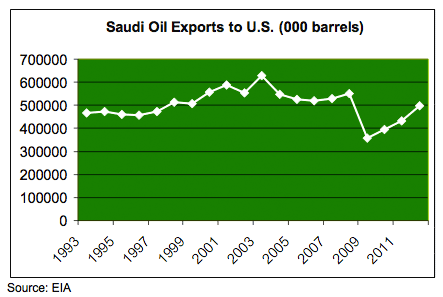
Fitch Ratings estimates oil export revenues of GCC countries have risen from an average of USD 375 billion between 2004 and 2010 to nearly USD 700 billion last year.
"This has helped them strengthen their sovereign balance sheets, build fiscal buffers and improve their external financing positions at the same time as significantly enhancing physical infrastructure."
Losing its clout
While OPEC has maintained its business as usual policy, some analysts warn that OPEC is losing its clout in global energy circles.
"The bigger picture is that the cartel now ranks no higher than a distant fourth in the list of factors determining global oil prices," said Julian Jessop, head of commodities research at Capital Economics.
Supply has become a periphery issue while global macroeconomic fundamentals and non-OPEC supply has been on top of the agenda of energy markets. Even the growing conflict in Syria, which has already pitted a number of regional players against each other, has not been able to push prices higher although it has put a floor on prices.
But rising production and slowing demand is a problem OPEC will need to contend with. Apart from the United States, resumption of production from the two Sudans, continued output from Canada and Brazil will also add to the crude stockpile.
So does OPEC production.
Iraq is expected to start production from its giant fields in Majnoon and Gharraf during the summer, raising capacity by nearly 400,000 barrels per day.
"The next move in the output target will probably be a cut as demand remains weak and non-OPEC supply ample," Jessop said. "This might prevent prices from falling as far as they would otherwise have done, but fundamentals should remain soft and the trend should remain down. In any event, compliance would probably still be weak."
OPEC will need to close ranks, even as they are under pressure from non-OPEC countries.
"There are plenty of tensions between the relatively wealthy OPEC members in the Middle East and the poorer producers in Africa and Latin America. And even within the Gulf, there are three-way disputes (and, of course, broader geo-political conflicts) between Saudi Arabia, Iran and Iraq," said Jessop.
Lower demand
The excess supply comes at a time of lower demand. Bank of America Merrill Lynch expects oil demand to grow 800,000 barrels per day this year, compared to the 950,000 bpd it projected previously.
"We now see non-OPEC supply growing by 820,000 bpd this year and 910,000 bpd next year, compared to 700,000 and 815,000 bpd previously," wrote Francisco Blanch, global investment strategist at BAML.
Since November, US oil output alone has exceeded even our optimistic forecasts by 400-500,000 bpd in 4Q12 and 1Q13, although production in some other non-OPEC countries has continued to disappoint, notes BAML.
"In sum, the combination of lower demand and higher supply could tilt the market into a small surplus over the next 18 to 24 months," Blanch said.
The rising demands come at a time of sluggish growth in emerging economies. Chinese, Indian and Latin American economies are cooling down, leaving plenty of oil sloshing around in the markets. Meanwhile, economic data from the United States, Japan and Germany looks weak.
Given the demand outlook, Brent will do well to remain in triple figures, says BAML which predicts crude hovering between USD 103 and USD 105 over the next two years.
"With oil demand growth exclusively supported by buoyant EM growth for years and rising non-conventional oil supplies, there is a growing risk that Brent moves down structurally to an USD 90-USD 100 bpd band after 2014," Blanch said.
"This price range is in line with our equity research team's long-term oil price assumption of USD 100 per barrel and in line with a forward price for Brent of USD 90 per barrel in December 2017."
Capital Economics is even more bearish, predicting the price of Brent to drop below USD 100 in the coming months and falling further to USD 70-USD 95 between 2014 and 2020.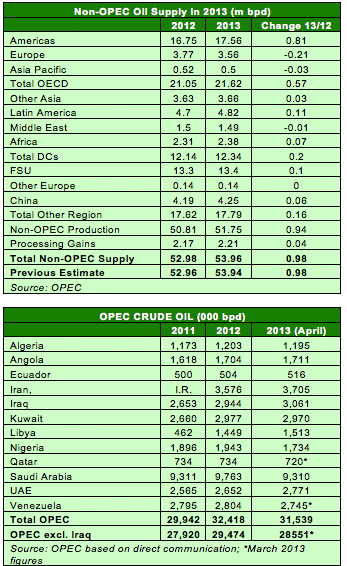
© alifarabia.com 2013