Iraq is emerging as one of the riskiest oil and gas jurisdictions to invest in, according to research house Sanford C. Bernstein & Co., a Wall Street investment management firm.
Major oil companies had flocked to Iraq after the US invasion of the country, and its first oil and gas auction in 2009 saw oil majors BP Plc, Exxon Mobil Corp. and Royal Dutch Shell Plc. looking to pick up a piece of one of the world's most under-developed resources.
Since then, the relationship between Iraq and major players has soured.
BP and Eni have cited major delays in receiving permits such as routine contractor visa approval as a major bureaucratic chokepoint.
In particular, Eni CEO Paolo Scaroni said the Italian company would quit the country if a six-month delay in government approval for a key permit was not delivered (his statement practically brought about a next-day result, but it is probably difficult to repeat credibly).
Finally, contractor performance has also been challenged in the country, with Gazprom Neft citing unmet obligations around drilling and sourcing equipment at Basra.
INSECURE ENVIRONMENT
In addition, the political environment in Iraq continues to deteriorate.
The country has seen a recent uptick in violence, with civilian deaths reaching their highest rate last year since 2008; increasing at 175% in the rolling 12-month year-on-year period, Bernstein analyst Oswald Clint noted.
In addition, oil infrastructure is a constant target, with the Kirkuk pipeline being attacked twice by the end of January and as many as 40 times in 2013.
In November 2013 oil service company Schlumberger suspended operations in Iraq (particularly around BP's Rumaila field) after violent protests.
POOR RETURNS
With 143 billion barrels of reserves and plenty of undiscovered geological-friendly basins, Iraq remains one of the greatest unclaimed prizes in the oil and gas world.
Despite the geological ease, however, operating in Iraq is a tough proposition.
Oil companies are most concerned about the structure of the country's Technical Service Contracts (TSCs), which were signed five-year ago and underpin the economics for major projects.
Under these TSCs, operators are entitled to a pre-agreed per-barrel remuneration fee for each barrel produced above a pre-agreed threshold rate. There are nuances to further tax-take on this fee (25% government carry, 35% corporation tax), but peak earnings per barrel are capped by remuneration fee and independent of the oil price, Bernstein's Oswald noted.
"Consequently, achieving a good return in Iraq is highly dependent upon rapid recovery of costs, which is achieved by the companies' ability to capture up to 50% of annual revenues for this purpose."
"If USD 1 billion of up-front development capex was recovered in-full within a one-year delay, it would be possible to achieve around 20% IRRs [internal rate of return] relatively easily in Iraq.
"However, if the gap between spending the same USD 1 billion and recovering it lengthens to two or three years, the IRR drops to 11% and 7% respectively."
Not everybody agrees, however, with this assessment.
"News that IOCs [international oil companies] are considering exiting Iraq's southern fields is exaggerated; the profit margin of these contracts remains acceptable and provides IOCs with a stable cash flow," said Greg Priddy, director, Global Oil at Eurasia Group.
"In 2014, Western IOCs could become more reluctant to acquire new fields until a new government is formed. However, while this would negatively impact long term output expansion plans, it is unlikely to have a material short-term affect. Lastly, we still expect Iraq to introduce at least 400,000 bpd in additional export capacity by the end of 2014."
POLITICAL CHALLENGES
Baghdad's problems with the autonomous Kurdistan Regional Government are just the tip of the iceberg. Iraqi forces have struggle to control rebels in the Anbar province and there are numerous flashpoints in the Iraqi political landscape, including acts of terrorism, rampant corruption and a poorly conceived business framework and physical infrastructure.
In addition, the elections in April 2014 could further slow down the process.
"The electoral cycle could potentially have a negative impact on oil projects that aim to expand long-term output capacity; however we do not anticipate any dip in current export numbers," said Ayham Kamel, director, Middle East & North Africa at the Eurasia Group.
"Current officials and new parliamentarians are likely to become at least temporarily less focused on government affairs and dedicate more significant time to coalition building, appointing a new prime minister and president, and forming a new cabinet. Thus, approval of new projects is most likely to slow, and oil companies operating will confront more challenges in dealing with the bureaucracy."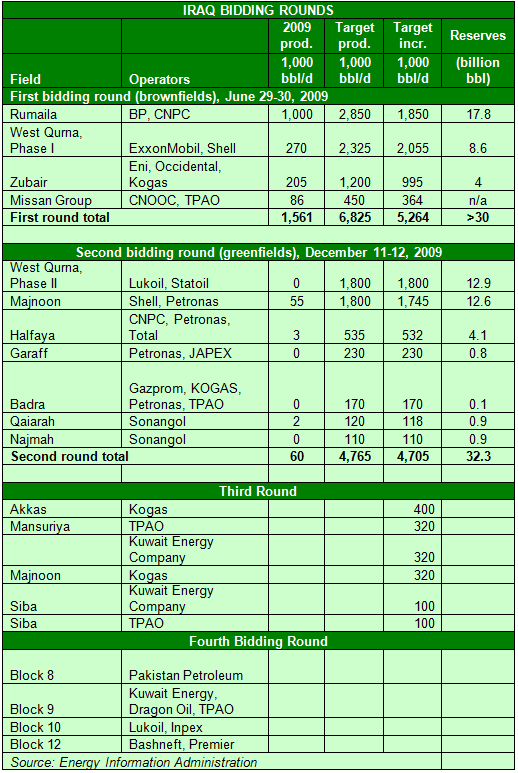
IOCS ARE HURTING
While international oil companies are disenchanted by Iraq, they are also under pressure from their shareholders to show profits and abandon less-commercially seductive projects.
The world's major oil companies including Shell, Total, ExxonMobil and BP are cutting costs, divesting from many projects and focusing on their core areas.
While many companies have cut exposure to Iraq, they have also cut down on their exposure in Africa, North America and Latin America, as high costs impact their bottomlines.
Given the changing scenario in the global oil and gas, Iraq will need to temper its target of nine million barrels per day.
Russian company Lukoil recently revised production target from West Qurna-2 to
1.2 million bpd, from 1.8 million bpd. Rumaila oil field's plateau was revised down from 2.9 million bpd to 2.1 million bpd in November 2013. Production from Zubair oil field was revised down in 2013 from 1.2 million bpd to 850,000 bpd (and Eni produced 300,000 bpd over the full year, versus a stated target of 400,000 bpd).
Business Monitor International has also pared back production forecasts to account for continued above-ground headwinds Iraq faces despite its abundant potential. "There are sizable risks to the downside, which could well materialize," BMI said in a recent report.
"Where we see further upside, is Iraq, although the country has struggled to advance the four major downstream projects since awarding design contracts in 2009," said BMI.
"This has left Iraq dependent on imports despite its growing crude oil production. Although there are incentives, we see little near-term scope for improvement in the above-ground economic and regulatory risks that have deterred foreign investment in refining projects to date."
Bernstein expects Iraq to likely revise production from the giant West Qurna-1 down from 2.8 million bpd to 1.8 million bpd and Majnoon down from 1.8 million bpd to 1-1.2 million bpd. Lastly, Sonangol has pulled out of Qaiyarah and Najmah.
"Overall, the waning interest to commit around USD 30 billion per year of required Iraqi capex leaves us still cautious on Iraqi oil output. We forecast growth to 3.6 million bpd this year, rising to 6.1 million bpd in 2020, which is around 30% below Iraq's stated target of 9 million bpd."
The feature was produced by alifarabia.com exclusively for zawya.com.
© Zawya 2014