Chad's economy beat analyst projections to grow 7.2% last year and is set to grow a further 7.4% this year, according to the African Development Bank (AfDB).
Much of the growth is driven by oil production of just under 120,000 barrels per day, but with output dwindling from a peak of 175,000 bpd reached in 2005, the government is keen to attract oil companies to tap into its 1.5-billion barrel reserve.
Foreign direct investment in oil sector is crucial to lift the country of 12.1 million people out of abject poverty. The country has a poverty rate of 83.3% and a GDP per capita of USD 981.1, and needs funds to improve infrastructure and bring Chad citizens into the mainstream economic cycle.
"Attempts to arrest declining production could be stemmed through the entry of players such as Caracal Energy, presenting material production output, and in turn mitigating any follow on risk from the government to constrain budget allocation on social and infrastructure programs," wrote Gerry Donnelly and Kingsley O. Jibunoh, analysts at London-based FirstEnergy Capital investment bank.
"We believe that this serves to encourage the government to encourage other operators to come in and develop prospective acreage ensuring interests are aligned."
THE WHITE BOOK
But governance remains a key weakness of the government. The country is ranked a poor 50th among 52 African nations on governance according to the 2012 Ibrahim Index of African Governance.
Chad also has the second least-favorable business environment in the world according to the World Bank's Doing Business report.
"Most private enterprises in Chad operate informally, except a handful of multinationals linked mainly to the oil sector," said the International Monetary Fund in its report on the country.
"Local private sector includes small and medium-sized enterprises, operating at the fringes of the economy, as well as large enterprises, particularly in commerce or construction, many of them living off public contracts, but eluding taxation. Formal private companies operate in a few niches of the economy, including telecoms, sugar refining, or tobacco processing."
To address the range of economic issues, the government has issued a White Book that looks to reform the legal environment, tax and customs processes, and development of human capital.
In addition, it is focusing on travel, logistics and telecommunications and has outlined a few key areas of focus:
- Lower taxes on airplane tickets to 5% from the current average of 40%
- Improve access to other sea ports (Cotonou, Port Sudan, etc.,) to create competition for Douala
- Enable the use of the fiber-optic connection by all licensed telecom operators
- Foster the use of 3G technology to allow easy access to high-speed Internet
- Foster training in telecom and information and communication technologies (ICT).
OIL TO LEAD ECONOMY
Despite two failed coup attempts since then, president Idriss Deby has managed to secure his 23-year-rule and was elected for another five-year term in 2011.
Libyan investments was a regular fixture in Chad for decades, but the new government in Tripoli is less likely to invest further in its neighbor as it looks to rebuild its own infrastructure.
However, Indian and Chinese investment could help meet the investment shortfall.
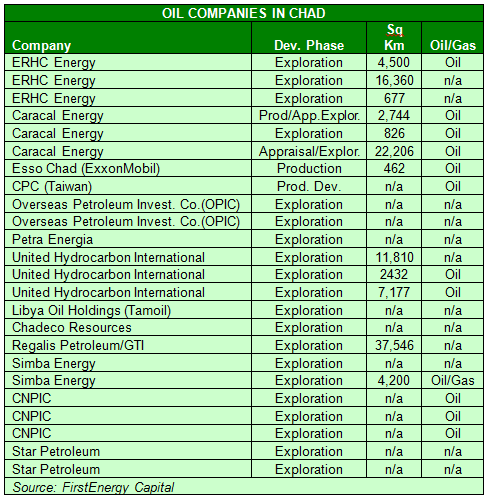
Some of the oil majors are already in the country. Doba Oil Project, which accounts for much of the 120,000 bpd production, is held by a consortium led by American companies Exxon Mobil (40%), and Chevron (25%), and Malaysia's state-owned Petronas (35%).
Other major players include: the state-owned China National Petroleum Company, Brazil's Petra Energy, Canadian companies United Hydrocarbon International and Caracal Energy Inc., apart from Taiwan's CPC Corp., which made a major discovery in 2011.
"This landlocked central African country that secured independence from France in 1960 is experiencing unprecedented levels of interest attracting an increasing pool of junior players seeking to gain access to the so-called 'easy oil' which has contributed to the sporadic E&A activity over the last 40 years, that could unlock Chad's 1.5 billion barrels in proven oil reserves," said First Energy analysts.
Caracal, which previously operated under the name of Griffiths Energy International, was fined CAD 10.35 million in a Canadian court in January on corruption charges for bribing the ambassador of Chad in return for improved production prospects.
However, the company has moved on since then. In June, Caracal signed a farm-in agreement with GlencoreXstrata plc for the development of the Badila and Mangara oil fields in Chad.
Under the agreement, Glencore will fund USD 300 million of Caracal's working interest share of joint venture expenditures in the two oil fields up to a maximum of USD 100 million per year.
CHALLENGES AHEAD
Operating in one of the most economically backward nations, with high poverty rates and lack of basic infrastructure remains one of the biggest hurdles in the country.
In addition, there are fears of resource nationalization - Chad's president kicked out Petronas and Chevron after the companies allegedly failed to pay their taxes. Issues of corruption, political instability and leadership succession issues are all unanswered questions as companies weigh Chad's potential.
"The economy relies heavily on the growing petroleum sector to diversify the country's economy. However, in some cases, the lower quality of crude incurs a steep discount thereby pushing up the required economic breakeven threshold," said First Energy.
The country's landlocked status also means it depends on Cameroon for its oil shipments, making it vulnerable to external factors.
The reliance on oil production - which is falling - also puts into question how Chad can move forward, attract oil companies to raise production, and at the same time try to diversify the economy.
New extraction in the next two years by the Caracal should also boost output.
In addition, "substantially increased production by the CNPC in the Bongor region should offset declining output from the country's first oilfields and make it possible to export the surplus," AfDB said.
The IMF expects growth could reach 180,000 bpd by 2017 - however, failure to find new discoveries could exhaust the supply within 20 years.
Beyond oil, public investments in infrastructures and an increase in cotton production are key drivers for non-oil growth. The restructuring of Cotontchad, the cotton company, could improve non-oil GDP and help raise cotton production to its historical levels.
But oil remains the lynchpin of the economy.
"The improved security situation, strong oil revenue receipts, and prospects for additional oil production coming on stream over the next few years create a unique opportunity for Chad to address its development and poverty reduction needs," said the IMF.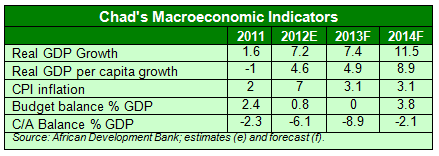
© alifarabia.com 2013