Saudi Arabia may rein in massive public sector spending slightly in 2014, but it will still be enough to keep the non-oil sector humming along and ensure domestic demand continues to remain robust.
The Saudi Arabia's 2014 budget shows project expenditure will rise 4.3% -- its slowest growth in a decade, but authorities often overshoot stated budget goals.
"We expect both government revenue and expenditure to be higher than what is budgeted; and to post a small surplus in 2014," wrote Rahmatullah Khan, economic analyst at Al Rajhi capital in a new note.
The lower increase in expenditure is not without precedent -- government expenditure rose only 5.6% in 2012 and 5.9% in 2013 compared to double digit growth since 2003.
"Moreover, we expect expenditure to grow at a slower pace since oil revenue declined in 2013 after peaking in 2012, which we believe will decline further in 2014. Therefore, a sustainable fiscal path would be to taper the growth in expenditure," said Khan.
The Ministry of Finance said it expects total revenue to be around SAR 1.131 trillion (USD 301.6 billion) in 2013 and expenditure to be around SAR 925 billion (USD 246.7 billion), leading to a SAR 206 billion (USD 54.9 billion) surplus.
The authorities remain focused on investment programs that enhance long-term strong and sustainable economic development and employment opportunities for Saudi nationals.
"Specifically, the focus will be on infrastructure, education, health, social services, security services, municipal services, water and water treatment services, roads and highways," the ministry said in a December 23 statement.
The Saudi economy is expected to have grown 3.8% this year, compared to 5.81% last year, and analysts expect the Saudi growth to continue strongly in 2014 on the strength of the non-oil sector.
"Its PMI [purchasing managers' index] reading continues to be one of the highest globally (57.1 in November 2013), while the engines of growth - expansionary fiscal spending, private sector credit and, increasingly, corporate bond and sukuk issuance - remain firm," said HSBC in a new note on the kingdom.
SECTOR ALLOCATIONS
The kingdom's key sector allocations highlight the authorities' focus on basic areas of education, health and social services and infrastructure.
The government aims to spend SAR 210 billion (USD 56 billion) of the budget on education - or 25% of the overall budget, and an increase of 3% over last year.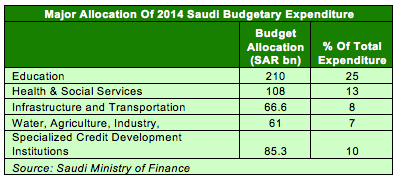
The massive spending spree will fund the construction of 465 new school buildings, apart from the 1,544 new school buildings already under construction, and the rehabilitation of 1,500 existing school buildings. The authorities are also expanding several girls' colleges, opening eight new colleges and related infrastructure.
The country also intends to send 185,000 students abroad for higher studies.
Health and social services will also be an area of focus with SAR 108 billion (USD 28.8 billion) being allocated to the sector - an 8% increase over last year.
The funds will be used to develop 11 new hospitals, two medical complexes, 11 medical centers and 10 clinics. More than 132 new hospitals are under construction in the in the country with a combined capacity of 33,750 beds.
Infrastructure and transport has also seen a 2.5% increase over last year, with the SAR 66.6 billion (USD 17.8 billion) being used to build 3,500 kilometers of roads, as well as the expansion and development of airports, railroads and infrastructure projects in industrial cities.
Finally, water and agriculture is another key area of focus with development worth USD 16.3 billion being poured into building dams, desalinization, aquifers well and water treatment plants.
The government has also earmarked USD 22.75 billion for key credit institutions including Real Estate Development Fund, Saudi Industrial Development Fund, Saudi Credit and Saving Bank, Agriculture Development Fund, Public Investment Fund, and Government Lending Programme.
Al Rajhi Capital data shows that the government's spending has grown sharply over the past decade and remains focused on infrastructure.
"Capital spending has been growing faster than the government's current expenditure, with the former's share of total government expenditure growing from 12% in 2001 to around 32% in 2013. In absolute terms, capital expenditure has grown from a meager SAR31bn in 2001 to an estimated SAR293bn in 2013."
LOWER OIL REVENUES
The oil sector contracted by 3.83% in 2013, as Saudi production failed to match the historically high production and prices of last year. However, it is all relative.
Jadwa Investment expects oil revenues of SAR 957.8 billion in 2014 - close to the trillion-riyal mark.
"We estimate that a price of USD 67 per barrel for Saudi export crude (around USD 71 per barrel for Brent) and production of 9.4 million barrels per day are consistent with the revenue projection contained in the budget," wrote Fahad Al Turki, analyst at Jadwa Investment. "We expect both revenues and expenditures to be above the budgeted level and forecast a budget surplus of SAR 140.8 billion (4.8% of GDP) based on oil price of USD 104 per barrel for Brent."
The key downside risk to Saudi Arabia remains lower crude production, especially if Libyan, Iraqi and Iranian oil come on stream
"That said, any decline is likely to mean diminished surpluses, rather than a deceleration in spending, with the government's policies continuing to be driven by the needs of its growing, and overwhelmingly young, population," said HSBC.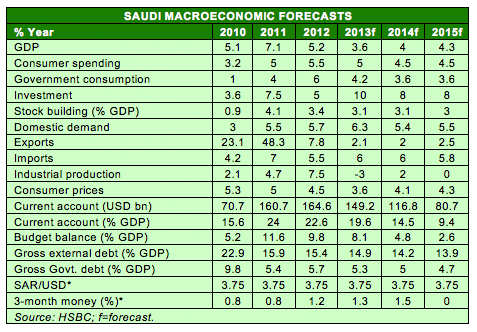
© alifarabia.com 2013