Mauritania, lodged between Morocco and Guinea on the African bulge in the West, is just the latest African country being eyed by energy companies.
BNP Paribas ranked Mauritania, along with Kenya and Gabon, as African countries which may see the most significant oil and gas discoveries this year.
The French bank opened a branch in capital Nouakchott in 2006 just as the country produced its first oil from the Chinguetti oilfield, and it sees great potential as companies look to explore offshore in 2013.
The West Africa Resource Watch estimates the country has one billion barrels of oil reserves, second only to Nigeria in the continent.
But investors have been disappointed in recent years. Chinguetti - the country's most significant crude oil discovery - has seen production rates plummet from 70,00 bpd to 2,000 bpd, as the field declined rapidly.
New finds, however, has spurred renewed interest. Since Chinguetti, new discoveries have included Banda in 2002, Pelican and Tiof in 2003, Tevet in 2004 and Faucon in 2005.
In January 2011, the Cormoran-1 exploration well successfully appraised the Pelican gas field and discovered two new underlying fields: Cormoran and Petronia.
"Mauritania is highly under-explored with just 1.7 wells historically per 10,000 square kilometers of licensed acreage [compared to 50 wells globally]," wrote Clint Oswald, analyst at Wall Street bank Bernstein Investment, adding that while early explorations were disappointing, 3D seismic technologies have improved discoveries by 50%.
"Mauritania has considerable potential, but it will take peer-leading explorers to locate the reservoirs."
Enter Tullow, the intrepid UK explorer that has earned a reputation of unearthing hydrocarbon riches far and wide in unlikely places. It has an especially impressive portfolio in Africa and spearheaded Kenya's first major oil discovery last year.
Tullow is in the midst of expanding its operations with a major focus on East Africa and the Equatorial Atlantic basin, where Tullow is already a dominant player following exploration success in Ghana, French Guiana, Uganda and Kenya.
The company opened a Mauritania office in March as it prepares for a four-well exploration program and increased operational activity in the country.
"In 2013, we are targeting Kenya, Ethiopia, Norway, Mauritania, Mozambique, Côte d'Ivoire and French Guiana and still see further upside in those original core campaigns in West and East Africa," said Aidan Heavey, chief executive officer of Tullow as he outlined his 2013 agenda.
Unspecified oil riches
While official estimates suggest the country may have a billion barrels of oil reserve, exploration companies and other analysts believe the actual figure may be a lot higher.
"We believe the basin holds significant potential, due to a proved total petroleum system, a proven source rock, relatively extensive sedimentary input and also the creation of traps from mobile salt structures," Bernstein's Oswald notes.
"The basin has proven commercial hydrocarbon potential, recent exploration is encouraging, although early exploration failed due to technology and limited understanding of depositional systems in the 1960s-80s."
Much will depend on Tullow's performance. The company has licenses for six exploration wells across 40,000 sq km, which it plans to operate along with a range of partners.
"We conclude that Tullow has a reasonable chance of making a discovery at its four near-term wells: Fregate (aka Scorpion), Tapendar, Sidewinder and Ida," said Oswald.
In particular, Fregate, Tapendar and Ida-1 are targeting deeper play-concepts in parts of the basin that are known to have proven total petroleum systems, as evidenced by discoveries at Chinguetti, Banda, Cormoran, Pelican and Faucon, the analyst said.
Dana Petroleum, owned by the Korean National Oil Corporation, also holds two licenses covering an area of 14,400 sq km. France's Total SpA also bought acreage of 10,000 sq km, while international developer Kosmos Energy holds a 90% share in three blocks with combined acreage of 27,000 sq km.
London-based Chariot Oil has also bought lease with combined acreage of 12,000 sq km in the country.
Mauritania's unemployment woes
Mauritania's economy depends heavily on commodities and natural resources and the results of the offshore exploration would have a huge impact on the country's prospects.
"Mauritania continues to face several longstanding challenges stemming from a narrow production base, vulnerability to external shocks, a weak business climate, and high poverty levels," said the international Monetary Fund in an April 9 note.
"One out of two Mauritanians lives below the poverty line, and the country's food situation remains structurally precarious with a significant segment of the population (11%) subject to food insecurity."
Indeed, more than 50% of Mauritanian youth are unemployed according to African Development Bank.
The IMF recently agreed to offer the country another USD 17 million, as part of a three-year credit facility of USD 118 million, as the country tries to meet its obligations.
The authorities have managed to contain inflation and growth has picked up after drought hit agricultural production.
The country's other commodity exports such as gold, iron ore and copper has also stalled, which has hurt business sentiment.
The IMF expects the country to post a 6.3% growth in GDP this year, a tad higher than the 6.2% estimate for last year, but the actual result may fall short of expectations as commodity prices have fallen dramatically at least in the first quarter of the year.
Resource development will be crucial to Mauritania's fortunes going forward. The country attracted USD 1 billion last year in foreign direct investment and is expected to attract a similar amount this year - the highest in recent memory.
All that is needed now is for Tullow and Co. to strike commercial quantities of the black gold.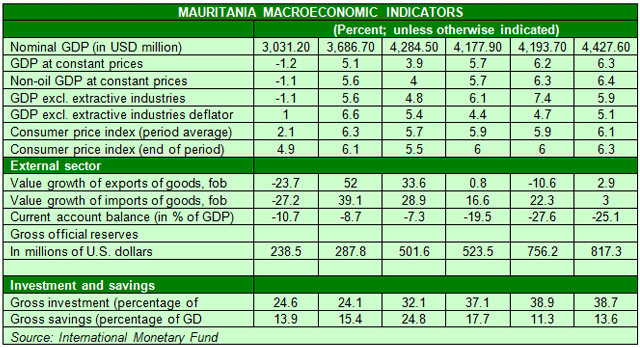
© alifarabia.com 2013