Kenya has made international headlines for all the wrong reasons lately.
Terrorists stormed an upscale shopping mall in Nairobi and killed 67 people leaving the upscale urban area into a battleground.
Worse, shop owners at the mall reported mass lootings - not by the terrorists - but by the soldiers who had stormed the mall to fight the militant group.
The attack has certainly woken up the authorities of militant threats that could upset Kenya's carefully cultivated reputation as an economic star in Africa.
Renaissance Capital, an emerging market investment bank, estimates Kenya will lose USD 160 million in direct tourism revenues due to the attack on the Westgate Mall.
"We expect tourism numbers to be down 18% over 2013 and rise only 7% in 2014, before rebounding with 25% growth in 2015," said Charles Robertson, global chief economist at Renaissance Capital. "We still expect Kenya to record nearly 2 million arrivals in 2015, up 1/3 from 2010 levels."
The chief economist expects tourism revenues to remain subdued at just around USD 80 million in 2014 and then rise by USD 165 million in 2015.
"Foreign travel receipts were USD 936 million and 2.3% of GDP in 2012 and we expect them to be 1.7% of GDP in 2013-14."
Overall, Renaissance cut Kenya's GDP growth from 5.6% to 5% to reach USD 45 billion this year.
'CREDIT NEGATIVE'
Moodys' ratings agency noted that the attack is a "credit negative" for Kenya, but it may not have much impact on foreign direct investment, especially from the Chinese who often take a longer-term view on their investment.
"We expect this high profile attack to be credit negative and will adversely (affect) Kenya's growth and fiscal revenues, most directly through its effect on tourism, which accounts for 12.5% of GDP, 7.4% of investment and 11% of total employment."
Kenya, of course is no stranger to terrorist incidents. An attack on the US embassy in 1998 led to a 7% decline in tourist figures, while Kenya's elections of 2005 turned into a bloodbath, which kept tourists away.
Tourism figures had already fallen 18% in the first quarter as visitors worried about violence during the elections earlier this year, and the second quarter is estimated to have dropped 6% - although official figures are not out yet.
Renaissance expects a 17% annual decline in tourism numbers.
"For 2014, we assume -27% in 1Q14, -2% in 2Q14, +2% in 3Q14 and +50% in 4Q14," Robertson said. "As Indonesia and Egypt show, terrorism is a temporary interruption of existing trends, and does not change the trend. The strongest YoY figures in 2015 will then be in the first half giving a full year figure of +25%."
ICC TRIAL
Another key issue facing Kenya that could impact its international reputation is the trial of president Uhuru Kenyatta and deputy president William Ruto at the International Criminal Court (ICC). Both have been accused by the ICC for their violence during and after the bloody elections of 2005.
Barclays Capital says the trial, which starts on November 12, "may weigh on the otherwise upbeat long-term outlook for the country."
"Kenya's outlook has been clouded by the terrorist attacks in Nairobi, while the ICC case against Kenya's leaders may also distract and derail the much-needed reforms," said Ridle Markus, analyst at Barclays Capital. "Kenya's already large fiscal deficit of 7.9% of GDP projected for FY2013-14 means that any military response to the terrorist attack (and to the threat of any further incidents) will need to be carefully considered."
Before the attack stole all the headlines, the economy appeared to be on surer footing.
"Kenya is adapting to a new governmental landscape, and infrastructure development is gaining increasing attention," Barclays noted.
The positive economic momentum was underscored when the country hosted a regional infrastructure summit featuring the five East African Community (EAC) member states in July.
UNCERTAIN FUTURE
The EAC, which also features Tanzania, Burundi, Rwanda and Uganda, is an economic bloc comprising 135.4 million people and USD 84.7 billion in GDP, with Kenya as the biggest economy.
The summit included time-bound agreements among member states on several areas, including in railway, energy and power sector development.
"Kenya, the biggest EAC economy, is poised to benefit from these plans, with the construction of the Mombasa-Nairobi railway segment now scheduled to commence by November 2013," said Barclays, noting that the project is expected to cost around USD 4 billion and will be built in five years.
The attacks may also upset what had been a robust economic performance to date. The country's real GDP grew 5.1% year-on-year in the first quarter -- the highest in five quarters. The second quarter was expected to be weaker due to a severe flood in the country, which damaged infrastructure as well as agriculture, although tea production remained stable.
"Meanwhile, the Central Bank of Kenya delivered further monetary policy easing via a 100bp decrease in the policy rate in July, which could help a recovery in credit growth. Credit extension is at historically low levels, despite the CBK's substantial easing since mid-2012," the Barclays analyst said.
The next few months will be crucial as Kenya navigates through the backlash of the terrorist attack and the ICC trials which will no doubt distract investors and tourists alike.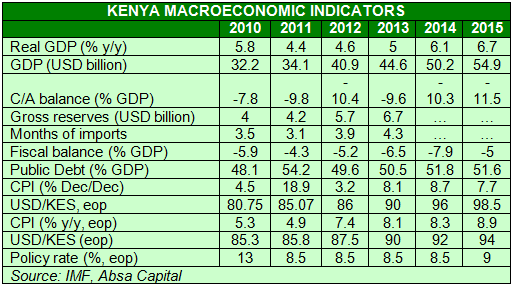
© alifarabia.com 2013