After flying high for a number of years, growth appears to be cooling in the West African state of Ghana.
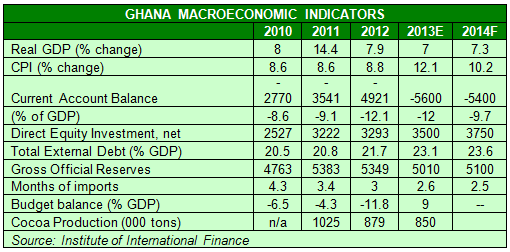
Real GDP growth had soared to 14.4% in 2011 and 7.9% in 2012, but has since grew at 7.9% this year and a relatively moderate 6.1% in 2014, as the Ghanaian economy faces headwinds.
"Growth slowed in the aftermath of the December 2012 election, as the result was subject to legal challenge, adding to uncertainty," said Standard Chartered bank in its latest outlook on the country.
Ratings agencies Moody's Investor Service and Standard & Poor's have both revised the country's outlook to negative.
Moody's pointed to "a steep deterioration in its (Ghana's) debt and debt-servicing ratios, despite rapid economic growth."
"The negative outlook indicates at least a one-in-three possibility that we could lower the ratings on Ghana within the next 12-18 months, due to its weakening fiscal and external profile," S&P said.
Fitch Ratings, which had downgraded the country in October, was also unimpressed with the country's 2014 budget announced in late November.
The ratings agency said the news budget aims for a very limited fiscal correction following slower-than-anticipated consolidation this year.
"We do not think it will effectively address the deterioration in government finances over the past two years that has substantially eroded Ghana's creditworthiness," Fitch said.
SLOWING GROWTH
Ghana is considered a star performer among African states and has been lauded previously for its strong economic policies and for leveraging its strong natural resource riches such as cocoa, gold, and now, oil.
The country became an oil producer in 2011, but while the crude sector has performed well thanks to strong prices, its other main exports have taken a hit. Indeed, both gold and cocoa production has declined in the past two years, adding to loss of revenues.
In addition, Ghanaian economy was also stuck in limbo after the elections at the end of 2012, which was inconclusive and disputed by the opposition. It took eight months for the Supreme Court to uphold president John Dramani Mahama's win in August, leaving many investors in a wait-and-see mode.
Economic growth decelerated in the first half to 6.4%, well below the initial government target of 8.0% for 2013.
However, the Bank of Ghana's Composite Index of Economic Activity suggests that growth tracked higher in H2, rising 7.5% year-on-year in September, compared with 5.8% in July, in real terms, according to Barclays Capital.
"Overall, Bank of Ghana data indicate that the balance of payments (BoP) recorded a deficit of [USD 1.7 billion] in the first nine months of 2013, an improvement from the [USD 2.1 billion] deficit in the corresponding period in 2012," noted Barclays Capital. "Against this backdrop, foreign exchange reserves totaled [USD 5.6 billion] in November, from [USD 5.3 billion] at end-2012, despite the (net) [USD 750 million Eurobond] issue in August."
OIL TO THE RESCUE IN 2014
The risks in the Ghanaian economy are unlikely to improve in 2014. Gold prices are expected to remain muted and could even decline next year, especially as the US dollar is buoyed by a strong economic recovery in the United States.
"Poor profitability in the sector is resulting in some volume reductions (-8.7% y/y in H1) as mining houses reconsider their production plans. In addition to being the biggest source of export revenues, the mining industry is important for the economy as a whole. The sector accounted for 27% of domestic tax revenue collections in 2012 and is also a key employer," Barclays noted.
It will be up to Ghana's oil sector to keep the revenues flowing, although most analysts are predicting lower crude prices in the New Year. The country is also producing below its capacity of 120,000 at just under 80,000 barrels per day over the past two years.
"Despite a sharp increase in output this year, the plateau may not now be reached until 2014," the Institute of International Finance said. "The government has also approved a second major offshore oil development, which is expected to raise output by 80,000 barrels per day. This will boost production starting in 2016 if plans are met."
DEBT RISKS
Ghana's key concern is its rising debt. The country's total debt stock stood at 53.5% of GDP by the end of September 2013 (up 31.3% from December 2012 to GHS 46.1 billion).
The government's decision earlier this year to scrap fuel subsidies and raise electricity prices by 79%, reduced an important source of budget overruns. "However, the decision to scale back the electricity price increase, by 25%, highlights the challenges the authorities face in implementing unpopular measures that would help bring the deficit back under control," Fitch said. "The further build-up in arrears highlights continued challenges with public sector financial management despite commitments to substantially reform the system."
Over this time, domestic debt rose by 35% to GHS 24.9 billion, and external debt increased 23% to USD 10.8 billion, partly reflecting new Eurobond issuance (USD 250 million of proceeds were used to refinance the Ghana 2017 Eurobond)..
"In order to curb rising debt-service costs, Ghana will seek to increase external issuance in 2014. Given a more difficult environment, with expectations of Fed QE tapering, maintaining investor confidence will be key," said Standard Chartered.
"Plans to better identify contingent liabilities and self-financing SOE projects may bring debt ratios down from current levels. Efforts to lengthen domestic debt maturity, reducing dependence on very short-term debt financing, might help."
As the authorities grapple with debt issue, they must keep a sharp focus on development of infrastructure projects, including the development of natural gas infrastructure, which would help cut electricity prices and boost manufacturing.
"The outlook for 2014 carries risks on the upside and the downside," according to Barclays. "Potentially lower mining output may continue to hinder growth of the industry sector even as oil production is expected to increase further. Higher VAT and tight monetary policy will likely affect consumer spending."
After weakness in the previous agriculture season, the prospects of stronger cocoa production could help boost the agriculture sector. Infrastructure development will also be an important driver of growth, with key projects planned in the energy (government aiming to increase power generation to 5,000MW in 2016 from current capacity of 2,800MW) and transport sectors.
"Overall, we expect growth to remain close to 7% year-on-year in 2014, though external uncertainties pose downside risks to our forecasts," Barclays said.
© alifarabia.com 2013