After calling for the approval of a Saudi mortgage law for years, analysts were quick to focus on the lack of short-term benefits after it was endorsed by the Council of Ministers.
While investment banks often fixate on stock markets and judge the value of government policy based on the benefits to listed companies, it is important to take a step back to examine what it means for Saudis.
A report earlier this year from Banque Saudi Fransi estimated that developers will have to build 275,000 units a year till 2015 to build a total of 1.65-million homes to meet demands of a rising population. However, the industry's capacity is capped at 120,000 units per year.
In short, Saudi Arabia will need to complete 900 houses per day over the next five years to meet domestic demand, according to real estate consultants Jones Lang La Salle (JLL).
Dr Ibrahim bin Abdulaziz Al-Assaf, Minister of Finance, told the Saudi Press Agency (SPA) in a statement that the funding system "constitute a new financial sector affiliated to the Ministry of Finance."
Interestingly, the SPA stated that the laws will need to ensure that funding costs are curbed and are provided in accordance with Shariah rules. The Saudi Arabian Monetary Agency is also expected to issue a number of important regulations in ninety days to clarify the picture further.
These are significant developments that would be a game-changer for Saudi real estate in the long term, although it may not have an immediate impact on the industry in the near term.
However, just the thought of a real estate bonanza boosted the Saudi market, albeit other global economic factors also contributed to the buoyancy.
The mortgage law is the first major step in the real estate sector since King Abdullah Bin Abdulaziz Al Saudi pledged to build 500,000 affordable housing at a cost of SAR250-billion last year.
The mortgage law had been pending for years and has been through a few iterations as powerful elements within the Saudi authorities resisted its approval, leading some analysts to believe that the departure of Prince Nayef from the scene may have finally pushed the law to the top of the Cabinet's file.
Significantly, the new Saudi Crown Prince Salman Bin Abdulaziz Al Saud, was the governor of Riyadh, the most populous metropolis in the country, and is well aware of the critical housing needs of the five million citizens living in the city.
There is also a dire need for Saudi Arabia to create employment and the real estate and financial services sector could lead job-creation to make up for what has largely been a jobless recovery for the Kingdom over the past two years.
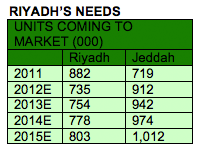
According to Jones Lang La Salle, a little over 900,000 housing units are planned each year in Riyadh alone for the next three years, and well over a million units in 2015.
There is clearly a dire need for housing. JLL's first quarter data showed new supply completed during was mostly absorbed.
In anticipation of the mortgage law, Riyadh city has saw an 11% increase in residential villa sales prices and a 10% increase in apartment prices. Another key emerging trend identified was more relaxed financing terms.
Similarly, Jeddah also saw an uptrend in the rental market. Apartment rentals increased significantly to as much as 8% due to higher expatriate demand for the former.
AFFORDABILITY: THE BIG QUESTION
A National Commercial Bank report estimated that average Saudis cannot afford a housing unit beyond SAR600,000. The Jeddah-based bank estimated that average salary of the public sector at SR8,300/month and the private sector at SR3,100/month; the weighted average of all Saudi employees is SR5,900 per month (or SR71,000 per annum;
Based on these figures, we estimate that affordable housing units for the majority of Saudis cost between SR300,000 and SR600,000 (depending on the income level). Given current real estate prices in Saudi, we expect most future demand to be for apartments and smaller villas in contrast to the historical norm of large villas.
So the stage is set for Saudi Arabia to enjoy a golden period in real estate where the average citizens can create wealth and not be beholden to the Saudi governments for subsidies and benefits, as the effects of home ownership becomes a part of the social infrastructure over time.
Of course, it will have to be carefully managed, otherwise the housing dream can quickly turn into a nightmare, as many regional countries can testify.
"We expect policy makers to be keen to ensure that speculative activity and rising prices do not occur, Wrote Fahd Iqbal, analyst at EFG-Hermes, in a note to clients.
"The low- and middle-income segments, where the housing shortage is most acute, are likely to remain a government priority, with continued funding support coming from the Real Estate Development Fund (REDF)."
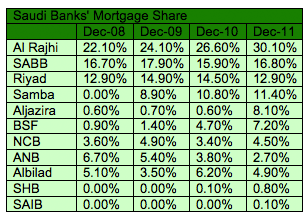
The table above shows there is tremendous headroom for many of the banks to become more aggressive in mortgage lending.
EFG-Hermes expects Al Rajhi and Riyad Bank to be the main beneficiaries of the law, while Samba, Banque Saudi Fransi, Aljazira Bank and Arab National Bank have also built up their mortgage books aggressively over the past two years.
"Clarity on the foreclosure process is likely to allow banks to be slightly more aggressive in mortgage lending," wrote Mr Iqbal.
© alifarabia.com 2012