Morocco is expected to emerge as the fastest growing economy in North Africa, with its GDP rising 3.8% in 2014 and nearly 5% in 2015, as the new consensus government ends a period of uncertainty and paves the way for bolder economic reforms, according to Institute of International Finance.
The country's external current account deficit has declined and reserves remained stable at more than four months of imports.
"The fiscal deficit narrowed as expected, owing to lower international oil prices that reduced the cost of subsidies and as a result of measures taken by the government to control spending," noted the International Monetary Fund.
Morocco should also be buoyed by Secretary of State John Kerry's visit to the country on April 4, and build on its free trade agreement with the United States.
"Morocco is convinced that it is necessary to implement common programs with our American partner to guarantee stability and economic prosperity and also to have access to energy and reinforce trade and encourage investments in various domains," said the country's foreign minister Salaheddine Mezouar.
Kerry told the Moroccan government that while bilateral trade between the two countries has actually tripled over the last 10 years, he would like to see foreign direct investment go further.
"We want that to grow. And Morocco is one of fewer than 20 countries in the world, and the only country on this continent, where the United States has a free trade agreement. That's important. But we can't pretend that that's enough and we don't come here pretending that it is."
Meanwhile, Gulf Arab states have announced plans to invest nearly USD 737 million in tourism projects in Morocco via Wessal Capital fund. The USD 3.4 billion fund is supported by Qatar Holding, Kuwait Investment Authority, Abu Dhabi's Aabar Investments, Saudi Investment Fund and the Moroccan Fund for Tourism Development (FMDT).
Qatar, Saudi Arabia, Kuwait and the UAE pledged to invest USD 5 billion till 2017 in the country's infrastructure and tourism sectors, but the Wessal investment is a separate initiative.
POSITIVE INDICATORS
Morocco's economy is also expected to benefit from improvement in the EU economy.
"Non-agricultural growth is expected to rebound from 2.4% in 2013 to 4.7% in 2014, supported by investment and improving conditions in the Euro area," the IIF noted.
Prudent monetary policy helped to keep average inflation around 2% in 2013 despite the significant increase in fuel prices and the introduction of a mechanism to gradually index local petroleum prices to international prices. The central bank has recently held its policy rate at 3%, but cut banks' reserve requirement to 2% from 4% to improve liquidity.
The fiscal deficit declined from 7.3% of GDP in 2012 to 5.5% in 2013, helped by a 2% GDP reduction in the subsidy bill. The IIF expects the current account and fiscal deficits to narrow to 6.8% of GDP and 5.0% of GDP, respectively, in 2014.
However, some of the country's key economic sectors are still not firing on all cylinders. Extractive industries such as phosphates and construction have slowed down, impacting other sectors as well.
"On the demand side, the main support came from private consumption. Inflation remained low, averaging about 2%, despite the increase in the prices of some subsidized energy products. Unemployment remained high, especially among young people," the IIF noted.
CHALLENGES AHEAD
Barclays Capital notes that the government will be challenged to keep the growth rate high. However, tourism receipts continue to disappoint as international visitors remain worried about regional instability. In addition, remittances declined 3.3% year-on-year, while foreign direct investment has not been as robust in the first quarter of the year compared to the same period last year, falling 60%.
The first two months of the year has seen the trade balance widen by 4.7%, primarily due to tripling of wheat imports. Exports, meanwhile, grew at a more sedate pace of 2.8% mainly due to an 18.15% drop in phosphate and related exports.
"Excluding the latter, however, exports rose by 7.6% year-on-year, benefiting from a remarkable 43.7% year-on-year increase in exports of cars as well as growth in exports of electronics (12.2% year-on-year) and pharmaceuticals (29.5% year-on-year), confirming the positive spill-over of the global economic recovery on manufacturing exports," said Barclays Capital.
IMF BUFFER
Against the backdrop of a relatively large current account deficit, the key question in the coming few months is whether Morocco and the IMF can agree to renew the USD 6.2 billion Precautionary Liquidity Line (PLL) due to expire in August 2014, noted Barclays Capital
The PLL has been Morocco's buffer against external shocks during periods of weak growth and volatile commodities markets, and has also served as an economic stabilizer as it pursues reforms.
In its recently published third review under the PLL, and despite highlighting some areas of underperformance in terms of weaker-than-expected fiscal and external positions, the IMF appeared broadly satisfied with the government's reform program, and stated that Morocco continued to meet the PLL criteria, Barclays analyst Alia Moubayed wrote.
Still, Barclays remains concerned about subsidy reforms that do not go far enough to reduce the deficit. Morocco also needs to implement pension wage reforms, as it has one of the highest levels of wages to GDP (11%) compared to regional peers.
"Moreover, the main public pension fund (the Caisse Marocaine des Retraites) is expected to run into a deficit starting in 2014 and to exhaust its reserves by 2021 if no reforms are undertaken.
Analysts believe the 2014 budget plans to introduce structural reforms to address the pension fund deficit. While this is a step in the right direction, "we remain concerned about how fast the government will be able to take action on that front," Moubayed noted.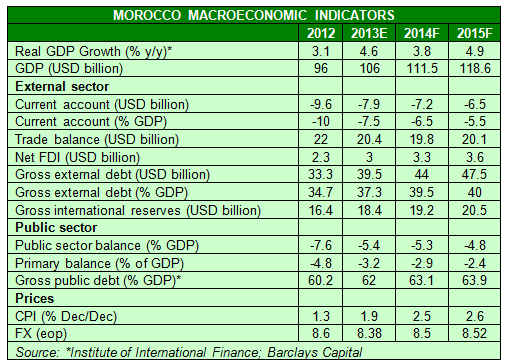
The feature was produced by alifarabia.com exclusively for zawya.com.
© Zawya 2014