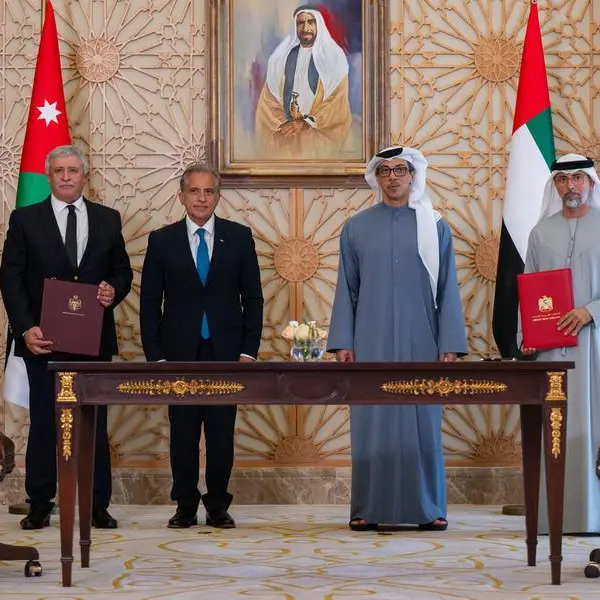
Guinea's impoverished economy received a major boost in late November when Abu Dhabi's Mubadala Development Company signed a deal with the government to build an alumina refinery, which is expected to attract an estimated USD 5 billion in foreign investment.
Despite being a politically unstable country, Guinea is the world's largest exporter of bauxite, a key ingredient in the production of aluminum.
"This agreement will deliver an estimated USD 5 billion of foreign investment into Guinea over the next eight years," Lamine Fofana, Guinea minister of mines and geology, said in a statement. "The development plan will create at peak 14,000 direct and indirect jobs and contribute substantially to Guinea's gross domestic product."
The deal would result in the construction of a bauxite export mine in Sangaredi and a port in Kamsar by 2017, along with the construction of an alumina refinery with an initial capacity of 2 million tons a year, with work due to begin in 2018 and commercial production set to commence in 2022.
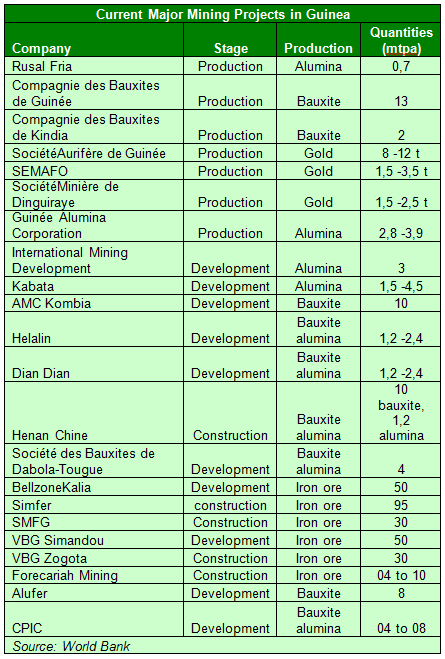
The project is the latest in a long line of mining projects expected to come on stream in the country.
"Guinea is poised to receive massive amounts of foreign direct investments in mining and related infrastructure projects," said the World Bank in its latest report on the country. "The pipeline of proposed large FDI inflows in mining and related infrastructure is estimated at above USD 20 billion, which is about 4-5 times the country's GDP in 2010."
POLITICAL INSTABILITY
Guinea has just emerged from a tumultuous period after a military coup in 2008 pushed the country back economically and socially.
The combined effects of regional insecurity, low international prices for key commodities, and political and social turbulence catapulted Guinea into a state of fragility comparable to that of post-conflict countries, according to observers.
However, clouds of uncertainty have dissipated somewhat after the adoption of a new Constitution in April 2010, which marked the beginning of a new era for Guinea. The new constitution allowed the return to civilian rule through elections, and the reform of the security sector.
"Presidential elections were successfully organized in 2010, and the suspension of aid was lifted as the newly elected government was recognized by the international community. In September 2012, Guinea achieved the highly indebted poor countries (HIPC) completion point," the World Bank said.
Foreign investors which had fled in 2010 due to instability are rushing back. In addition, the return of international donors and help and guidance from a range of multilateral organizations is helping Guinea back on its feet.
But the country has a long way to go. Poverty levels have skidded from 53% in 2007 to 55% by the end of 2012, and other socio-economic indicators remain weak.
The African Development Bank expects the country's real GDP to rise 4.8% this year and 5.6% next year as foreign investment starts flowing in, despite massive infrastructure challenges facing the country. The World Bank expects GDP for this year to have grown by as much as 5%, and 5.2% in 2014.
However, the real accelerator will kick in in 2015 and 2016, with the economy posting nearly 20% gains in each of those years driven by mining projects.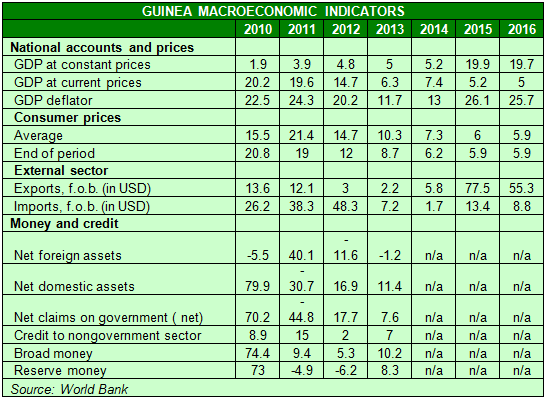
MINING POTENTIAL
"There are estimated to be more than 9.4 billion tons of iron ore deposits with 350 million tons at Mount Nimba with a 66.5% content, but bauxite is the major mineral with proven and probable reserves of more than 20 billion tons, or two-thirds of world reserves," according to the African Development Bank (AfDB).
It's unclear, though, whether the mining riches will trickle down to the average population. Apart from raising foreign direct investment, the sector has had a limited impact on economic activity, as the goods and equipment used to extract and process bauxite are not made in Guinea.
"Any rise in mine production or exports does not stimulate production in other sectors, but increases imports," the AfDB said, noting that a greater integration of the mining sector into the rest of the economy could have a more intensive ripple effect on the other sectors as investment in mining increases, and help reduce unemployment rates in the country.
Despite its poor business environment, development partners from the Arab World, Russia, India and China have descended into the country.
The mining sector already contributes more than 25% of Guinea's GDP and 8% of its export revenues, and the World Bank expects investments in the mining sector to double.
But dependence on a single sector is fraught with risks especially if projects are delayed and commodity prices remain low.
"On the other hand, efforts need to be accelerated to (i) improve the business environment for prospective investors, and (ii) convert revenues into effective and cost-efficient public investments in infrastructure and human development," the World Bank said. "This puts programs to improve mineral governance and public financial and investment management at the center stage of the government strategy."
Guinea authorities must leverage their mining resources to the maximum, but also move quickly to ensure that the windfall of investments expected to flood in over this decade translates into massive improvement in socio-economic indicators and lifts its citizens out of poverty and into meaningful jobs.
The African Development Bank's 2012 surveys of poverty and inequality in the Boké and Kindia regions, where bauxite-producing companies operate, show that they are among those hardest hit by poverty with rates of 58.9% and 62.5%, respectively. "The resurgence of poverty and the lack of infrastructure in these places indicate that the use of local resources has little impact on the economies and well-being of local populations."
That disconnect must change for Guineans to feel a part of - and rejoice in - their country's mining boom.
© alifarabia.com 2013