The Middle East's natural gas production will be a victim of low prices and lack of focus over the next five years, leading to a slowdown in output, according to the Paris-based International Energy Agency.
The regional scenario is in sharp contrast to the boom being enjoyed in other parts of the world, notably the United States which is set to surpass Russia as the world's largest producer of natural gas by 2017.
Meanwhile, the Middle East which holds 41% of the world's proven conventional gas reserves, could potentially face gas shortages.
"Middle East gas production is expected to serve exclusively the regional gas market needs in the medium term, as it is relatively unlikely that any export project, whether a pipeline or an LNG plant, would be completed by 2017," the IEA said in a report.
"That the Middle East could face gas shortages could appear as a contradiction, given that the region holds significant gas reserves."
But the reserve figures are skewed by Iran (29.6 trillion cubic metres) and Qatar (25.3 tcm) - the world's second and third largest holders of conventional gas - while Saudi Arabia (8 tcm), UAE (6 tcm) and Iraq (3.2 tcm), sit on more modest reserves.
The IEA expects Middle Eastern gas production to "slow down considerably over the coming five years", with the build-up from an estimated 516 bcm in 2011 to 588 bcm in 2017 - a much slower pace in the absence of the expansion of LNG export capacity in Qatar and difficulties in developing the next generation of fields.
At the same time, it will need to import natural gas either through LNG, or pipelines from Egypt or from Qatar which is in the enviable position of excess supply.
"Middle Eastern demand grows faster than production over the medium term," said the IEA. "Rapidly increasing domestic gas demand also leaves very little room for additional exports from Algeria and Egypt, while Latin American countries have to import increasing amounts of LNG."
COOLING QATAR
While Qatar will be able to meet its booming demand and export commitments without much difficulties, "Bahrain and Oman are expected to struggle to keep their domestic production at today's levels, either due to low domestic prices and/or to the difficulty of developing a new generation of tight gas fields, which often do not offer the benefit of liquids revenues."
Qatar is cooling down after a golden run which saw double-digit GDP growth for much of the past decade. While the Economist Intelligence Unit expects growth to remain above 6% over the next two years, it will be a shadow of the 14.1% posted in 2011.
The slowdown is natural given that the country is at the end of its massive expansionary cycle which saw a number of projects come online. New projects will take some time to get off the ground especially as Qatar has imposed a moratorium on its massive North Field gas field until 2015.
Still, the Middle East country remains an LNG powerhouse. Last year, Qatar contributed 30% to the global LNG trade, earning USD100-billion in revenues. Given that LNG makes up 9% of global gas trade, the IEA believes that a drop in Qatar's supplies could actually pose a security risk for gas-importing countries.
"Replacing missing Qatari LNG supplies would be challenging and could have an exacerbated impact on gas prices as markets are already tight," notes the IEA.
"There is currently little spare LNG production capacity in the world, as LNG producers tend to produce as much as they can. Therefore, other measures must be employed if there was a disruption. The key challenge would arise in countries entirely dependent on LNG - Japan, Korea, Chinese Taipei, and India. These countries imported an estimated 45 bcm from Qatar in 2011, almost half of Qatar's LNG exports."
Qatar is facing other challenges too. Close to 14 new LNG terminals will come online, half of them in Australia, by 2017, adding 114 billion cubic metres capacity.
Media reports say Australia has already booked USD500-billion from Asian markets for its LNG output, and will no doubt break Qatar's dominance as the most significant LNG supplier to eastern economies.
Rising competition would mean that Qatar will not be able to enjoy the current premium LNG prices to Asian markets.
"Towards the end of the forecast period [2011-2016] new sources of LNG supply, particularly from Australia and possibly North America, could lead to lower gas export prices," notes the EIU.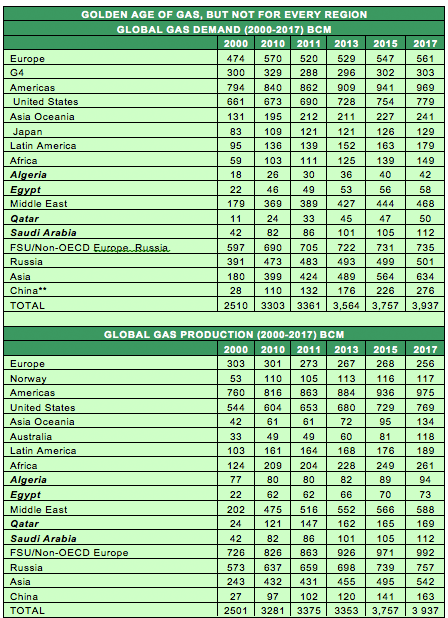
IRAQ: WILD CARD
Iraq is sitting on 3.2 trillion cubic feet of gas reserves, which should make it an investment magnet, but the country is hamstrung by severe infrastructure bottlenecks such as lack of roads, bridges to gas transmission network and gas-fired plants.
Despite the obstacles, the country has managed to add 2,913 megawatt of power generation, and plans are afoot to add 6.5 gigawatt of capacity by 2016.
But the lukewarm reaction to the country's fourth oil and gas auction - featuring seven gas fields - and troubles with the autonomous Kurdistan Regional Government, highlights the regulatory issues facing the country.
Much of the Iraqi gas is associated which is an advantage given the country's bright oil production prospects, but the biggest field, Khor Mor, is in KRG territory.
The federal government will need to finalise a hydrocarbon plan and reconcile with the autonomous region to fulfill its potential.
Given Iraq's electricity shortages, the country's export plans remain controversial.
Still, Iraq signed a Strategic Energy Partnership with the European Union in May 2011, apart from the construction of a 500-kilometre pipeline to the northern part of Jordan to replace Egypt's erratic supplies. Finally, an LNG terminal would also give access to international gas markets.
"Iraq is actually one of several wild cards in this region, for despite very high production potential, production has so far been constrained by lack of domestic demand, which is the opposite from what can be observed in many countries," said the IEA. "Additional associated gas production in Iraq may be flared, but new developments in terms of fields, infrastructure and power plants could change the outlook."
TIGHT GAS
Saudi Arabia will emerge as one of the fastest growing markets and benefit from the development of its domestic gas production, which will reach 112 bcm by 2017. Much of the increase will come from gas developments in Kurais, Nuayyim and Karan, and the Wasit Gas Programme.
The Middle East is also warming up to tight gas - an unconventional type of the produce, which has higher development cost but has revolutionised the industry in North America thanks to advanced drilling technologies.
"Tight gas potential is particularly high in Saudi Arabia, Oman, Jordan, Egypt, Algeria and Tunisia, where some fields are already producing or being developed to complement conventional gas resources," notes the IEA.
"Over the medium term, other tight gas fields in Algeria, such as Timimoun, will likely be developed. Meanwhile, BP is developing the Khazzan and Makarem fields in Oman. In North Africa, some exploration is under way in Morocco and Tunisia as well. Most countries are viewing shale gas prospects as a long-term resource. The most active on shale gas exploration is currently Algeria."
ARAB SPRING DISRUPTIONS
While the world worried about Libyan oil output drying up during the civil war last year, regional gas output also took a hit due to troubles in Syria, Egypt, Jordan, Lebanon and Yemen.
Libyan exports to Italy fell during much of last year while Egypt supplies to Israel were disrupted due to sabotage multiple times, forcing Israel to refocus on its own massive shale gas deposits.
While Egypt has invested heavily in its gas reserves over the past decade, it needs to find new fields and reduce subsidies to attract foreign investment in the sector.
"The challenges lie ahead, as the country faces a rapidly growing gas demand boosted by subsidies, while gas production struggles to keep pace," said the IEA. "There are some stranded assets in Egypt, as well as untouched areas, notably the East Mediterranean area, which could very well prove as resource-rich as its Israeli counterpart. The problem is now to convert reserves to production capacity faster."
GLOBAL GOLDEN ERA
While the Middle East is facing a raft of challenges, the global natural gas situation is extremely positive. In fact, the IEA notes that the world is entering a "golden era" of natural gas, thanks to the discoveries of unconventional natural gas, from North America, China, Africa and Australia.
"Unconventional gas represented 16% of global gas production as of 2011," said the IEA. "Despite the growing interest in shale gas, half of unconventional gas production consisted actually of tight gas. Production increases in 2011 came mostly from North America, where shale gas continues to boom despite record low gas prices and the reduction in the number of rigs. In addition to shale gas and tight gas, associated gas from light tight oil plays is also growing in importance.
While natural gas prices in North America are rock-bottom, they are expected to rebound, given the export potential to European and Asian markets.
CONCLUSION
The IEA expects to see Asia and Europe's gas imports rising, while Middle East and Latin America will also need to import gas 'in a more limited way'. The region may need to reassess its focus to exploit its gas reserves better, otherwise it may find itself in the unlikely position of importing gas from the United States.
© alifarabia.com 2012