The Middle East and North Africa (MENA) region is set to lose its dominant position as the world's largest supplier of liquefied natural gas (LNG), according to the International Gas Union (IGU).
"In 2012, the Middle East produced 112.7 million tons per annum (MTPA) and Asia-Pacific 80.8 MTPA," the IGU said in its annual report reported published on August 21.
"This trend is likely to reverse in the coming decade as new Australian projects are expected to come on-stream post-2015 and prospects for growth in LNG exports turn to newer regions such as North America and East Africa. "
While LNG export terminals crop up elsewhere, Middle East exporters face a myriad of issues, ranging from higher domestic demand to political turmoil that would likely hurt export potential going forward. In fact, Qatar production may start to decline in the near future as it is already operating at peak capacity and it may have limited technological room to expand production without investing heavily in new LNG trains, the IGU noted.
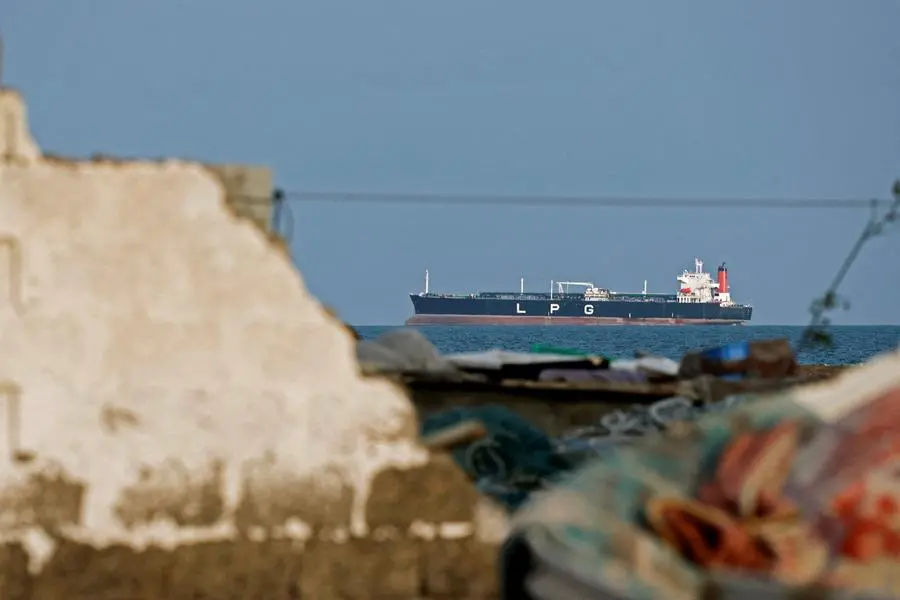
For now Qatari LNG exports dominate global supplies. The country holds more than a quarter of the world's liquefaction capacity and a third of its exports, or 77 MTPA last year - three times more than its nearest rival Malaysia.
While Qatar led the Middle East charge, other regional countries faltered. Growing domestic demand and political turmoil in places like Egypt, Algeria, Yemen and Libya meant that global LNG trade fell 1.6% to 237.7 million tons last year ‑ its first annual decline in decades.
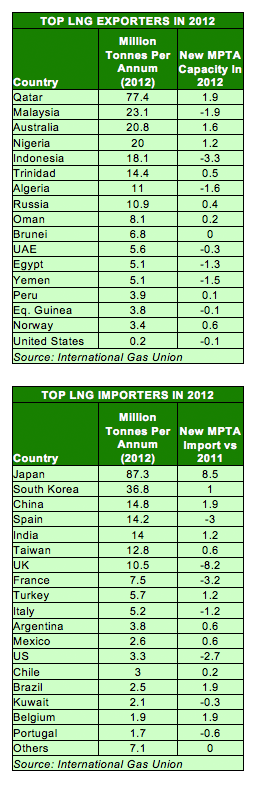
Indeed, future growth may not be found in Middle East markets. Algeria's new LNG plants will be to replace declining capacity only, while Qatar is already producing at near peak levels.
"After the commissioning of its final mega-train in early 2011, Qatar's role as the driver of liquefaction capacity growth in recent years has faded," said the IGU. "Taking its place is Australia, where projects currently under construction account for 64% of all projects that have reached FID [final investment decision], representing 62 MTPA of capacity."
GROWING MARKET
The Middle East states' loosening grip on the global LNG sector comes at a time when the demand for chilled natural gas is rising fast.
Since 2005, 15 additional countries have begun importing LNG.
To meet the rising need, 26 new LNG projects were underway at the end of last year and a number of new LNG-exporting regions are emerging in places such as the Canadian West Coast, Eastern Africa and the US Gulf Coast.
"Global LNG demand should continue to grow in the short term and the market will continue to be supply-constrained at least until 2015," said Jerome Ferrier, president of IGU. "Traditional consumers will keep their place on the market and a large number of new players are expected to emerge.
"Such dynamics will accentuate the globalization of the LNG market and probably change the price environment for the benefit of a larger use of non-oil-linked pricing. It is certain that LNG prices will remain firm, but their regional dichotomy will continue to provide opportunities for arbitrage trading."
Nearly 50% of new liquefaction capacity will be built in Asia Pacific by 2017, even as Middle East capacity remains flat during the period.
Another competitor to Middle East exporters could emerge from East Africa where huge gas discoveries in 2010-2013 have led to the proposal upwards of 30 MTPA of capacity in Mozambique and Tanzania, though underground resources could support upwards of 75 million MTPA, IGU said.
"Projects in the region have the advantage of low domestic demand and geographic proximity to Asian markets."
TRADE FLOWS
Middle East LNG exports to Asia have helped build strong trade flows with one of the world's most dynamic emerging economies over the past decade. The region's LNG exports to Asia-Pacific had more than tripled to 54.3 million tons in 2012, compared to 15.3 million tons in 2011.
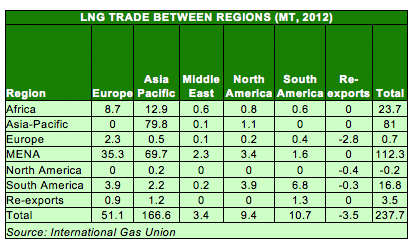
However, that trade flow may decline as major LNG consumers such as Japan, South Korea, China and India switch to Pacific, East African and North American supplies.
Other factors could also hurt LNG prospects from the MENA region.
After enjoying a huge cost advantage in developing LNG projects over the past decade, Middle East producers are no longer the cheapest.
"Over the next 10 years, the Atlantic Basin is expected to have the lowest project costs as a result of brownfield economics in the United States due to synergies from building on existing regasification sites," said IGU.
Cost considerations have emerged as a primary concern for new LNG exporters. A number of Australian projects have reported dramatic cost escalations leading to delays and slow-downs.
In tandem, Asian countries have also been bolstered by the wide variety of suppliers and are negotiating lower LNG prices.
The LNG space is set to evolve over the next decade as new exporters and importers come on line and the shale gas revolution that has transformed North America reaches other places such as China, South America and Europe.
With Asia seeking a number of alternatives, such as pipeline imports from Central Asia and Russia and investing heavily in renewable energy, not every LNG project will find suppliers ‑ some will fall by the wayside.
There is little doubt that LNG will emerge as one of the most desirable sources of energy, but it's unclear what role Middle East gas exporters or reserve holders will play in its burgeoning future.
© alifarabia.com 2013