Investors are circling around Egypt's key sectors, looking for opportunities and bargains on undervalued prices of key assets.
The economic fallout from the Arab Spring revolution in Egypt has changed the landscape radically and offered new opportunities for regional investors.
As Egypt underwent through a series of political crises over the past 20 months, the economy has sputtered. The International Monetary Fund expects the North African country to grow by a mere 1.5% this year, even worse than 2011 when the economy grew by a paltry 1.8% at the height of the political crisis.
Moody's Investor Service believes Egypt's operating environment will remain challenging over the next 12-18 months, underpinned by weak economic growth prospects and a negative investment climate.
In view of government financing needs stemming from its large budget deficit (equivalent to 10% of GDP in fiscal year 2012), Moody's expects the banks to further increase their already significant sovereign exposures.
"During 2011, Egyptian banks' government debt holdings increased to 550% of equity, from 430% in December 2010, linking banks' credit profiles directly to the credit risk of the sovereign," said the agency, adding that capital levels are weak and that reported capital ratios overstate the extent of banks' current buffers, as high exposures to government securities are zero-risk-weighted.
But few analysts are writing off the Egyptian's economy long-term fundamentals. A population of 86-million, nominal GDP of USD264-billion and close proximity to the important markets to the European Union, Africa and the Gulf markets makes Egypt a very attractive prospect for regional and international investors.
For all its problems, and there are many at the moment, the economy remains open and offers significant direct foreign investment opportunities.
The current crisis makes Egyptian assets even more tempting as they have been under-priced due to the political uncertainty.
"At the macroeconomic and political level, there have been a number of positive developments that have contributed to the upbeat market sentiment," notes Elena Sanchez-Cabezudo, analyst at EFG-Hermes. "The decision of President Mohamed Morsi in mid-August to change the military leadership ended the difficult relationship and power struggle between the Muslim Brotherhood and the SCAF (SCAF), which was seen as a key impediment for an economic recovery."
The recent escalation of violence in Egypt when protestors stormed the U.S. embassy to vent their anger over an anti-Islamic movie suggests the country's relationship with the U.S. will remain tense at least in the near future.
Investors are hoping that the country can move on from the episode and the U.S. plays its role in ensuring aid to Egypt continues to flow.
While Mr. Morsi is keen to be seen to be standing up to the U.S., Egypt needs the U.S. to secure the USD4.8-billion loan it has sought from the International Monetary Fund.
Christine Lagarde, the IMF Managing Director, has in principle agreed to help but notes that Egypt faces considerable challenges, including the need to restart growth and reduce budget and balance of payments deficits.
She also emphasized the importance of creating jobs and supporting small and medium-sized enterprises.
"Getting the country's economy back on track and raising the living standards for all will not be an easy task. The Egyptian people have legitimate expectations for a better life and greater social justice. We at the IMF stand ready to help," she said.
M&A OPPORTUNITY
Qatar National Bank's interest in SocieteGenerale's assets shows investors are keenly looking for Egyptian bargains.
"We believe there is a strong likelihood of further M&A newsflow in the Egypt banking sector," notes EFG's Sanchez-Cabezudo. "BNP Paribas is already in discussions with several banks on a potential sale of its Egypt retail business and CAE is also a strong takeover candidate, in our view, as the parent company Credit Agricole targets asset disposals to shore up its capital position. We believe that M&A and continued positive macro news flow, including international financial assistance, will add to the positive sentiment."
Cairo-based Pharos Research recommends investors to keep a keen eye on proceedings.
"At this stage, further re-rating will be contingent on: 1) acquisition noise, whether linked to NSGB or other smaller banks, 2) progress on the IMF loan negotiations and 3) indirectly re-rating in global banking stocks if the ECB endorses the unlimited bond buying plan. We remind readers that acquisition suspects from amongst listed banks are 1) Credit Agricole-Egypt (1.4x book) and 2) Egyptian Gulf Bank."
Pharos also notes interest in other sectors, especially in real estate 'to benefit from acquisition and reconciliation noise.'
"From within our two favourite exposures to real estate in Egypt, SODIC and TMG [Talat Mustafa group], SODIC fully re-rated during August following speculation on the sale of EFG-Hermes Holding 19.3% stake to an Arab investor. TMG market price is trading near our second case scenario assuming 25% of Madinaty land bank is returned to the government following a potentially unfavourable court ruling (expected by June 2013)."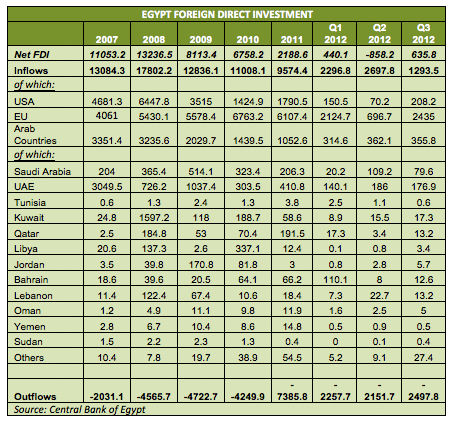
THE EXTERNAL AND INTERNAL CHALLENGES
For all its prospects, the country is hemmed in by a number of internal and domestic challenges.
Regional economic conditions, especially for oil-importing countries like Egypt remain unfavourable. Tension in Syria, Israel's sabre-rattling against Iran and now the sudden instability in Libya does not make for a conducive regional environment to operate in.
Meanwhile, the economic conditions in the Eurozone, which is a key source of investment and tourists for Egypt, remain subdued.
Internally, the country has been somewhat jolted by the attack on U.S. embassy in Cairo, and it is unclear whether it could have a long-term impact on the already uneasy relationship between the two countries.
Historically, a key non-NATO U.S. ally, Egypt's new government has a strained relationship with Israel leading to tensions with Washington. So much so that U.S. President Barack Obama emphasised that Egypt was "neither a friend nor an ally" as the U.S. continues to view the Muslim Brotherhood-influenced President with wariness.
It is not an irreconcilable difference, but it will take some effort from Mr. Morsi's government to mend fences with Washington.
The country also faces political tensions in the Sinai Peninsula.
"The greatest and most alarming trend-change in Egypt's security environment since the fall of former president Hosni Mubarak in February 2011 has taken place in the Sinai Peninsula," said James Petretta, Principal Analyst at Maplecroft, in a report to clients.
On August 5, masked gunmen attacked an Egyptian checkpoint at the border with the Gaza Strip and Israel, killing 16 Egyptian soldiers. The fallout saw the ouster of the army top brass as the President chose the opportunity to strengthen his position.
"Egyptian interests are at risk along with foreign tourists and company personnel. The deterioration of security inside Sinai poses risks as well to neighbouring Israel, Jordan and potentially to Saudi Arabia," notes Mr Petretta.
With the political and economic situation fluid, the government needs foreign aid and loans. Qatar deposited USD500-million in Egypt Central Bank last month and is expected to write another cheque for USD1.5-billion Qatar deposited USD500 million in Egypt's Central Bank in August and will deposit a further USD1.5 billion in September.
The government is also hoping to secure funding to the tune of USD5-billion from other Gulf states, apart from Arab Development Bank, Arab Monetary Fund and the European Union.
Pharos Research believes economy recovery depends on three key factors:
1) Tourism: Revenues from the tourism industry stood at around USD5.4-billion in the first half of the year, as 5.2-million tourists visited the country. Despite return of Arab tourists during Ramadhan, a full recovery is unlikely due to unrest on the eastern border and also in Cairo city. Problems in Syria and Libya's east may be reasons enough for many tourists to postpone their visit to Egypt till next year.
2) Remittances: "Remittances will likely post a record high in 2012. Despite the slowdown in the global economy, remittances from Egyptians working abroad rose to a historic high of USD15.2-billion in 2011," notes Pharos. "We expect remittances receipts in 2012 to surpass that of 2011 largely on the back of 1) the receipt of around US$0.4bn of remittances from workers employed in Iraq in the 1990s in the first half of 2012, and 2) the gradual return of Egyptian workers to Libya."
3) Investment Outflows: The Cairo-based investment bank believes investment flows bottomed out in the first half of the year. "We expect the call on foreign reserves to be cc US$ 0.5bn per month for the remainder of 2012. FX reserves fell from US$ 15.5bn in June 2012 to US$ 14.4bn as of end July 2012."
CONCLUSION
Egypt's economy continues to struggle due to a number of internal and external challenges facing the country. But even as the country's authorities wrestle through one problem, another one crops up, forcing the authorities to tackle short-term problems instead of enforcing real reforms.
Still, this turmoil is being viewed by many observers as a chance to position themselves favourably in the promising country. The investment adage 'be brave when others are fearful and fearful when others are brave', certainly applies to Egypt.
© alifarabia.com 2012