Libya has gone from a much-lauded country trying to get back on its feet after a bloody civil war, to a basket-case within the space of a few short months.
The country had made remarkable progress ramping up crude oil production over the past years, after a bloody end to Muammar Gaddafi's rule. Indeed, the country had quickly re-emerged as an important global oil player, pumping 1.42 million barrels per day of oil in April.
But in the past month oil production has come to a virtual standstill, with production averaging a paltry 150,000 barrels per day (bpd) amid crippling labor disputes, civil unrest and political infighting among tribal militias.
The country is estimated to be losing USD 130 million a day due to the continued turmoil.
The International Energy Agency's September report notes that Libyan exports have tumbled to 80,000 bpd, compared to 1.2 million barrels per day, with shipments operating only from the country's two offshore fields, Bouri and Al-Jurf.
"The burgeoning crisis, the worst since the onset of the civil war in early 2011, is weakening already‐fragile government institutions and choking off vital revenues," the IEA said.
"Striking workers have halted exports and forced the closure of the eastern region's oil‐producing fields off and on since the end of May. Tribal groups are now pushing for federalism whereby regions control export flows and revenues."
There appears to be no resolution in sight as prime minister Ali Zeidan issued arrest warrants for strike leaders, which would most likely lead to more acrimony among the warring parties.
Militants also blocked production in some of Libya's largest oil fields in August. The shutdowns impacted the Elephant and El Sharara fields, which together generate around 500,000 bpd.
The authorities have set up a crisis committee to negotiate with the striking workers and tribal militias, but the parties have made little progress to date.
"The striking workers and disgruntled civilians are demanding a multitude of changes, ranging from improved pay packages and management changes to a share of the revenues and greater regional autonomy, which have combined to complicate the already challenging negotiations," the IEA said.
OIL IS THE LIFEBLOOD
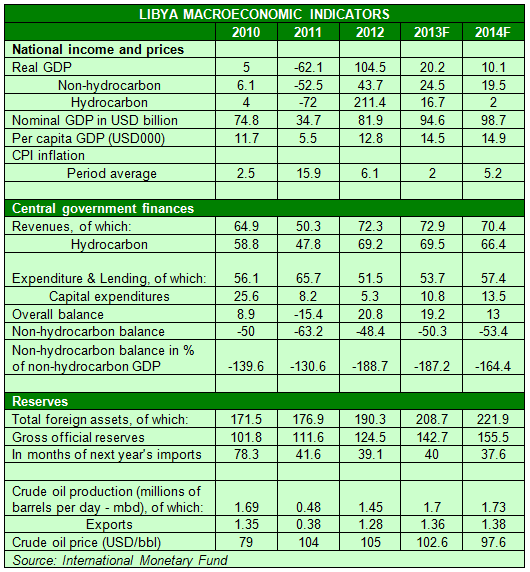
More than 90% of the government's revenues are generated from oil production, and those revenues are vital for the authorities to rebuild the underdeveloped country.
"Libya has an underdeveloped financial system; its manufacturing sector is small and contributes little to economic growth; the quality of infrastructure is poor; corruption is widespread, economic policies are erratic, and the quality of education is poor (though enrolment rates are quite high)," said KPMG in its latest report on the country.
"Unemployment is also widespread, though one cannot be certain exactly how severe it is, due to the lack of timely and accurate economic data."
It would also be naïve to say at this stage of Libya's development that the country should try to move away from hydrocarbons production and diversify its economy.
That can only occur if the oil revenues are reliable and steady enough to allow the authorities to invest heavily in the areas of healthcare, infrastructure, transportation and housing.
Annual crude exports of well over USD 60 billion over the past two years, means the country's foreign reserves (including investments from the Libyan Investment Authority) is expected to cross USD 208 billion by the end of this year, the IMF forecasts.
LIBYA'S IMPACT ON GLOBAL SUPPLIES
But recent developments have placed a major question to the market over the reliability of Libyan oil. The Libyan crisis, along with tensions in Syria, has raised oil prices at a time when global economic recovery is fragile.
Even if the Libyan authorities manage to avert a crisis in the short-term, it may take a while for oil majors to return to the country.
That could be a blow to the country that has significant oil and gas reserves.
Libya holds the largest oil reserves in Africa and also has significant natural gas reserves. The country holds a number of advantages over its African neighbors in hydrocarbons sector, especially given its existing infrastructure and proximity to the key market of Europe.
But as its oil and gas sector dithers, oil majors are being attracted to a number of new African countries which are also closer to European markets, but offer far more stable regulatory and political regimes.
It is crucial for the Libyan authorities to get a handle on the escalating situation in the crude oil instability, lest it descend into chaos.
© alifarabia.com 2013