Saudi Arabia will emerge as the second fastest growing G20 country after China this year, while Gulf economies will outpace global and emerging growth, according to Barclays Capital research.
The jury is still out whether the new stimulus packages and programmes announced by the U.S. Federal Reserve, the European Central Bank and the Bank of Japan will boost the global economy.
"While the timing of a global growth rebound remains uncertain, the tail risks for investors, in particular those related to the euro area, have been reduced," said BarCap's Christian Keller. "This improves the outlook for risky assets and should support flows into emerging market assets."
Investors, tired of waiting for global economy to pick up are scrounging for yield, and they would do well to look up some of the regional markets.
Bank of America Merrill Lynch (BAML) notes that investors are unsure of the effectiveness of the Fed's stimulus packages and 'false dawns' in Eurozone, where policymakers seem to fight fires in member states rather than dousing the raging inferno that is the debt crisis.
"Looking ahead, the focus shifts, in effect, to who scores the next "own goal," notes Ethan S. Harris, analyst at BAML. "Will it be the US with multiple rounds of brinkmanship around the fiscal cliff? Or will Europe tip the ball into its own net with either Greece unable to deliver a credible austerity plan or other parts of the periphery refusing to ask for aid until a full-force funding crisis develops? After a welcome relief trade, the risks from both sides of the Atlantic will grow as year-end approaches, in our view."
Some global investors are already positioning themselves in regional markets. Data from investment banks show net foreign buying in Qatar, Dubai and Omani markets are rising, especially in August. EFG-Hermes data shows that the Egyptian market has also seen outflows decrease over the past few weeks, as the haze over the North African country's economy dissipate somewhat.
Still, all the countries will be beholden to the tough global economic environment. Barclays Capital believes the global economy will grow at 3.1% this year and 3.5% in 2013, with the Eurozone contracting by -0.5% and growing a paltry 0.3%
next year.
BarCap's figures are below the International Monetary Fund's 3.5% growth projection for this year for the global economy and a relatively healthy 4.1% in 2013. And while it believes Eurozone will contract 0.3% this year, it expects a near 0.9% growth in 2013.
And while the global economy will stutter, Gulf economies will be outpace both global and emerging economies, rising 5.5% this year, compared to 5.1% by emerging markets, BarCap estimates.
Qatar will lead the way among major economies, rising a staggering 11.5% this year. But it will be Saudi Arabia, the Middle East's largest economy, and a G20 nation, that will clock growth of 6.2% this year, followed by a robust 5.1% in 2013.
Saudi Arabia's performance among G20 nations will only be bettered by China, the world's second largest economy. For all of China's economic woes, the country will still post 7.5% growth this year and 7.6% in 2013.
"Our expectation is for China's growth to stabilise within a 7-8% range, which is where we see its new potential. However, our current forecasts for 7.5% growth in 2012 and 7.6% in 2013 do require some pickup in momentum in Q4 and a modest recovery in 2013," says Barclays.
A pick up in Asia is important for Gulf oil exporters that depend heavily on growth among Eastern nations.
India, the other major Asian trading partner is also looking to revive growth. Bank of America Merrill Lynch analysts believe Reserve Bank of India will continue to ease liquidity to soften lending rates to revive growth.
"Experience suggests that cycles tend to turn up (down) only when the real lending rate, now 8% slips below the 7.5-8% potential growth. India is the only BRIC in which lending rates are at their peak."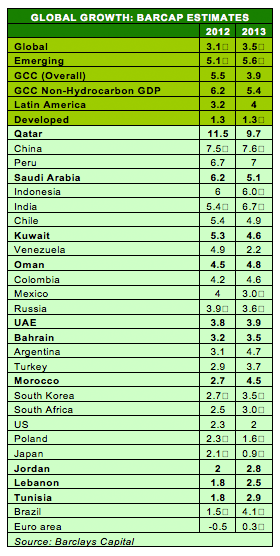
GULF CREDIT
"Emerging market corporates look cheap versus sovereigns; low-investment grade and high speculative grade credits look particularly attractive," note BarCap analysts. "We continue to like Dubai Inc. and highlight the Korea and India complex, Chinese property and Brazil and Chile investment grade among our preferred sectors."
BarCap suggests investors to go long on Dubai Inc, based on improving credit fundamentals, strong liquidity positions and reduced reliance of local borrowers on the international markets, and highlights DEWA, DP World and MAF on the investment grade side and DHCOG and JAFZ in high yield among its top picks.
However, the bank is less bullish on high-quality sovereigns such as Abu Dhabi and Qatar. "Current spread levels do not leave much room for further upside given asymmetric U.S. Treasury, supply and perceptions about geopolitical tail risks, in our view."
© alifarabia.com 2012