Saturday, May 28, 2005
Bread is the original food. And the original bread was flat. Still, it may be surprising that flat bread is very much back in fashion, mainly due to the increasing popularity of wraps. According to figures released recently, sales of wraps in the UK have risen by 40 per cent in the past six months.
In prehistoric times, bread was a hard cake baked by pouring porridge over a heated stone. Then the ancient Egyptians discovered leavening and the heavy cake evolved into a lighter loaf; and as new technologies were developed, flat (and other) breads were made in all kinds of shapes and forms.
The variety may be great but the types of flat breads are limited to only two basic ones: those made in one layer and those made in two or more layers.
Pitta, the name by which many people identify any flat bread, is one of the most common two-layered ones. In Lebanon, it is known as khobz arabi (Arabic bread), in Egypt as aysh baladi (local bread) and in Syria as shami (Damascene). Pitta is the name used in Greece, Cyprus, Europe and the United States.
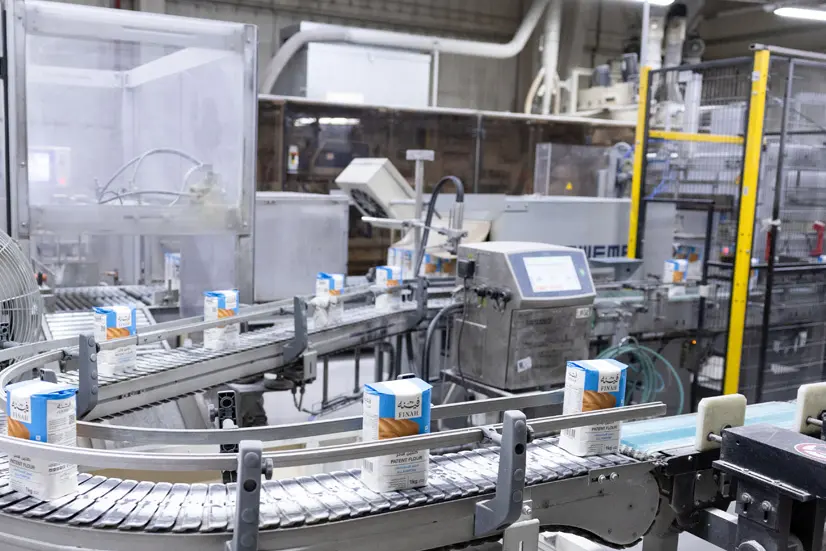
The Arab pitta is a large round loaf that separates in two thin, miraculously equal layers. Whether it is made in a primitive bakery or in a modern one, the process is the same and almost fully automated.
The dough is kneaded and divided, the pieces being fed to rollers, which flatten them into perfect disks. They proof during their conveyor belt journey to the very hot oven, where they puff up and bake within seconds. The baked breads are then returned to the conveyor belt, where they deflate and cool as they are conveyed to the seller's window or, in the case of bigger bakeries, to the packing room.
Egyptian pitta is a lot smaller and thicker and is often made with wholewheat flour, while the Greek version is spiked all over so that it doesn't puff up during baking.
Being Lebanese, I have a predilection for the little known tabouneh, from the north of my country, which is a sourdough variation on pitta. The sourdough is started every year on the day of Epiphany, January 6. The baker hangs a piece of dough on a tree for Christ to pass over and bless it.
Tabouneh are large and the layers even thinner than pitta. The bread has a long shelf life due to the fact that it is left to dry for a few hours before being sprinkled with water, left to dry again and then packed.
Another variation on pitta is mishtah, from the south of Lebanon, which is flavoured with spices and has cracked wheat kneaded into the dough.
Khobz al-sabah (morning bread), another southern variation on pitta, is made with three flours: plain, wholewheat and corn.
As for the multi-layered flat breads, there are several versions, two similar ones from North Africa, fiteer and rghayef, and focaccia al formaggio from Naples.
Egypt is not famous for its cuisine but fiteer, a flat bread made in nine extremely thin layers, is its one truly delicious speciality.
To achieve the paper-thin layers, the fatatri (fiteer maker) picks up a disc of dough and rotates it in the air to stretch it further, not too differently from an experienced pizzaiolo. Then he slaps it against his marble work surface, picks it up and repeats the process a few times, until the dough has stretched to a huge, extremely thin disk, which he folds in thirds to form a long envelope. He folds the envelope, again in thirds, to make a square and then tucks the corners in to form a circle.
Fiteer is baked on a slightly concave metal tray kept hot in the oven and is brushed with clarified butter as soon as it is taken out of the oven. It is served with either a sweet or savoury garnish. It can also be made with a variety of fillings.
Rghayef (also known as m'laoui in Tunisia or m'hajjib in Algeria) is my favourite Moroccan breakfast. It is similar to fiteer, although the technique for flattening the dough is far less dramatic.
The ball of dough is placed on an oiled surface and flattened by hand. The disc of dough is then folded, like fiteer, to make a square that is then flattened into a larger, thinner one. Rghayef is baked over a hot griddle or in a pan and is made plain to use as a wrap or to have with butter and honey for breakfast. Like fiteer, it is also made with a filling.
Focaccia al formaggio is quite a different multi-layered bread, made more like puff pastry. The dough is rolled out to a large rectangle. One half is spread with lard and sprinkled with grated parmesan and the plain half is folded over. The dough is rolled out again and the process repeated three more times. When the focaccia is baked, the layers separate slightly, resulting in a scrumptious, flaky bread with a subtle cheese flavour.
This layered focaccia is not the norm, though. Most focacce are made in one layer, in large rectangular trays, and either baked plain, simply sprinkled with salt and olive oil (as in Genoa), or topped with a variety of garnishes such as herbs or thinly sliced vegetables. In Palermo the local focaccia, sfincione, is very thick and topped with tomato sauce, anchovies and cheese.
French focaccia, or fougasse, is made in small or large ovals that have gaps in the middle and along the sides. It can be made plain or with olives, anchovies or bacon kneaded into the dough.
Of course, many a reader must have been waiting for a word about pizza, which can be considered a relative of focaccia. Italian pizza is too well-known for me to explain here how it is made or what the toppings are, but there are variations on pizza throughout the Mediterranean.
Manaqish is a Lebanese "pizza" topped with za'tar (a toasted mixture of dried thyme, sumac and sesame seeds) and olive oil. It can be cooked in an oven or over a hot saj, a kind of inverted wok. Another Lebanese/Syrian/Turkish "pizza" is lahm bil-ajine (meat in dough, and known as lahmacun or etli ekmek in Turkey), which is topped with a seasoned ground meat mixture.
The Catalan "pizza" is known as coca. It is long and oval and can be sweet (topped with sugar and pine nuts or candied fruit) or savoury (topped with sliced vegetables, sausage or anchovies) while the French "pizza", pissaladiere, is a speciality from Nice and is topped with onions, olives and anchovies.
The thickest one-layered Mediterranean flat bread is Turkish pide, a spongy, one-layered, oval bread, usually garnished with sesame seeds, and ciabatta, the ubiquitous sandwich bread.
And the thinnest are Lebanese marqouq, Turkish yufka, Armenian lavash and Syrian tannour - variations on a round one-
layered bread that is usually cooked on a saj except for the latter, which is slapped against the wall of a tannour (a kind of pit oven).
It's no surprise then that flat breads, with a variety that stretches to Mexican tortilla or Indian naan, are back in vogue and, after millennia, are still the most widely eaten breads in the world.
By ANISSA HELOU
Copyright The Financial Times Ltd 2005. Privacy policy.