This time around MSCI didnt completely disappoint regional investors. Although the index provider opined that Qatar and the UAE markets sould continue to languish in frontier market status, it did suggest it may upgrade the Saudi Tadawul market to frontier market status.
The Tadawul index is largely insular at the moment, focused on GCC investors and foreign investors have no direct access to the market they can only access the market through swaps.
However, the introduction of a new scheme allowing direct access for non GCC based investors to the Saudi equity market may result in MSCI considering the inclusion of Saudi Arabia in Frontier Markets or Emerging Markets, depending on the level of market accessibility, MSCI noted.
There is a long way to go, but analysts believe it could radically alter the regional markets, and could pose significant challenges.
However, the market is ready to welcome foreign investors, says Rahmatullah Khan, economic analyst at Al Rajhi Capital.
We believe that Saudi Arabian equity market is ready for foreign investors, says Mr. Khan in a note to clients.
But some local investors worry that the arrival of foreign investors would expose the Saudi market to the whims of global financial markets and encourage hot money to flow in, which could destabilise the carefully-curated market.
Thats against statistical evidence as closed markets are generally considered more volatile.
A case in point is Chinese market which allowed limited access to foreigners in 2002, notes Mr. Khan. During 1990s, standard deviation of monthly return in Chinese markets was 26% compared to just 8.2% during a period of 2000-12. Similarly, standard deviation of monthly return in Brazilian market was 25% during 1990s compared to 7.4% in 2000-12.
In addition, the Saudi market went through a massive bubble period during 2004-05 and saw great volatility during the global financial crisis of 2008, suggesting that market can be exposed to huge mood swings even in the absence of foreign investors.
BIG FISH IN A SMALL POND
The Saudi market is the largest in the Middle East, but remains one of the most inaccessible to foreign investors. As a G20 nation, the Kingdom needs to step up to compete with its 19 peers.
For all its riches, Saudi Arabia suffers from lack of foreign direct investment. While the Kingdom has no shortage of capital, FDI is important because it exposes local industries to international companies which bring in their technological and managerial expertise.
It also releases pressure from governments to act as the sole source of capital and nurture the private sector.
However, the MENA region saw portfolio equity flows fall off a cliff in 2011, even though countries like Kuwait, Saudi Arabia, UAE, Bahrain and Qatar invested heavily to stimulate their economies.
Net capital inflows to the region fell by almost 90% in 2011, reflecting large outflows on debt instruments as both foreign and domestic investors sought safer havens for their assets, given political and regulatory uncertainty.
Gross flows also fell sharply with no new equity issuance in 2010, and a negative net figure for 2011 of some $200 million. Regional stock markets have lost 15% over the last 2 years contrasted with modest gains of 2.5% for all emerging markets, states a World Bank report on the Global Development Prospects.
MUCH WORK TO BE DONE
Analysts and observers agree that Saudi Arabia needs to open the market much further in order for the Tadawul to gain maturity. The International Monetary Fund proposes broader capital market reforms to foster the development of corporate bond markets and Islamic products could also enhance financial intermediation.
Permit foreign institutional investors to invest directly in Tadawul, notes the IMF as part of its recommendations for Saudi Arabia.
But there is much work that needs to be done before MSCI can elevate Saudi Arabia to the status of a frontier market, let alone an emerging market.
From mundane issues, such as aligning Tadawuls trading days with international markets, to more important issues such as the development of a government bond market, the Kingdom has a long way to go before MSCI will come calling.
However, there are numerous strengths than Saudi Arabia could build on. Strong volumes, and a strong roster of companies from a diverse range of sectors could provide the breadth and depth foreign investors seek. A strong financial system with a robust banking sector is another key advantage.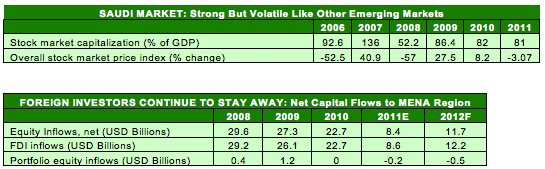
The size of the Tadawul, largest in the MENA region, is comparable to many emerging markets. Volume and value traded are also comparable to many emerging markets when measured as percent of market capitalization of the stock market, notes Mr. Khan.
The accrual of benefits of allowing foreign investors, which is a slow process, outweighs the concerns in medium to long term. Therefore, we believe that Saudi Arabian equity market is ready for foreign investors. However, it should be done in a calibrated manner so that the advent of large investors does not destabilize existing stakeholders.
alifarabia.com 2012