Remove oil from the Iraqi economy and you have a country that has weak governance, major insecurity and instability, fractious regional governments, massive corruption and high unemployment and poverty rates.
That is not illustrative of a country that is the world's third largest exporter of crude and expects to play a greater role in global oil markets, with hopes of rivaling Saudi Arabia in the future.
Iraq's economy is set to grow at 9% this year - it's highest in four years on the back of rising crude exports, but non-oil GDP will grow at a much slower pace of 6%.
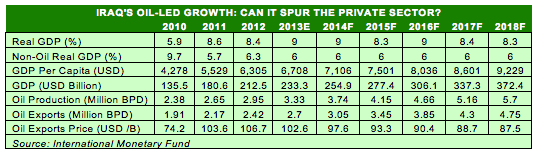
And while oil GDP is set to grow between 8-9% over the next five years, the non-hydrocarbons sector will remain at 6% during the period.
These are not impressive figure especially when you consider that Iraqi oil production is set to nearly double from 2.95 million barrels per day in 2012 to 5.70 million bpd by 2018, according to the International Energy Agency (IEA).
But the robust growth will be tempered by a lackluster private sector and a bloated public sector.
"With an economy dominated by oil production and public spending, the authorities will need to focus on creating an enabling environment for private-sector development," said the International Monetary Fund (IMF) in its latest report on the country." A stronger financial system, better business environment, and a far-reaching structural reform plan can boost private-sector activity and employment."
Sansar Capital report notes that Iraq remains one of the most difficult places to conduct business and is often ranked high on corruption indices.
"Corporate governance at most publicly traded companies is poor and regulatory oversight weak; anecdotal examples of management teams serving their own self-interest at the expense of other stakeholders remain abundant," said the Singapore-based company that invests in Iraq and other emerging markets.
"In such an environment, investors are cautioned to carry out extensive due-diligence including having on the ground presence in Iraq."
UNDERBANKED
Banks, which are the backbone of economies, remain weak and suffer from poor governance. The country is also one of the most underbanked in the world, with almost 80% of Iraq's 35 million people without a bank account.
Not surprisingly, Iraq's total banking assets stand at 77% of GDP, compared to 130% in the Middle East and North Africa region, with total credit estimated to be around 29% of GDP, compared to 55% in the wider region. Two state-owned banks -Rafidain Bank and Rasheed Bank - dominate the sector. In addition, both are in dire need of restructuring, says the International Monetary Fund.
"Development of the private banking sector requires leveling the playing field with
state-owned banks," said the IMF. "Options include opening up the market for trade finance for government imports and allowing private banks to honor customers' checks to the government."
Citibank Group and Standard Chartered Bank recently established a presence in the country which suggests that change is afoot.
"Iraq is an important market, with an economy that has substantial potential over time. Having a presence in Iraq will position us to better attune our services to the banking needs of our clients as they grow and develop their businesses in the country," said James Cowles, the bank's chief executive for Europe, Middle East and Africa. "It will also help us to provide liaison functions for Citi's clients globally and contribute to the development of Iraq's banking and capital market."
However, international banks are focused on servicing the oil companies rather than on the retail sector which remains undeveloped. Recently, HSBC sold its 70% stake in a local bank, which suggests Iraq still remains a long-term bet for most financial services institutions.
GOVERNMENT JOBS
The private sector's development is crucial as the public sector is straining to absorb the waves of young Iraqis joining the labor force.
The government absorbed 40% of the workforce last year, compared to 31% in 2007, which suggests increasing Iraqi dependence on the public sector. The Iraqi government hired 120,000 of its citizens last year alone.
"The public sector is reaching the limits of absorptive capacity to employ new workers, and that a new model for employment growth is needed. For example, in 2013, the ILO [International Labor Organization] projects about 300,000 new entrants in the labor force, while the authorities expect the public sector to hire about 150,000 new employees, and only 130,000 are projected to be taken in by the private sector."
Iraqis, however, are increasingly feeling entitled that government should provide them jobs as part of sharing the crude oil wealth, which is a dangerous precedent to set.
Michael Rubin, an analyst who worked for the Pentagon during the American invasion of Iraq, says that, ironically, oil trade threatens Iraq's long-term health.
"Iraqi government officials privately acknowledge that every ministry could function with one-tenth of the staff. Most young Iraqi college graduates, however, aspire to a safe government post rather than take a chance in the private sector," he wrote in a recent commentary. "Entrepreneurship is still frowned upon in many families. The result is that the majority of Iraq's oil income goes to salaries, but not to basic infrastructure."
But for all its generosity, Iraq's youth unemployment remains considerably high and expected to rise as 41% of the population is under the age of 15.
As we have seen in other Arab states, unemployment and lack of opportunities are the breeding grounds for unrest and social dissension.
But it's unclear whether Nour Al-Maliki's government is up to the task. With Iraq's economy set to propel over the next few years, the government will have to find efficient and effective ways to use the fiscal bounty for the benefit of the beleaguered Iraqi people.
'[IMF] directors emphasized that fostering growth in the private non-oil sector requires improving the business environment, investing in infrastructure and social capital, reforming state-owned enterprises, and enhancing public service delivery. Judicious use of the country's oil wealth can help address these pressing challenges."
© alifarabia.com 2013