Iraq ramped up oil production to a 35-year high last month despite a worsening security situation and political standoffs in the country, but experts said more investment was needed if Iraq wants to realize ambitious output targets.
After many false starts, one of the major bottlenecks at Iraq's southern terminals was finally removed, allowing a long-awaited increase in exports to materialize.
"Whether this gain can be extended or even sustained is an open question, as Baghdad continues to face formidable above-ground challenges. But the latest spike in Iraqi exports proves that even in the face of these obstacles, Iraq's huge potential as supplier cannot be dismissed," the International Energy Agency (IEA) said in its monthly report.
Output jumped to 3.62 million barrels per day in February, near Iraq's production capacity of 3.65 million bpd, and impressively higher than 3.13 million bpd in December.
Crude oil exports soared by 572,000 bpd to reach 2.8 million bpd in February.
"The exceptional increase in February's exports has been an unexpected boost for the country, which has struggled to meet production targets over the past five years," the IEA said.
Iraq aims to export 3.4 million bpd this year, including 400,000 bpd from the Kurdistan Regional Government.
The IEA believes the country is targeting production of four million bpd once domestic use at refineries and crude burned at power plants is factored in.
UNDER-INVESTMENT
Increased export capacity and the start-up of new production from West Qurna 2, Majnoon and Halfaya oil fields is expected to add 500,000 bpd by the end of the year.
But skeptics believe the four-million-bpd target is optimistic.
"Iraq continues to struggle with chronic problems expanding its capacity, in large part due to limited institutional capacity to manage its ambitious plans," the IEA noted.
Iraq continues to suffer from under-investment in the all-important oil and gas sector due to political risks.
"Recent investments have gone some way to alleviating some specific problems at choke points, but significantly more investment is needed both in production and export facilities, if Iraq is going to be producing anywhere near its target," said Thomas Pugh, commodities economist at Capital Economics, noting that the country is aiming for a 9-million bpd production target by 2020.
"Of course, installing all of the necessary infrastructure to reach the target will take a considerable amount of time, most likely much longer than the six years to 2020."
Despite reaching a revenue sharing deal with the autonomous Kurdistan government late last year, International Oil Companies (IOCs) still face huge amounts of bureaucracy and lengthy delays, preventing investment.
"What's more, even after sweetening its production terms, the deals on offer to IOCs in Iraq are not as lucrative as those offered by rival Iran," Pugh noted.
Parliamentary elections due to be held in April are expected to see the reappointment of Prime Minister Nouri al-Maliki, but building a coalition could be an arduous process, which will likely cause further delays to project timelines.
POLITICAL CHAOS
Iraq's April 30 elections could push the country to the brink of another civil war, says Alia Moubayed, analyst at Barclays Capital.
Nearly 9,000 people were killed in Iraq in 2013, the bloodiest year since 2008. This year has witnessed 2,688 deaths even before the end of March.
"The upcoming April elections could add to the volatility," Mouobayed wrote in Barclay's latest quarterly report on the country. "In many respects, the 2010 elections helped steer Iraq onto its current negative political and security trajectory."
Violence in the province of Anbar and across Iraq continues unabated. Anbar was ground zero of the armed resistance against U.S. occupation of Iraq, and the Sunni-majority province continues to remain opposed to Maliki's administration.
Capitalising on the chaos, militant group Islamic State of Iraq and Al Sham seized control of Fallujah and Ramadi, the province's largest cities, opening a new flashpoint in the troubled country.
Maliki has been heavily criticized for allegedly waging a political campaign against rival Sunni politicians in the run-up to, and aftermath of, the controversial 2010 polls.
His opponents have also accused him of failing to honour the terms of the power-sharing agreement that allowed him to secure a second term in office even though his coalition did not win the most seats in parliament, Moubyaed notes.
BUDGET LAW DELAYS
Political standoffs have delayed the passing of the 2014budget. Approval will require addressing the stand-off between Baghdad and the semi-autonomous Kurdistan Regional Government over oil exports.
The Kurdish Alliance party says the Kurdistan Regional Government has still not received the 17% share of budget revenues, which it is owed in return for the sale of its oil exports. KRG believes it is due USD 10 billion, but Baghdad contends that the KRG owes the federal government USD 24 billion.
Iraq's 2014 budget aims at USD 141 billion in spending -- 16.4% higher than the previous year. Revenue, however, are estimated at USD 119.7 billion, on the assumption that the country will sell 3.4 million bpd of crude oil.
The budget also assumes that 400,000 bpd would be exported by KRG, compared with 250,000 bpd registered in 2013, something that the KA and other Kurdish parties contest.
Kurdish parliamentarians, among others, also question the state's General Budget Law for 2014.
The draft law stipulates that all Iraqi oil revenues, including from Kurdistan's oil sales, should be deposited in the Development Funds of Iraq (DFI) in the U.S. and be sold through the State Owned Marketing Organization (SOMO).
"While the KRG's PM offered on 20 March to send 100,000 bpd of Kurdish oil through SOMO as of 1 April 2014, in an attempt to appease Baghdad's authorities, we remain skeptical about further progress on the general framework agreement on the management of the hydrocarbon sector," Moubayed concluded.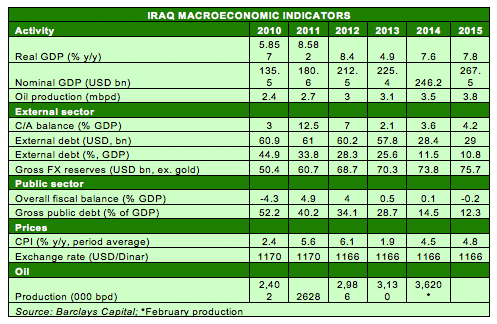
The feature was produced by alifarabia.com exclusively for zawya.com.
© Zawya 2014