Wednesday, Jan 25, 2012
  By Neena Rai
  Of DOW JONES NEWSWIRES
LONDON (Dow Jones)--Iran's threat to block the Strait of Hormuz--the gateway to the Persian Gulf--could disrupt food supplies to the Middle East by forcing countries in the region to seek more expensive, less convenient sources of commodities, analysts and traders have said.
Rising food prices were partly blamed for sparking the unrest in the region--known as the Arab Spring--last year that saw the leaders of Tunisia, Egypt and Libya fall. The countries bordering the Persian Gulf--in particular Iraq--rely on grain supplies usually shipped through this route.
Iran, the world's fourth-largest oil producer, has threatened to block the strait in retaliation for global powers imposing sanctions on the country including its oil industry over its nuclear activities.
"Iran is relatively self-sufficient when it comes to importing wheat and only really needs to import the grain in exceptional cases," says Nick Higgins, grains analyst at Rabobank. "Iran can import from the Caspian Sea, via port Bandar Anzali, thus the blocking of the strait hampers Iraq much more than itself."
Iraq has just one port, Um Qasr, in the Persian Gulf. Iraq is forecast to import 1.3 million metric tons of rice and 3.6 million tons of wheat through Um Qasr in the 2011-12 crop year, according to the London-based International Grains Council.
"Given a potential closure, the issue for Iraq would be sourcing its rice, which comes currently from Thailand and India," Higgins told Dow Jones Newswires.
Grain traders agree that it would be more inconvenient for Iraq to get its food supplies if the route is blocked.
"The biggest problem for Iraq would be the extra time needed to source food, if it could not use its own deep sea port," a Geneva-based major grains trader told Dow Jones. "Of course, Iraq can source food via Turkey and through Jordan's Aqaba port, but this takes much longer. Let's not forget that Iraq predominantly imports Canadian, U.S. and Australian wheat all via the strait," he added.
Abdolreza Abbassian, a grains analyst at the United Nations Food and Agriculture Organization, agrees that in the event of a closure, the main inconvenience to Iraq would be the longer distances the food would have to travel.
International shipping companies operating in the area agree that a closure of the strait could severely disrupt food supplies to neighboring countries.
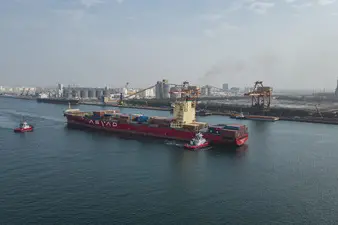
"The Strait of Hormuz is, of course, a very important way to get goods in and out of the region. Any alternatives would be determined by how much of the strait was closed, but would be overland, linking to other ports," says a spokesman for AP Moeller-Maersk, owner of Maersk Line. Maersk Line, which operates through the strait to and from the port of Jebel Ali in the United Arab Emirates, said the port acts as a transshipment hub for the region, so cargo entering the port is dispersed all over the Middle East.
As an alternative, "UAE cargo could be trucked via [the Omani port of] Salalah or go via Fujairah [in the UAE] on the eastern side of the strait. Saudi cargo could potentially go overland via Jeddah, but those are the less than ideal alternatives, Maersk added.
-By Neena Rai, Dow Jones Newswires; 4420-7842-9450; neena.rai@dowjones.com.
(END) Dow Jones Newswires
25-01-12 1803GMT