The Egyptian economy appears to be freefalling as crisis after crisis seems to chip away at business confidence.
The country's purchasing manager's index (PMI) fell to 37 last December, and the survey continued to point to a decline in jobs, new orders and output.
"The situation in Egypt has materially worsened over the first quarter of 2013," said Simon Williams, analyst at HSBC. "With parliamentary elections being called, but then cancelled following a judicial decree rejecting the legal framework, the transition process remains stalled, as economic conditions worsen and the window for recovery narrows."
This is why the USD 4.8-billion loan from the International Monetary Fund is crucial for Egypt to restore confidence in the economy.
IMF officials are currently in Egypt and insist on tax increases and cutting subsidies before they extend the loan. Expect the IMF to be even more stringent if Egypt looks to increase the loan amount.
While planning minister Ashraf Al-Araby is expecting a deal within two weeks, market observers are less optimistic especially before parliamentary elections are called and a fully functional government is in place to take tough economic measures.
That may not happen till the fourth quarter of the year, which means the Egyptian economy could remain stuck in a limbo.
"With a fluid electoral timeline, uncertain domestic political scene and likely continued secular opposition boycott, we still do not sense a credible political commitment behind the reforms necessary for an IMF-SBA arrangement in the run-up to parliamentary elections," wrote Jean-Michel Saliba, analyst at Bank of America Merrill Lynch, after meeting with the Freedom and Justice Party (FJP) officials, which has strong ties to the Muslim Brotherhood.
In the interim, the Egyptian pound will continue to fall fuelling a black foreign exchange market.
"The result has been a weaker pound and dollar shortages, which have further hampered economic activity and boosted inflation," said HSBC's Williams. "Although we have cut our currency forecast to EGP 7.5/USD 1 by end-2013 (a 10% drop from the mid-March rate) the risks appear on the downside."
The authorities' decision to raise the price of cooking gas days before the IMF officials' visit, suggests that president Mohammad Morsi's government is tentatively looking to implement some politically sensitive reforms.
But the IMF has given the authorities a long laundry list, including sales tax on key items such as tobacco, alcoholic and non-alcoholic beverages, cement, steel and mobile phones. In addition a property tax and implementation of other energy subsidies could come as early as the first half of the year.
Morsi's risks
The IMF expects Egypt's economy to grow by 3% last year, while the HSBC expects half that growth, given Egypt's travails since IMF made that prediction five months ago.
The economy grew by a mere 2% last year, a far cry from the robust days of Hosni Mubarak when growth annually reached 7% for much of the past decade.
International reserves had fallen to USD 15 billion by the end of 2012, less than half of the USD 36 billion it boasted before the revolution.
Loans from Gulf states, especially Qatar, has helped prop up the Egyptian pound, but it has been tough going.
"On a cumulative basis, the Central Bank of Egypt has spent more than USD 22 billion since the uprising in January 2011 in the aim of containing the fall of the local currency," notes Marwan S. Barakat, analyst at Bank Audi in a research note.
While tourism arrivals picked up last year, with 11.5 million visitors, the country has yet to see the peaks of 2010 when visitor arrivals reached 15.76 million. The Suez Canal revenues dropped 2.5% as the Eurozone crisis meant lethargic growth in global trade.
While the economic situation is grim, the political system was no better. President Morsi has managed to permanently upset liberal groups and the security situation has deteriorated as Egyptian frustration spills on to the streets.
An IMF deal is crucial to help Egypt return to form and ease the pressure faced by the government from virtually all quarters.
In the absence of a "Plan B", the IMF may be able to force the Egyptian government's hand, according to the BAML analyst.
"We remain skeptical that sizeable additional bilateral aid can be secured in the near-term from Arab states, including Iraq, Libya or Qatar, while the M&A pipeline appears rich but prone to delay due to litigation or regulatory hurdles, in our view," said Saliba.
The transfer of USD 190 million budgetary aid from the US and the finalization of QNB takeover (USD 500 million in inflows), the OCI, EFG-Hermes deals could bring in USD 1.2 billion, which may help tide things over.
"There is some scope for believing that political consensus can be achieved through sheer necessity to allow the USD 4.8 billion IMF deal to be done," said HSBC's Williams. "If it is not, the already tough economic situation could yet get materially worse."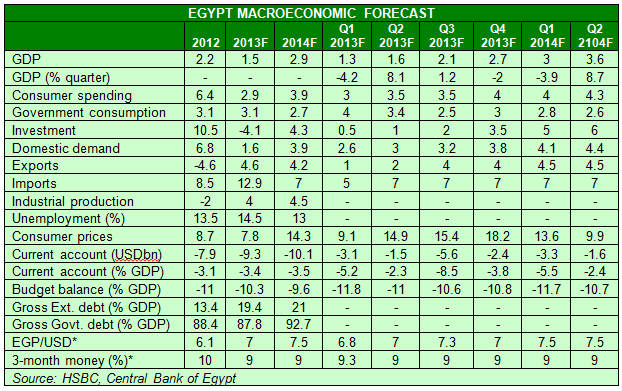
© alifarabia.com 2013