African countries have seen the greatest incidences of corruption, according to the latest survey by Transparency International (TI).
Of course, corruption is not only purely an African phenomenon: TI's latest Global Corruption Barometer 2013 shows globally more than one person in two thinks corruption has risen over the past two years.
One in every four people surveyed around the world said they had paid a bribe in the past 12 months. The fact that the survey spanned a massive 114,000 people across 107 countries highlights the scale and depth of the problem across the world.
"The Global Corruption Barometer 2013 also found that in too many countries the institutions people rely on to fight corruption and other crime are themselves not trusted," TI noted.
"Thirty-six countries view police as the most corrupt, and in those countries an average of 53% of people had been asked to pay a bribe to the police. Twenty countries view the judiciary as the most corrupt, and in those countries an average of 30% of the people who had come in contact with the judicial systems had been asked to pay a bribe."
African countries have been at the forefront, unfortunately, and reveal some of the highest incidences of corruption.
More than three out of every four people surveyed in Sierra Leone and Liberia said they had paid a bribe in the past year - the only two countries in the world with such a high rate of bribery.
Between 50-74.9% of residents in Cameroon, Ghana, Kenya. Libya, Mozambique, Senegal, Tanzania, Uganda and Zimbabwe confessed to offering bribes to get their tasks accomplished. The only other non-African states in that category were Cambodia, India and Yemen.
Other African states such as Algeria, Democratic Republic of Congo, Ethiopia, Morocco, Nigeria and South Africa also showed high incidences of corruption.
The one exception in an otherwise gloomy picture for Africa was Rwanda, where residents reported the least amount of corruption.
BRIBERY INDEX
The problem in Africa is so endemic that TI created a separate East African Bribery Index in 2009. The latest report showed Uganda faring the worst in the five-country survey, with bribery levels of 40.7%.
Burundi recorded a significantly lower index of 18.8%, Tanzania recorded 39.1%. Kenya was at 29.5%, while Rwanda also scored high in that survey, with an aggregate index of 2.5%.
"Rwanda also registered the best future outlook with 80.1% observing that corruption levels will decrease in the next one year," TI said in its report.
"Ugandan respondents had the worst future viewpoint with 50.4% observing that corruption levels will rise in the coming one year. 31% of respondents from Kenya said they expected corruption to decrease in the next 12 months."
MORE TRANSPARENCY
"When governments are more transparent, their countries are not only less prone to corruption, they are also more likely to enjoy higher levels of human development, stronger fiscal discipline and long-term economic growth," said the World Economic Forum in its Africa Progress Panel 2013 report.
"Moreover, greater transparency is affordable, unlikely to do harm and an important goal in its own right. The bad news is that most resource-rich countries in Africa score poorly on most indexes of transparency in managing natural resources."
Last year, Revenue Watch and Transparency International conducted a report on transparency in major national oil and gas companies in the world, which highlighted the scale of problem among African state-owned companies.
Equatorial Guinea's GEPetrol, Angola's Sonangol, Nigeria's National Petroleum Corporation and Republic of Congo's Socit Nationale des Ptroles du Congo, scored a big fat zero for not implementing any anti-corruption measures.
Indeed, NNPC, GEPetrol and SNPC received the lowest score on institutional disclosures in the survey.
Even international companies contributed to the global endemic. Canadian giant SNC Lavalin, for example, has been accused of paying bribes of USD 160 million to secure contracts in Libya.
Canadian and Swiss authorities raided the engineering company's headquarters in 2012, after it was alleged that company employees had paid million including luxury yachts to the son of the late dictator Muammar Gaddafi.
"The analysis by Revenue Watch and Transparency International also highlights the broader global governance deficit in some oil companies that are major investors in Africa," noted the World Economic Forum report.
"When opaque African companies are linked to opaque Western and emerging market multinationals, the risk of corruption is greatly increased."
TOP-DOWN APPROACH
Transparency will have to start from the highest echelons of government, but too often that is not the case.
Government budgets and strategies of major state-owned corporations are often opaque and secretive. The Open Budget Index's (OBI) latest ranking shows countries like Equatorial Guinea, Benin, Chad, Niger and Zambia had among the most opaque budgets in the world.
"Equatorial Guinea's score indicates that the government provides the public with no information on the national government's budget and financial activities during the course of the budget year. This makes it challenging for citizens to hold the government accountable for its management of the public's money," the OBI said in its survey.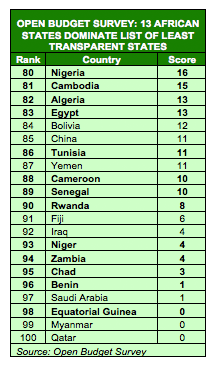
Many African governments understand that the corruption epidemic is a job-killer, and can deprive their most vulnerable of citizens their rights.
It is also deemed as a great weakness when governments seek international financing or attract multinational corporations.
Greater transparency is crucial for Africa to lift the continent's citizens out of poverty and ensure greater social stability in the region.
alifarabia.com 2013