Gulf banks are showing renewed confidence and are hungry for acquisitions, especially as Western banks retreat.
Assets of the 22 major Gulf banks tracked by Global Investment House rose 12.7% during the fourth quarter in 2012 to reach USD 938.3 billion.
"Qatar-based banks witnessed the strongest increase in total assets (up 18.1% to USD 174.8 billion), followed by banks in Kuwait (up 15.3%) and KSA (up 12.2% year-on-year)," wrote Faisal Hasan and Naveed Ahmed, analysts at Global. "UAE banks witnessed the smallest increase, with asset base expanding 9.1% year-on-year due to subdued growth in loan book."
Meanwhile, net earnings of the surveyed banks rose 14.9% to USD 4 billion in the last quarter, due to higher revenues and lower provisioning expenses. UAE banks saw the biggest jump in profits to 43.1% in the fourth quarter, while Kuwait saw a 25.4% jump, the Kuwait-based bank said.
Profits of National Bank of Abu Dhabi soared 54.7% as investment rose and provision costs declined. Net profits of Emirates NBD tripled in the last quarter compared to the same period in 2011.
"Other banks in the GCC region that reported strong growth in profits include Abu Dhabi Commercial Bank (up 19.2%), Banque Saudi Fransi (up 22.2%), Saudi British Bank (up 24.4%), Saudi Hollandi Bank (up 35.5%), Kuwait Finance House (up 23.4%) and Commercial Bank of Qatar (up 18.9%)."
Indeed, provisions, which had weighed down many Gulf banks after the global financial crisis, saw a huge decline. UAE and Kuwaiti banks, which had been waylaid by provisions in previous quarters, saw their biggest declines in the region. Collectively, Kuwaiti banks saw a 28% drop in provisioning, while UAE saw a 27.7%, far eclipsing the 21.6% of Gulf banks.
The banks have been able to repair their balance sheets as confidence returns to the Gulf economies and regional governments pour funds in infrastructure development.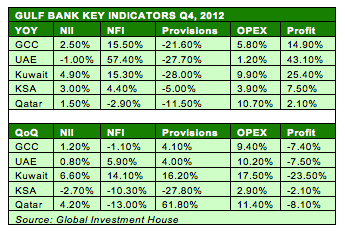
Emboldened by their prospects, Emirates NBD is seeking a bond sale to repay the USD 3.4-billion bond it secured from the government during the global financial crisis. Dubai's largest bank by assets is also seeking to increase its profits from its overseas business and diversify away from exposure to a single market.
Fitch Ratings says it is witnessing "a sharp increase" in GCC banks looking to issue subordinated debt in the international markets.
"It is worth highlighting that Fitch's ratings for GCC banks' subordinated debt often factor in a high probability that sovereign support will be available for this debt class if and when required. Expect an increase in subordinated debts from Gulf banks," said the ratings agency.
M&A hungry
Standard & Poor's forecast of an average 4.6% GDP growth in the GCC for 2013 should keep demand for bank credit high and expand banks' earnings.
"We believe strong bank lending, on the back of corporate and infrastructure growth, will help expand revenues of banks in Saudi Arabia, and Qatar," said Standard & Poor's credit analyst Timucin Engin. "Specifically, we expect average lending growth to remain above 10% level for Saudi Arabia."
The regional banking sector's growing confidence coincides with a loss of appetite among Western and European banks who are reeling from a credit crisis in their home territories.
Cyprus's latest fiscal debt debacle underscores the fact that the European Union remains a long way away from recovery and the continent's banks will continue to deleverage their balance sheets and offload assets to comply with stricter banking regulations.
S&P expects the EU banking sector's deleveraging to continue for years, creating opportunities for Gulf banks.
"Banks in the Gulf are tempted by the large and young populations of Egypt, Turkey, and in Asian countries such as Indonesia," said S&P's Engin. "These are also countries with visibly lower bank penetration, which signals long-term growth opportunities."
Bargain shopping
Nearly a third of the M&A in the region were focused on financial service sector, as Gulf banks picked up bargains.
Qatar National Bank picked up a 77.2% stake in Socit Gnrale's Egyptian unit, while Emirates NBD bought out BNP Paribas' Egyptian subsidiary last year.
The Turkish financial services sector was also popular among Gulf banks, with Qatar's Commercial Bank taking a controlling stake in Turkey's Alternatifbank, while Kuwait's Burgan Bank bought Eurobank Tekfen and picked up a 25% stake in FimBank in Malta.
Fuelled by low borrowing costs and declining valuations, Gulf banks find themselves in a buyer's market.
"The declining prices for bank stakes in emerging markets are a further buying incentive for Gulf banks," Engin said.
"But now it's a buyer's market, which the prices for announced and completed transactions last year illustrate. The number of potential buyers has dropped because major European banks are now trying to shed assets instead of buying more, and there are a significant number of sellers."
This became evident when Burgan Bank paid 0.9 times over the book value of Eurobank Tekfen last year, compared to the 3.5 times paid for similar Turkish banking assets prior to the 2008 crisis.
Meanwhile, Qatar National Bank refused to pay a steep price for Turkish bank Denizbank, which was eventually picked up by Russia's Sberbank, at 1.4 times the book value. Four years ago, Saudi Arabia's National Commercial Bank had paid 3.5 times the value of Turkiye Finans Katilim Bankasi AS four years ago.
"In Egypt, the last major transaction before the crisis was the acquisition of a majority stake in Al Watany Bank by National Bank of Kuwait at an implied trailing to book price of greater than 4x, whereas QNB is paying an implied equity to book value of about 2x for National Socit Gnrale Bank SAE, the Egyptian subsidiary of the French lender Socit Gnrale in December 2012."
Lessons from telecom
While regional banks are seeking assets abroad, there is a danger that their foreign operations could weigh on their balance sheets.
As their telecom counterparts can testify, operating in a comfortable home environment does not prepare companies to operate in foreign jurisdictions. Most Gulf banks are cushioned by extensive government support at home, but they will not be afforded that luxury abroad.
"We question whether Gulf banks would be able to continue to generate risk-adjusted returns that are on a par with those at home. Gulf banks traditionally feature high returns because of the limited competition, high margins, low cost of labor and the absence of taxation."
In fact acquisition in higher risk markets such as Egypt could weigh on capital requirements.
"Depending on the size of the acquisitions, and how well these new assets will be managed over the next few years, we might see an increase in the contribution of revenues from overseas for some banks," said Engin.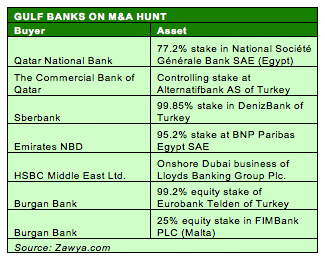
alifarabia.com 2013