Ask any gold investor and he will lament that gold is undervalued. It should actually be anywhere between USD2,000 to USD10,000 per ounce, they say.
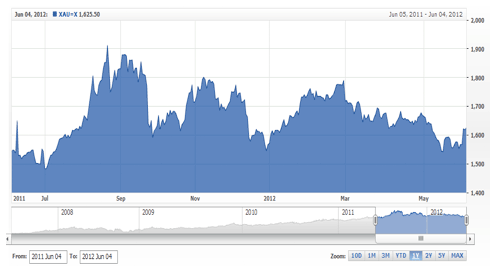
Much to the investors' dismay, gold actually fell 6% in May. Indeed, gold had only risen 1.4% in 12 months by the end of May, a disappointing performance after the sterling annual double-digital growth of the past decade.
But a sudden turn of economic events appears to have the yellow metal back in favour - but will it disappoint this time around.
While the Eurozone implodes, and American and Chinese economies slow down, gold should be soaring, but it isn't.
Source: Zawya.com
A key reason may be its relationship with the American dollar.
"Gold prices remain range bound despite the further strengthening of the dollar as macro worries and political uncertainties in Europe remain in the backdrop," wrote Sudakshina Unnikrishnan, an analyst with Barclays Capital.
Indeed funds have been flowing out of precious metal funds over the past month, suggesting that markets are treating gold as just another risky asset.
Julian Jessop, chief global economist at Capital Economics says gold's relationship with the American greenback is over done, arguing that the prior to the global financial crisis, the two had little correlation.
"A closer look at the same chart also makes it clear that the US monetary base has not been the sole driver of the price of gold," said Mr. Jessop. "Indeed, until the Fed began quantitative easing (QE) in the wake of the collapse of Lehman Brothers in 2008, there doesn't appear to be any relationship at all."
In addition, gold prices rose in the 1970s only to collapse in the 1980s, without any corresponding changes in the monetary base.
Indeed, the bull run of the last decade was triggered by demand from emerging markets, rise of exchange-traded funds and central bank sales, long before the economic events of 2008 shook the world.
BUYING GOLD AMIDST A EURO BREAK-UP
Mr. Jessop says that the market has been treating gold as a risky asset, and still seems 'sanguine' at the prospect of euro falling apart.
"We have suggested in the past that this may be because the markets have yet to focus fully on the possibility that the euro may actually break apart. But that position is increasingly hard to defend now that the potential exit of Greece has been a major talking point for weeks," says Mr. Jessop.
"Otherwise, confidence in the US dollar remains high due to the relative strength of the US economy and fading prospects of additional QE. Weaker demand for gold from some emerging economies, notably India, may also have played a part."
And even as Spanish and Italian credit default swaps have risen, gold has been falling - which could mean one of two things:
1) Gold is losing its status as a safe haven
2) Gold is set for a rebound.
Mr. Jessop favours the second interpretation: the extra uncertainty that would accompany the break-up of the euro should still be positive for the price of gold, as an asset whose value is not dependent on the creditworthiness of any government or financial institution.
"Additional monetary easing, whether from the Fed or other major central banks, should also help. In short, the failure of the gold price to advance in conditions which should already be positive may be undermining the case for further large gains, but the risks still appear skewed to the upside."
Meanwhile, legendary investor Marc Faber says investors must own gold even if there is a risk that it may trend downwards for a while to the USD1,522 per ounce it hit on December 29, 2011.
Mr. Faber recently noted in an interview that people say the price of gold is in a bubble stage, and is up substantially from the lows in 1999. However, as he remarks about conferences and speaking engagements, "I usually ask the audience, 'How many of you own gold?' Normally, hardly anyone owns it. I've been to conferences with thousands of people attending, and nobody owned any physical gold." A recent headline earlier in the week noted that more people own Apple stock than own physical gold.
A RETURN TO GLORY?
The yellow metal surged this month by 4.3% only to pull back again, but it suggests the precious metal may be showing signs of life.
Added to the EU fear is the United States' own 'fiscal cliff' that it's trundling towards by the end of the year.
"Financial conditions have tightened, and we think they would tighten further if the Fed were not to act at its June 19-20 meeting. Given our economic forecast we think the odds of additional Fed action at the June meeting are about 4 out of 5," says Morgan Stanley analyst Vincent Reinhart, who expects gold to average around USD1,825 per ounce in 2012 and USD2,175 in 2013.
With markets all over the place and gold vacillating between safe haven and risky assets, and analysts' opinion divided, the yellow metal remains an enigmatic investment instrument.
© alifarabia.com 2012