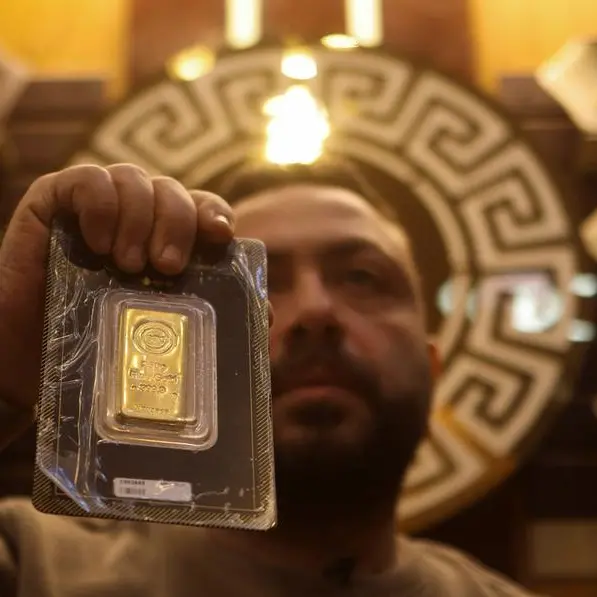
Gold bugs may be loving the favorable winds that are carrying the price of the yellow metal upwards, but few analysts believe that we are on the verge of a long-term surge.
Gold has been up 4.4% this year as the bottom fell out of emerging markets. Scared investors have piled into gold as the metal reprised its role as the safe haven of the global financial community.
"With US monetary policy a new headwind for EM current accounts and the risk of the crisis spreading to more and more countries, dollar-strength and risk aversion should continue to support gold volumes in the short-term," said Aakash Doshi, analyst at Citibank.
But this surge may not last too long, as other catalysts - such as Chinese demand - remain absent.
"Gold prices have proved resilient in the absence of the Chinese market, and speculative positioning has risen to a 12-week high," wrote Gayle Berry, analyst at Barclays Capital in a note to clients. "Despite the patches of improvement, without a more meaningful shift in investor sentiment, prices are likely to struggle to retain their gains."
But after taking a pounding for much of last year, some investors seem to be warming up to gold again.
Fund managers have raised their net bullish trades for the fifth consecutive week, by 40% week-on-week to 60,672 gold contracts, their highest level since mid-November and the largest weekly increase in these positions since July 2013, while hedge funds reduced shorts by 16% weak-on-week to 59,424 contracts.
But a clear direction is still not visible as exchange traded fund continued to shed their gold holdings by another 11 metric tons last week (or 353,608 oz.), with holdings of the SPDR Gold ETF -- the largest physically backed gold ETF -- falling by 7 MT (or 212,120 oz.) during the period.
INDIA OFFERS REPRIEVE
While the picture remains mixed, prices found support from comments made by India's finance minister that restrictions on gold imports can be reviewed by the end of March if the country gains control of its record current account deficit.
However, it is worth noting that the Reserve Bank of India (RBI), which enjoys a degree of independence from the country's government, is responsible for setting the rules on the re-exporting of gold.
Recent reports suggest that an RBI official has indicated that it is unlikely to review its rules until after the end of March. This leaves China as the main provider of physical support to the gold price in the near term.
GOLD GURU
Even Jim Rogers - the noted gold investor - is not as bullish on gold in the medium term.
"There are huge shorts that have developed in precious metals as you know. So, it's overdue for a rally. We had a big drop in 2013. Everybody got negative, everybody got short. So, we are going to have a rally," Rogers said in a recent interview.
"I would prefer silver to gold. I am not buying either at the moment. Silver is down 60% from its all-time high, gold is down 30-35% from its all-time high. But I won't buy just because they are down."
It could well be that gold is "oversold" and the current economic environment may help the metal find a floor.
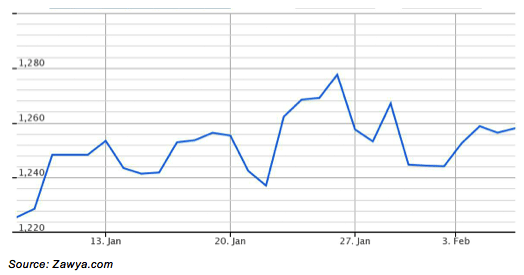
"We view physical demand for jewellery, bars, coins and industrial uses as being strong enough to support average prices above the USD 1,200/oz level in 2014," according to commodity research house GFMS, a unit of Thomson Reuters.
While investors focus on demand from China and India, there is less attention on supply side, which may also impact gold prices.
Recent strikes in South Africa, for example, could hold back production, especially if they escalate. In addition, many gold and mining companies are in the red and may spend 2014 deleveraging from their production commitments and focus on repairing their balance sheets.
GFMS expects gold production to increase by 6% this year, but producers may pull back if prices continue to slide.
"There is... little economic incentive for a surge of above ground stocks to enter the market should most mine supply begin operating at a loss," GFMS said. "Average all-in costs, excluding write downs, are estimated around USD 1,200/oz in 2013, a level not far off our first half price forecast of USD 1,233/oz in 2014."
The feature was produced by alifarabia.com exclusively for zawya.com.
© Zawya 2014