The UN Habitat has developed a brand new way to look at the liveability of global cities. Known as the City Prosperity Index and developed by UN-Habitat, this new model combines the five dimensions of prosperity, which includes environmental sustainability, equity and social inclusion, productivity and quality of life.
According to the UN's criteria, Amman emerges as the city with the region's highest prosperity, with Cairo and Casablanca. No other Arab cities featured in the list.
However, Alifarabia.com research extrapolated from UN Habitat data published in State of the World's Cities 2012-2013 - Prosperity of Cities, to determine the fastest-growing cities in the region in terms of population.
And the results were startling: Sanaa, in troubled Yemen is set to emerge as the fastest growing city in terms of population over the next three years.
Fast-growing populations, of course, don't necessarily translate into fast-growth and Yemen's Sanaa is a prime example as its population has grown 5.26% between 2205-2010, but its economy has been wracked by a crippling civil war.
But it is also true that cities can be investment magnets for an economy, and Sanaa could play a key role in rebuilding Yemen's infrastructure.
"So far, cities have been perceived as the 'engines' of national economies and there is no reason to depart from that view," the UN Habitat reports. "Indeed, urban authorities find themselves, at least notionally, in a position to boost production in the real sector of the economy at local level, with attendant employment and income generation."
In fact, UN Habitat believes cities could be the perfect remedy to ward off the global crisis the world finds itself in. "They provide ready, flexible and creative platforms that can mitigate the effects of regional and global crises in a pragmatic, balanced and efficient way.
"Cities can act as the fora where the linkages, trust, respect and inclusiveness that are part of any remedy to the crisis can be built. Acting locally in different areas and spaces, urban responses to the crisis can be structured and included in national agendas for more efficiency, with better chances of flexible responses and more beneficial effects."
SYRIAN DOMINANCE
While three Syrian cities are among the 10 fastest-growing cities in the region, a big question hangs over the growth of Hamma, Homs and Aleppo given the devastation the cities have borne over the past year. The Syrian regime has waged a bloody civil war against its restive population which has deeply scarred the nation psychologically, and the cities are unlikely to recover from the tragic deaths of its citizens.
Alternatively, a quick change in regime could lead to massive infrastructure and rebuilding needs that could accelerate growth in the three cities.
Most analysts believe the latter scenario is too rosy for a country that has had very few breaks in the past few decades.
Two Iraqi cities - Mosul and Irbil - also appear among the 10 fastest-growing Middle East metropolises in the region. Iraq is aggressively trying to rebuild the country and hoping that its oil revenues can fund investment.
The Iraqi government is looking to spend USD250-billion to USD275-billion over the next five years on infrastructure projects and to reduce unemployment, which stands at 15%.
Irbil is the capital of the autonomous Kurdistan Regional Government which is currently engaged in a bitter dispute with the Iraqi government over oil-sharing rights.
The KRG has styled itself as a peaceable region within the troubled Iraqi borders and has offered lucrative deals to international oil companies to exploits its hydrocarbon riches. Oil giants such as ExxonMobil, Chevron, Total and Gazprom have already bought assets to participate in the region's oil prospects.
Among Gulf cities, only Sharjah and Dubai are in the top 10. Both the emirate-cities are expected to see population growth of well over two-per cent till 2015, although they are set to achieve slower growth between 2016-2025 as both cities start maturing as metropolises.
Dubai and Sharjah have a symbiotic relationship and Sharjah has traditionally benefited from Dubai's boom and its success has historically spilled over into the neighbouring emirate. With Dubai making a strong recovery from its debt crisis, the two emirates are expected to match their population growths with economic growth.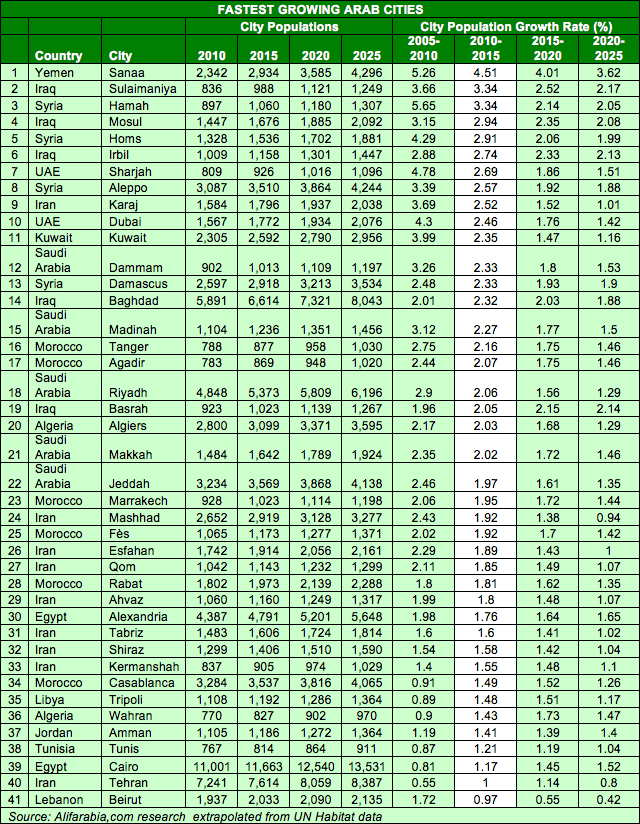
Arab cities also have the highest level of vehicle ownership, according to UN Habitat.
"Over the past two decades, the Arab region has witnessed phenomenal rises in motorization," the report notes. "In 2008, the total number of vehicles reached 26.7 million - growing at a 4.2% annual average between 1997 and 2008.31 In Bahrain, Kuwait, Qatar, the United Arab Emirates and Oman, the ratios of motor vehicles per 1,000 stand at 509, 507, 724, 313 and 225, respectively."
In fact, Dubai's ownership ratio of 541:1,000 exceeds those of London (345) and New York (444), according to UN Habitat estimates.
Interestingly, a number of cities are inexplicably missing. Doha, Abu Dhabi, Manama and Muscat have not made it to the list without any clear explanation.
PWC DATA
While Abu Dhabi was shunned in the UN Habitat list, it has emerged as the only Middle East city rife with opportunities, according to a PriceWaterHouseCooper;s survey.
"There are very few cities in the world with the financial resources of Abu Dhabi, which has already been able to bring its infrastructure up to developed-city levels," argues PWC in its recent report, which identifies 27 global cities such as Hong Kong, Shanghai and Moscow.
According to management consultancy, Cities of Opportunity 2012 analyzes the trajectory of 27 cities, all capitals of finance, commerce, and culture -- and through their current performance seeks to open a window on what makes cities function best.
Abu Dhabi is ranked 22nd city of opportunity and has done well in the category of health and security and costs. However, the UAE capital was considered last among 27 nations as a transportation and connectivity hub, which shows that it still has a long way to go despite Etihad Airways efforts to transform Abu Dhabi into a global connecting hub.
Western-bias in such surveys was once again apparent as New York emerged as the top city of opportunity, but was given a strong challenge by London. Both cities - unequivocally two of the most important financial centres in the world - have struggled with the global financial crisis, with London especially losing a lot of influence over the past few years.
However, the tide seems to be turning in favour of emerging markets.
"The two Chinese cities move to the top 5 in economic clout and city gateway along with London, Paris, and New York. Balanced progress across a range of social and economic indicators represents the next step for Shanghai and Beijing in transforming exceptional growth into sustainable performance at the top tier of world capitals."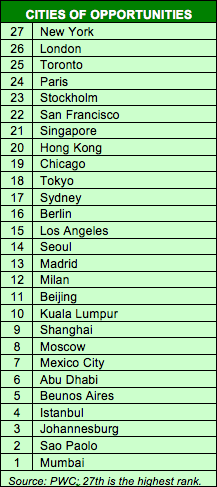
PWC says these cities will need to invest heavily to maintain their population and employment growth.
Shanghai and Beijing will need to invest what represents 42% of their GDP just to satisfy forecast growth from 2012 to 2025. For Mumbai, it's 35%. London, by contrast, only requires 17% and Stockholm 19% to meet the forecast of investment spending relative to growth."
PWC does make a special mention of Dubai, highlighting its debt crisis and suggesting that the city could return to its fold as a 'City of Opportunity as it has recovered from the global financial crisis far better than other similar cities such as Dublin and Athens.
PWC says even though Dubai lost thousands of jobs during the global financial crisis, it projects the emirate will create 45,000 jobs annually till 2025.
The reasons for this relatively benign employment environment are unique to Dubai, says PWC.
"First of all, despite (or perhaps because of) Abu Dhabi's financial intervention, whatever marginal job loss occurred during the city's crisis was made up by increased hiring in the public sector, which added more than 61,000 jobs between 2008 and 2010. Moreover, and as counterintuitive as it may appear, although the city's troubles originated in the real estate sector, employment in construction has actually grown, by roughly 37,000 jobs during the same period."
© alifarabia.com 2012