Kenya appears set to issue its debut USD 2 billion Eurobond before June, as the government looks to capitalize on favorable fiscal conditions and the prospects of middle-income status after a GDP revision.
The bond was delayed due to market volatility, but Oyin Anubi, an analyst at Bank of America Merrill Lynch, believes the government will launch the bond before the end of the financial year, which will be this summer.
"Around USD 600 million will be used to refinance an outstanding syndicated loan, with the remainder going to fund the budget," Anubi said in a note after a meeting with Kenyan government officials.
Kenyan officials have indicated they will recalculate gross domestic product by changing the base year from 2001 to 2009 and release the data in September.
BAML estimates Kenya's GDP may rise 20%. The Kenya National Bureau of Statistics said GDP is expected to grow from USD 41.6 billion in 2013 to USD 50 billion. GDP per capita would rise from USD 943 to USD 1,136 - transforming the country into a middle-income status, according to the World Bank benchmark.
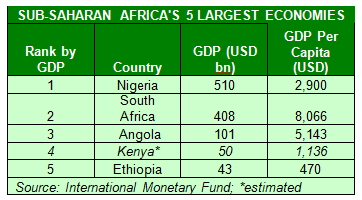
The new figures would make Kenya the fourth largest economy in the Sub-Saharan African region, adding to its status as East Africa's regional hub. The country will join other African middle-income status countries such as Ghana, Cameroon, Ivory Coast, Botswana and Senegal.
"The new data are due in September and should better reflect the growth contribution of services, especially telecommunications, which has been boosted by the mobile money system M-Pesa," BAML said. "The M-Pesa systems handles around KES 2 billion (USD 23 million) of transactions every day."
Last month, Nigeria doubled its economy by rebasing its GDP and is now the largest economy in Africa, overtaking South Africa, which has long held that title.
Kenya's middle-income status would also allow the company to access new funding channels and raise the country's economic profile.
ON A HIGH
The International Monetary Fund expects the country's GDP to average 6.3% this year and the next, beating the Sub-Saharan Africa average of 5.4%.
Uhuru Kenyatta's election as president last year was off to a shaky start due to his case in the International Court of Crime in Hague, which had led to anxiety among many Western nations, but nerves have since calmed down.
"The perceived weakening of the cases in The Hague will improve president Uhuru Kenyatta's core team's focus on domestic issues as the budget drafting process heats up, and we expect the government will likely hold firm on a payroll audit and incremental cuts to central government personnel as it continues to prepare for an inaugural Eurobond launch," said Eurasia Group, which has a positive short-term and long-term outlook for the country.
Barclays Capital also believes the Kenyan economy continues to strengthen despite numerous challenges, including still-large twin deficits.
Sectors such as power, trade, construction and financial services have been performing strongly in recent quarters while key exports such as tea, vegetable and sugarcane have done well. However, coffee production declined.
The tourism sector was down 10% in the first three quarters of the year, following terrorist attack on a mall in Nairobi that froze tourist arrivals for a period of time.
"Along with the anticipated improved external sector performance, the ongoing focus on expanding infrastructure and the accommodative monetary policy environment will lend further support to growth," according to Ridle Markus, analyst with Barclays Capital.
KEY VULNERABILITIES AND RISKS
Downside risks include the security environment and the country's narrow export base (predominantly agricultural), while volatile weather conditions and global growth (if it disappoints) remain key threats, the analyst said.
Other key vulnerabilities for the economy are the twin deficit. While the current account deficit has contacted from 10.5% of GDP in 2012 to 8.1% in 2013, some key sectors such as agriculture and manufacturing remain under pressure.
"Export data for the twelve months to October 2013 show a 4% y/y decline, while imports rose 1% amid still-strong imports of manufactured goods and capital goods. We expect the current account deficit to rise to 10.5% of GDP in 2014 in the wake of continued strong capital goods imports," Barclays said.
In addition, the system of devolved government is uncertain and could be a costly program. Lack of clarity and clear guidelines on responsibilities and right of national and state governments has led to complications and with nearly a quarter of total central government revenue being spent on devolution.
"Ultimately, we believe that the system of devolved government is likely to be costly should systems to ensure accountability fail. This could, in view of the IMF, derail fiscal discipline and erode the recent success toward gradual consolidation leaving lower buffers to deal with adverse shocks".
"Major spending pressures emanating from devolution have caused authorities to adjust the deficit for FY2013-14 upwards to 8.7% of GDP from the initial 7.9%," Markus noted. "Still, we believe upside risk remains to the FY2013-4 deficit target. The government is considering the Eurobond, domestic borrowing and multilateral support to finance the deficit."
The Kenyan authorities may also go back to the IMF to seek another Extended Credit Facility Programme when the current program ends at the end of the year.
POVERTY LEVELS
While Kenya seems poised to achieve middle-income status, poverty levels remain high, although authorities have bring them down from the past decade.
The IMF estimates poverty levels to have fallen from 39% in 2012, compared to 47% in 2005 among a population of 43 million.
"This is driven by a decade of sustained positive economic growth, combined with improvements in safety nets and migration from rural to urban areas," the IMF said in a report. "The continuing structural economic shift from agriculture to services and sustained economic growth in Nairobi and its expanding suburban areas have been particularly important drivers to lower poverty rates."
Inequality remains high in Kenya compared to neighboring Uganda and Tanzania, and the authorities are looking to create jobs for 1 million people to close the inequality gap.
"This transformation is to be achieved through investment in physical infrastructure (including ICT and science) and human capital, as well as through reforms in the public sector, security, land, education and drought risk management," the IMF noted in a March report.
"The areas of reform are well identified overall. However, prioritization may be warranted both across and within the proposed areas. The strategy's aim is that the proposed reforms for national transformation would lead to higher employment, as well as increased productivity through more formal employment."
Kenya is in the midst of transformative boom and this year could see the country climb the income ladder and attain middle-income status. But the authorities need to ensure all Kenyans feel the benefit of this elevated rank.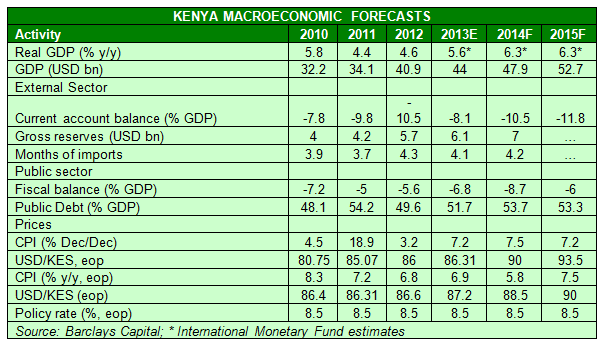
The feature was produced by alifarabia.com exclusively for zawya.com.
© Zawya 2014