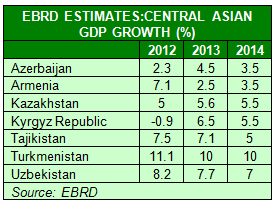
Turkmenistan is expected to post the highest growth in Central Asia, according to the European Business for Reconstruction and Development (EBRD), but elsewhere in the region, growth is faltering.
Central Asian GDP growth is expected to average 6.6% according to the EBRD, down a percentage point from its previous forecast.
"In most of Central Asia, economic growth remained relatively strong, albeit weaker than in recent years," EBRD said in its latest report on the region. "The deceleration reflects a more difficult external environment, flattening of commodity prices, and weaker growth in Russia. The latter may have a further negative impact on growth in this region, mainly through the impact on remittance flows, which have so far continued growing."
Indeed, the region may be coming to the end of its resource-driven boom.
Countries such as Turkmenistan, Azerbaijan and Kazakhstan have benefited over the past decade from the expansion of their extractive industries.
Indeed, they have emerged as formidable natural gas and oil exporters to Chinese and European markets.
Turkmenistan is a case in point. The country is expected to post double-digit of 10% this year and the next, driven by large public construction projects and increased gas exports to China.
"GDP growth is expected to reach 10% in 2013, as a new gas field comes on stream, and remain strong over the medium term, supported by exploration of Turkmenistan's abundant gas reserves and further diversification of export routes," EBRD said.
The IMF has an even more bullish forecast for the country, with a 12.2% expansion of the economy this year and 10.4% in 2014.
But the fund warns that high levels of public investment may compromise long-term fiscal sustainability "and weaken prospects for the diversification of the non-hydrocarbon economy."
"In addition, improved capacity to monitor expenditure efficiency and transparency could reduce opportunities for corruption. A new budget code, to be adopted by end-year, should help strengthen public finance management and introduce a medium-term fiscal framework. Expanding public finance coverage to include the extra-budgetary activities would be a welcome step."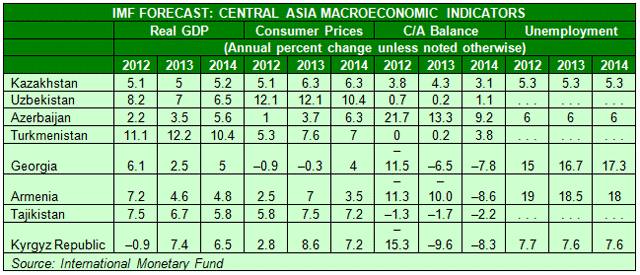
LOWER GROWTH
While the Central Asian countries' oil and gas sector will continue to remain strong, other sectors of the economy are suffering.
The GDP of Kazakhstan - Central Asia's largest economy -- is expected to grow 5.5% next year, compared to 5.6% -- driven primarily oil revenues. The country has yet to see revenues from the giant Kashagan oil field as first output is expected to start from the spring next year.
The country's current account surplus contracted 63.3% in the first half of the year, as key exports oil and metals fetched lower prices. The surplus stood at USD 1.67 billion during January to June, compared to USD 4.55 billion during the same period last year.
EBRD notes Kazakhstan's banking sector remains weak, suffering from overhang of non-performing loans (in excess of 30% of total loans). The country must continue to move toward a long-lasting solution to its high stock of non-performing loans and revamp its monetary and fiscal policy frameworks, the International Monetary Fund recommends in its recent global economic outlook.
That may also be true for the wider region that remains focused on hydrocarbons to generate revenues.
"Reforms are needed to boost the region's growth potential, while in several countries policies also need to reduce macro imbalances, given heightened risks and limited buffers," the IMF said in its report.
STRUGGLING WITH REFORMS
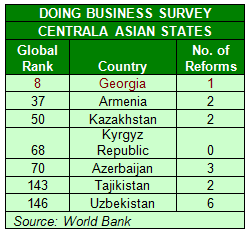
But reforms remain a distant dream in most countries. World Bank's Doing Business survey ranked Uzbekistan (146th), Tajikistan (143rd) were in the bottom half of the 189-country survey, although Georgia, ranked 8th globally, and Armenia (37th) impressed with their business-friendly jurisdictions.
Tajikistan, which recently saw president Imomali Rakhmon secure another seven-year term in rigged elections, is expected to see its GDP growth to unwind from 7.5% in 2012 to 5% in 2014.
"Growth outlook in Tajikistan is particularly uncertain given weaknesses in the banking system and continued tensions with Uzbekistan that may lead to further interruptions in gas supplies and railway shipments," EBRD said.
Meanwhile, growth in more progressive economies such Armenia and Georgia is also expected to decelerate this year.
In Armenia, this reflects slower growth in the agricultural sector in 2013 after a strong performance in 2012 related to favorable weather, upward price adjustments in gas and electricity tariffs, and budget under-spending, the IMF said.
"Growth in Georgia is expected to be moderate given slower private investment, weak credit growth, and budget under-spending."
While the region contends with lower growth, a host of other factors are also rearing their head. Sectarian and religious tensions are brewing in many parts of the region and, combined with social and economic dissent, could spiral out of control.
SECURITY THREATS
Western troops' departure from Afghanistan next year also poses a huge question on the region's instability.
Gordon Hahn, senior associate at the Russia and Eurasia Program of the Centre for Strategic and International Studies, believes destabilization in the predominantly Tajik and Uzbek northern provinces would have unsettling security implications for bordering states in Central Asia like Uzbekistan, Turkmenistan, and the less viable state of Tajikistan, including: an influx of refugees, cross-border fighting, and Tajik and Uzbek Afghan pleas for the intervention of their co-ethnics across the border.
"Already, each of the Central Asian regimes, with the possible exception of Turkmenistan, suffers from several challenges, which if mismanaged can lead to an existential threat to the regime and, in the cases of Kyrgyzstan and Tajikistan, even the state's territorial integrity - that is, to failed states," Hahn said in an October report on Central Asia's security.
Meanwhile, Uzbekistan is another crucial state in Central Asia which is vulnerable to destabilization.
"As goes Uzbekistan, so will go the rest of the region in all likelihood," Hahn said. "The regime's harsh authoritarian nature, falling short of totalitarianism, remains vulnerable to destabilization, especially if and when the succession of 75-year old president Islam Karimov moves to center stage."
With a whole host of challenges facing the region, the authorities may need more than high commodity prices to get them through the storm.
© alifarabia.com 2013