Three African states and one Middle East country emerged as some of the best performing countries in a survey on sustainable development conducted by Standard Chartered Bank.
The Standard Chartered Sustainable Development Index (SCDI) survey shows Ghana and Uganda made the most progress in the past decade in developing sustainable economies.
The bank's 31-country survey shows emerging markets are progressing well on a number of fronts over the past decade. The bank assessed each country based on five key elements namely environmental health, ecosystem, health, education and GDP per capita growth.
"Emerging countries have 'grown' faster than developed countries, not only in terms of GDP but also in improving education, life expectancy and environmental well-being," Standard Chartered said in a report. "However, most emerging countries have retreated in terms of ecosystem vitality, while developed countries have mostly improved."
Ghana led the rankings, rocketing to the number one spot in Standard Chartered Bank's inaugural survey.
The country did especially well in per capita GDP growth, education and healthcare, which boosted its ranking.
Uganda, another country that holds a lot of promise for investors, performed well on improving health, education and GDP indicators over the past decade.
"Most of the top-ranking countries on our summary measure are low-income countries. Just as poorer countries have greater potential for rapid GDP growth, they also have greater catch-up potential in environmental health, life expectancy and education," the bank said.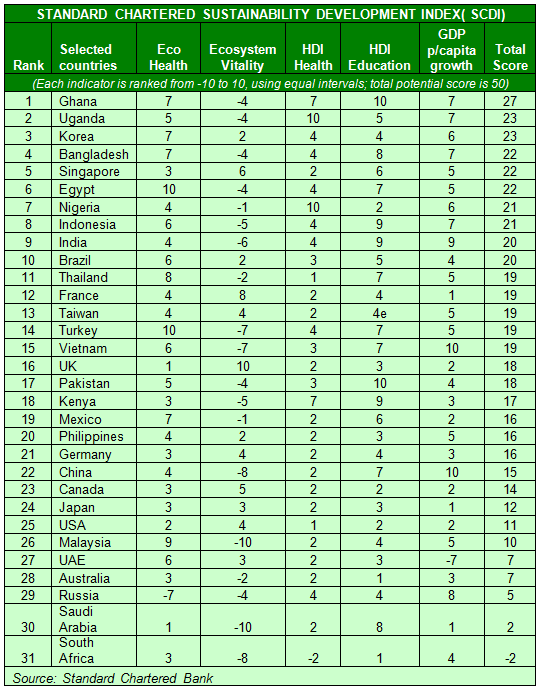
"Ghana and Uganda have made significant progress in all three areas, while Bangladesh, Egypt, Indonesia, Thailand, Turkey, Vietnam and Kenya have all made good progress in at least two of them."
SAUDI ARABIA'S LOW RANKING
This partially explains why countries like the United Arab Emirates and Saudi Arabia and South Africa, or even Japan and Australia, don't feature higher in the ranking, as they have already attained high levels of infrastructure in areas of education and health and are unlikely to see double-digit GDP growth.
Still, the UAE and Saudi Arabia can take a leaf out of South Korea's book, which has a far more developed economy, but still managed to emerge as the world's third's most sustainable economy.
"South Africa and Saudi Arabia come last in our SCDI, both dragged down by large negative scores for ecosystem vitality," the bank said. "South Africa also performs weakly on all the other measures, though it already has higher GDP and more education than other African countries so it has less catching up to do."
Saudi Arabia performed poorly in most categories except education. The kingdom, which is the largest exporter of crude oil, ranked especially poorly in ecosystem vitality due to massive greenhouse gas emissions.
The UAE also failed to impress the Standard Chartered team, as it performed badly in environmental health and, especially water use. Its gains in education have been marginal, while child mortality rates are also high.
"Declining GDP per capita is due to the near-doubling of the population as the country imported large numbers of low-skilled workers in construction and other services sectors," the bank said.
AFRICAN COUNTRIES SHINE
In keeping with their growth trend, African counties did well in the survey. Three of the five countries were in the top 10, while Kenya sat in the middle of the 31-country ranks, although South Africa emerged last in the survey.
South Africa has been a laggard in Africa over the past few years, as political issues and labor disputes hurt the country's economic prospects, and worsened healthcare and education levels.
GDP growth in Africa and the Indian sub-continent has lagged China's, but most of these countries have made faster progress on environmental and human health; South Africa is the important exception, the bank said.
"Most still score negatively on the ecosystem vitality measure, reflecting air pollution and pressures on water use. South Africa also scores poorly on ecosystem vitality. This, together with its negative health score (due to AIDS) and slow progress on education, environmental health and GDP growth, results in a negative overall score and the lowest on our list."
The SCDI is a good indicator of how countries are progressing in five key areas that determine their prosperity and the well-being of their citizens.
Most of the countries in the survey appear to have performed well across the five categories in the past decade, especially in education, life expectancy and environmental health.
"The major disappointment is in ecosystem vitality: the majority of the countries in our sample have deteriorated in this area. The worst problems are over-use of water, loss of forests and increasing CO2 emissions," the bank said. "While life expectancy, education, and better environmental health are generally correlated with rising GDP, ecosystem vitality is not. Indeed, it is negatively correlated."
© alifarabia.com 2013