The Egyptian economy has managed to avoid the worst, but it needs foreign investment to get better.
The North African country had enjoyed stellar growths of 5% to 8% during the last decade, before the promising but challenging Arab Spring cut short economic growth.
Egypt has attracted foreign direct investment of USD13-billion during the 2006-07 fiscal year, but it has plunged to a mere USD2-billion in the first three quarters of the year.
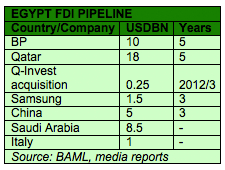
"Following Presidential elections, a sizeable medium-term FDI pipeline appears to be taking shape, starting from the hydrocarbon sector (accounted for 60% of FDI in FY2008-10) and regional entities, as the government has approached bilateral partners with investment and greenfield projects," says Jean-Michel Saliba, analyst at Bank of America Merrill Lynch Capital in a note to clients.
While the Egyptian Cabinet is looking to attract foreign direct investment, court challenges to the old regime's legacy privatization and contract deals have contributed to clouding the investment outlook, the analyst said.
"While social pressures remain elevated, the large external funding gap, particularly in the potential absence of a timely IMF deal, suggests the government will look for suitable compromises to resolve commercial disputes and restore investor confidence, in our view."
Analysts believe that the USD4.8-billion is critical for Egypt's fiscal fortunes, and it would also play a huge role in bringing other investors back to the economy.
The Egyptian Finance Minister Mumtaz Al-Said has expressed hope that the country may reach a deal with the IMF by the middle of December.
The IMF agreement could serve a major shot in the arm as the country grapples with 2% growth and unemployment of 12.6%, which stood at 9% before the revolution.
"Lower revenue collection and higher spending have widened the budget deficit, which reached 11.8% of GDP (excluding grants) in FY2011/12," said the IMF in a recent report on Egypt.
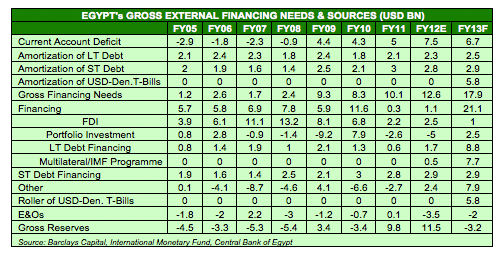
"Reliance on the domestic market to finance the deficit has contributed to a sharp increase in domestic t-bill rates, which peaked at nearly 16% in August before receding," the IMF says.
The balance of payments also deteriorated owing to portfolio capital outflows and lower tourism revenues and FDI. As a result, international reserves (including the central bank's foreign currency deposits in domestic banks) declined to USD15.1 billion at end-August, from USD43-billion at end-December 2010, notwithstanding some bilateral support and the issuance of foreign currency T-bills.
"The government has approached non-traditional geographical partners as well, partly to diversify FDI sources," says BAML's Saliba. "In addition, the government intends to launch mega-projects; projects under development include the East Port Said projects, the Suez Economic Zones, the Alexandria Medical City and the Red Sea-Upper Egypt Road."
OIL LEASES
The Egyptian General Petroleum Corporation recently awarded 11 concessions to foreign oil companies including Royal Dutch Shell, U.S.-based TransGlobal Energy and German-based RWE. Other concession winners included Dana Petroleum, Petroceltic International and Beach Petroleum.
BP has already pledged to invest USD10-billion in Egypt's offshore natural gas deposits.
In late August, the British company also announced gas discoveries in the Taurt North and Seth South gas discoveries in the North El Burg Offshore Concession, Nile Delta. These are the fourth and fifth discoveries made by BP in the concession following Satis-1 and Satis-3 Oligocene deep discoveries and Salmon-1 shallow Pleistocene discovery.
"The discoveries show our commitment to develop the remaining potential of the shallow reservoirs within the Nile Delta and make the best use of the existing infrastructure. It demonstrates the ongoing cooperation with the Ministry of Petroleum to deliver new gas discoveries and incremental supply to meet the future growth of the gas business in Egypt," said Hesham Mekawi, President and General Manager of BP Egypt in a statement.
IMPROVING INDICATORS
It's a testament to the underlying fundamentals of the Egyptian economy that many of the macroeconomic indicators are slowly improving, despite going through a major political and economic crisis just 20 months ago.
Foreign reserves in October nearly USD450-billion to reach USD15.1-billion, as Turkish and Qatari governments' deposited funds into the Central Bank.
The reserves are equal to 3.2 months of imports, the best since February. However, it is clear that external support is making the difference between Egypt's macroeconomic stability and recession.
Excluding the one-off support, foreign reserves fell by USD559 million, in line with an average run rate of USD500 million per month, says EFG-Hermes.
External support will also go a long way in propping up the Egyptian pound.
In the medium-term, the analyst says a weaker Egyptian pound is inevitable due to three key reasons:
1) expectations of a slow recovery in tourism and FDI;
2) a shifting energy balance where Egypt is becoming a net importer of energy;
3) widening inflation differentials with Egypt's main trading partners which is expected to become wider in the coming years as the government pushes ahead with fiscal consolidation to reign in its widening budget deficit.
The currency reached its lowest level in eight years on November 6 in a sign that the government is willing to agree to IMF terms to secure the USD4.8-billion.
This may be prudent given that the government has already spent USD20-billion to support the currency.
HURDLES TO INVESTMENT
While the Egyptian government is keen to attract FDI, investors are also worried about the spate of court challenges that has led to investor disputes.
"While the Qandil government is intent on restoring the flow of private capital and has made resolving investor disputes a priority, it appears to lack a structured, comprehensive approach, in our view," says BAML's Mr. Saliba.
"It also has to tread carefully on reaching settlements given a revived labor movement, social justice demands and conserving political capital ahead of elections. In some cases the government has looked to strike out-of-court settlements; in others, it appears to have appealed domestic court rulings returning assets to the public sector, keeping impacts confined to the equity market rather than on sovereign creditworthiness."
Another hurdle to FDI is the slowdown in privatisation of companies. The Mubarak regime had embarked on a grand privatisation spree which was the source of precious foreign direct investment.
But at least seven of these investments have been challenged and are under investigation, adding further uncertainty to the investment environment.
"Following the Revolution, the authorities went as far as dismantling the Ministry of Investment (since reinstated in the Qandil Cabinet), which was in charge of the privatization and state-owned enterprise (SOE) asset management program," said Mr. Saliba.
"The program in practice ended in 2010 following the workers' protest and as most of the performing SOEs were sold already, with revenue and debt repayment to the banking sector targets broadly met. Effectively, at that time, only 147 public companies out of a total of 314 slated for privatization were left in the pipeline of the program launched in 1991."
A ruling against London Stock Exchange-listed Centamin Plc highlights investors caution towards Egypt's investment climate.
The company had secured a licence to operate the Sukari gold mine in 1994, although production commenced in 2010. An Egyptian court ruled in October that the contract was invalid on the grounds that the country is not receiving enough returns from the deal.
The company, which employs 1,200 people, has pledged to continue production despite the legal challenges and will appeal the ruling.
"The gold is there. What isn't there is the investment climate," Centamin's head of business development Andy Davidson told Reuters in an interview on November 8.
The issues highlights why investors remain nervous despite the promising opportunities in the economy. Analysts say the government needs to handle such disputes with transparency so prospective investors are certain of the predictability and clarity of investment rules.
CONCLUSION
The Egyptian government must walk that fine line between keeping investors interested and at same time investigating previous deals that seem fishy.
Clearly, the Egyptian economy needs foreign direct investment to grow the economy, spur growth and reduce that stubbornly high unemployment rate.
The IMF believes that Egypt's considerable economic potential will depend on its ability to unleash the private sector.
"Creating a more transparent and competitive business environment, streamlining burdensome regulations, and improving access to financing, especially for small enterprises, should help boost economic activity and create jobs," said the IMF.
"Increasing investment in human capital and infrastructure should help provide more equal access to job and business opportunities for all sections of society."
© alifarabia.com 2012