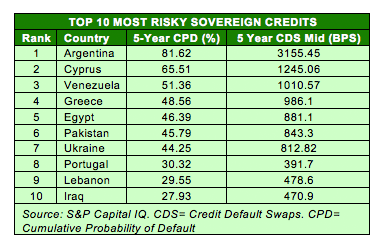
Egypt is the fifth most likely country set to default according to latest data from S&P Capital IQ.
The troubled Middle East country's cumulative probability of default (CPD) - a metric that quantifies the probability of a country being unable to honor its debt obligations over a given time period - stood at 46.39%.
"[Mohammad] Morsi's tenure as the leader of Egypt came to an abrupt end following civil unrest and a military leadership once again takes control," the research firm said, noting that spreads widened 50bps and the cost of protection widened to 900bps.
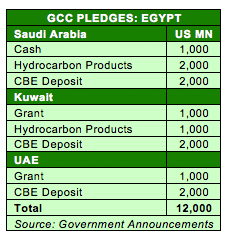
However, Arab Gulf funds will ensure that the country won't face a default. Saudi Arabia, the United Arab Emirates and Kuwait pledged USD 12 billion in 24 hours, as Morsi was shown the door by the army who effectively took over the country.
Qatar, which got a black eye after enthusiastically backing the Muslim Brotherhood government, also plans to "gift" Egypt five liquefied natural gas cargoes.
"We suggested Egypt needed roughly USD 8 billion to keep FX reserves stable over the next 18 months, though this would depend on the central bank's FX management framework as well," said Jean-Michel Saliba, analyst at Barclays Capital.
"In our view, exposure to short-end NDFs is attractive given a total of USD 6 billion in pledged fresh deposits at the Central Bank of Egypt and USD 3 billion in grants, the start of the Ramadan period, likely easing fuel bottlenecks, and the imperative of a narrative showing improvement in the post-Morsi era," said Saliba, noting that the Egyptian pound is unlikely to be devalued in the interim.
Standard & Poor's notes that the pledge by Arab states will "reduce the likelihood that Egypt will face a balance-of-payments crisis," noting that the recent announcements of support amount to 4.4% of Egypt's 2013 GDP and is evidence of bilateral donors' willingness to provide ad hoc funding to avert an external financing crisis.
"The stable outlook balances our view of Egypt's changing political landscape and the significant pressures on foreign currency resources against its moderate external financing needs and our expectation that bilateral donors will provide funds over the remainder of 2013."
BEYOND AID
But beyond financial aid by Arab Gulf states, the economy is unlikely to recover any time soon.
While the Muslim Brotherhood has been removed from the government, they remain a potent political force and have considerable support from a segment of the 70-million Egyptians.
Numerous protests and the tragic deaths of scores of Muslim Brotherhood members mean the group is unlikely to melt in the background and dig its heels in.
"One thing that we're going to be keeping an eye on is that the Muslim Brotherhood has been a very pragmatic organization throughout its history and certainly in the last 20 or 30 years hasn't chosen violence as a path expression, but they did just have their leader physically removed from political office," Jacob Shapiro, analyst at Stratfor told clients of Sanford Bernstein in a conference call.
"So there's certainly the potential for a radicalization of elements of the Brotherhood - we've already seen youth members split off from the group because they were unhappy with the way that the leadership was doing it."
Analysts are watching whether the interim government can include the disenchanted Muslim Brotherhood in broader political discussions. While MB will be hard-pressed to contest the presidential elections, the decision to participate in parliamentary elections would be more testing, said Barclays' Saliba.
"Conceivably, the MB remains one of the most organized and disciplined forces on the ground, and could still do well in parliamentary elections. This would pose intractable issues in the transition, particularly within the context of the suspended 2012 Constitution. That said, the secular opposition has shown its mobilization capacity and much remains to be settled with the writing process for the constitution."
IMMEDIATE ECONOMIC CHALLENGES
Even as the interim government looks to resolve the political wrinkles, economic challenges continue to pile up. Egypt's large population of 80 million is growing at 2% each year and demands on basic services including power and energy are crucial.
In addition, tourism - a major source of foreign dollar inflows and up to 20% of employment - is also expected to suffer.
"This political unrest that we're talking about and this political instability [do not] bode well for tourism... So on the whole, an increase of tourism is not going to actually help any of Egypt's structural problems," said Stratfor's Shapiro.
The S&P says Egypt's public finances are "very weak", with government debt estimated to remain 10% of GDP in 2013-2016.
"In our view, the subsidy system will remain a heavy expenditure item over the medium term. The government's stock of debt is relatively high and expensive, with general government interest payments amounting to almost 30% of revenues. In our view, the government's ability to raise revenues or cut spending is limited, particularly given Egypt's shortfall in basic services."
Investors are also wondering whether the International Monetary Fund's USD 4.8 billion package will be further delayed due to the turmoil.
Some analysts believe that either the new unity cabinet could resume discussions with the IMF, or a new elected government will be tasked with the challenge.
"On balance, we think Option 2 is more likely, but would particularly scrutinize the ministerial appointments at economic portfolios to judge the direction of policymaking going forward," said Saliba. "We do not exclude Egyptian authorities inviting an IMF mission to Cairo to reassure markets once the dust settles."
© alifarabia.com 2013