Egypt's fresh stimulus of USD 4.9 billion would provide a short-term push to the economy, but the country's medium-term challenges remain.
Interim finance minister Ahmed Galal said the country's second stimulus package since August would be financed primarily by the United Arab Emirates. The government will spend nearly EGP 20 billion (USD 2.87 billion) on development projects, including EGP 2 billion on upgrading the Suez Canal. The rest will be spent on funding social programs, and raising the minimum wage in an effort to ease some of the social pressures in the country.
The stimulus comes on top of a similar EGP 30 billion stimulus package unveiled in August 2013, aimed at upgrading the infrastructure and expanding power supply to more villages.
Both stimulus packages are being financed through the USD 12 billion aid pledged by the GCC states and hence will not add to the high fiscal deficit.
"While stimulus spending will likely provide a short-term boost to the economy, the sharp build-up in public debt to 83% of GDP by June 2013 is clearly unsustainable," said Standard Chartered in a report.
"Significant fiscal reforms are needed over the medium term to reduce debt and support a durable recovery. This looks unlikely at this stage, with Egypt heading towards new elections. The January 15 referendum on the new Constitution was a positive step forward, paving the way for presidential elections likely to be held in March 2014."
ECONOMY SUFFERS A BLOW
The Egyptian economy has suffered over the past three years after Hosni Mubarak's rule ended in a popular uprising, only to be replaced by the rule of an overzealous Muslim Brotherhood, which was toppled last summer by the army, led by field marshal Abdullah Fatah al-Sisi.
Al-Sisi has consolidated his position since then and is widely expected to run for president with the backing of the key Gulf states of Saudi Arabia, the UAE and Kuwait.
While the political machinations play out slowly, the economy needs a jumpstart.
And there is not a moment to lose.
The Egyptian economy has grown by a mere 2% in three years, while unemployment has risen to 13.4%. Key sectors such as tourism have been hit, while foreign direct investment have fallen as both tourists and investors wait on the sidelines.
Tourist arrivals fell 65% last year and an attack on a tourist bus earlier this week does not bode well for the spring and summer tourist seasons in the country.
The Suez Canal has been a strong performer for the country amid troubled times, but analysts say there is little scope for much higher revenues from this source.
Meanwhile, remittances have risen rapidly, supporting balance of payments.
"However, these have slipped in the past two quarters. The improved business environment is likely to drive some growth in exports, though the oil sector, which contributes about 45% of total revenues, could well be held back by financial issues," said Fitch Ratings in a detailed report on the country.
STRAINED FINANCES
The ratings agency expects the country's external finances to improve, although they will remain strained till 2015.
"Officials from GCC countries have publicly indicated that there will not be unlimited unconditional supply of funds and they are likely to push for some economic reform, with the Egyptian authorities likely to acquiesce. Fitch judges that additional GCC support is likely in the event of extreme strains."
Aid from other donors such as the International Monetary Fund may only be possible once a new government settles in and embarks on fresh discussions on the stalled USD 4.8 billion loan agreement.
The country's gross external debt has also declined from USD 10.2 billion at the end of 2010 to USD 200 million at the end of October 2013 as foreign investors fled.
"This fall has more than offset the increase in GCC deposits at the central bank. Non-bank private sector external debt has also dropped. Further external assistance is expected for the next few years, but other financing sources will be drawn (notable FDI from the GCC) and foreign portfolio investors are likely to remain cautious."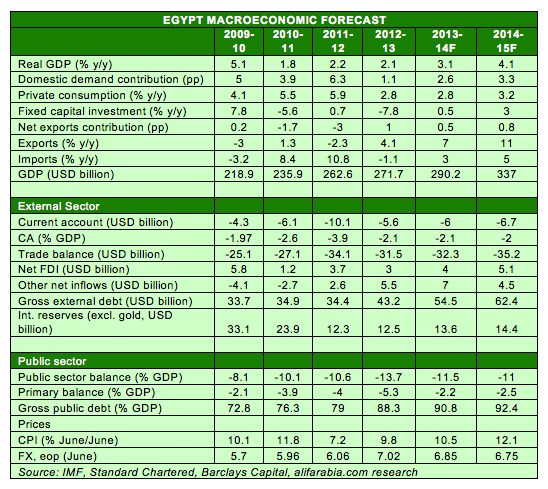
INFRASTRUCTURE SPEND
Despite the challenges, the two stimulus packages are expected to raise infrastructure investments. The government's spending targets new housing, water and sanitation, and transport and infrastructure projects, apart from building 50,000 new housing units and upgrading water and sanitation facilities for more than 151 villages.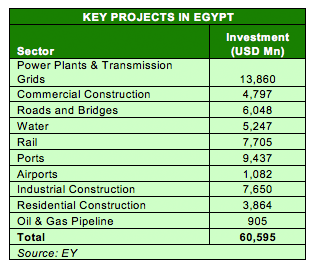
Management consultant EY's data shows more than USD 60 billion worth of projects are under way in Egypt. Most of the investments are focused on building power plants and port development, but other modes of transportation such as rail and airports is also securing investments.
"Infrastructure is relatively well developed across the country and, despite the political uncertainty, there remains a fairly large number of active infrastructure projects," said EY in a report which considers Egypt as a long-term opportunity for investors based in its market size and well-educated workforce.
Apart from capital expenditure, the government is also stretching itself by raising its minimum wages for public employees by 70%, in an effort to quell discontent. The move will benefit five million public-sector workers and will hopefully trickle into the economy.
But the populist move will raise the wage bill by 0.5% of GDP. The government also plans to spend 10% of GDP in the fiscal year on untargeted subsidies for gasoline and food commodities.
"This was the single largest contributor to the high fiscal deficits in the past three years," said Standard Chartered.
The new constitution also outlines the government's commitment on universal medical care and education, which would effectively double social spending within the next four years to 10% by 2017 fiscal year.
"There is little space left for the government to continue its aggressive expansionary fiscal policy, with public debt at 83% of GDP, by June 2013. We estimate that the debt will rise to 89% of GDP by end-FY14," said SCB.
"The new government will have to undertake significant fiscal reforms, including cutting back on untargeted energy subsidies and increasing tax revenue, to narrow unsustainable deficits and create fiscal space for greater social-sector spending."
The feature was produced by alifarabia.com exclusively for zawya.com.
© Zawya 2014