The main Egyptian stock market index could hit 8,500 before the end of the year as economic and political conditions stabilise, according to Pharos Holdings.
The Egyptian Stock Exchange has vacillated over the past few years, mirroring the country's political turmoil, but the market was on a tear late last year, rising 24%. This year the EGX has already risen 21% year to-date, trading at 8,277 points - a five-year high.
"We expect the last leg of the risk compression cycle to push the index to 8,500 by June/September 2014," Pharos analyst Hany Genena, said in a report.
"Beyond this level, end of the natural gas shortage crisis will be necessary to trigger the next leg of the re-rating cycle - the 'Cash Flow Expansion' cycle."
Egyptian businesses are reluctant to loosen purse strings as a combination of energy shortages and political uncertainty has compelled them to delay capital expenditure.
Businesses are also waiting for the Central Bank of Egypt to cut interest rates by as much as 100 bps, before they start spending, some analysts say.
Reading the tea leaves, Genena said dovish statements on growth and inflation made by the ministers of finance and planning as well as the CBE governor point to a rate cut.
The Egyptian market could also get a major lift if the UAE-based telecom provider Etisalat decides to list the shares of its Egyptian arm on the EGX. Dubai's Emaar Properties also announced this month it is considering listing its Egyptian unit on the market in an initial public offering.
The twin developments could trigger a new wave of optimism in a market that remains undervalued compared to other regional markets, and has seen listed companies decline.
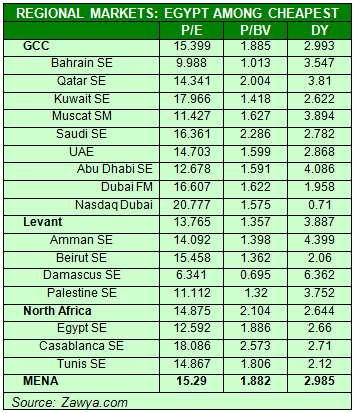
Price-to-earnings ratio among listed Egyptian corporations stands around 12.59, compared to 18 in less liquid Casablanca SE, and also below the GCC average of 15.40, Zawya.com data shows. Indeed, the Egypt SE is the cheapest among major regional markets.
The attractive valuations may encourage international investors to revisit the Egyptian growth story and rotate away from the overheated Gulf markets.
"Foreign fund managers will underweight GCC and overweight Egypt," Pharos' Genena noted. "Lower commodity prices will trigger fears over fiscal balances and liquidity dynamics in the GCC. Egypt overweight status will be supported by presidential elections in June/July, GCC aid, a sovereign rating upgrade and El Sisi's 'Marshall Plan'."
MARKET PICKED UP IN 2013
President Mohamed Morsi's ouster last summer and subsequent injection of Gulf funds into the Egyptian economy turned the tide for the market. The bourse index rose 42% in the second half of the year, reversing a 13% decline.
Food and beverage sector surged 78% last year, while basic resources sector (+46%), the banking sector (+33%), the real estate sector and the chemicals sector (+26% each), the telecommunications sector (+22%), the industrial goods, services and automobiles sector (+21%) jumped, data from Bank Audi shows.
Market cap rose just under 4% last year (in foreign currency terms) to reach USD 61.4 billion last year, although far below the USD 91.1 billion market cap of 2009.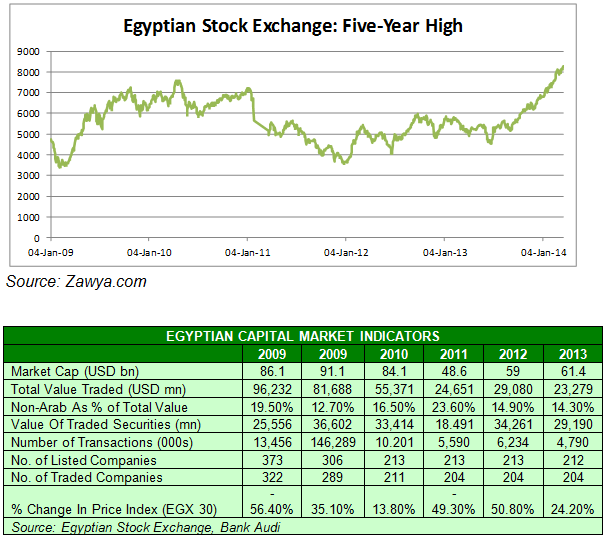
MIXED CORPORATE RESULTS
Egyptian corporations continue to find the economic environment challenging. Orascom Development Holding warned on March 19 that it expects to report a net loss on Egypt's economic weakness.
The Swiss-listed company said the company expects a net loss by as much as CHF 160 million (USD 181 million) mainly due to the challenging market
environment caused by the political instability in Egypt.
"The main contributors to the bottom-line loss are: reduced revenues, lower
capitalization of financing costs, Egyptian Pound devaluation in addition to provisions, impairments of investments and reassessment of the recoverability of deferred tax assets," the company said in a statement.
Other companies are also showing signs that they have not fully recovered. Real estate company Talaat Mostafa Group reported revenues at EGP 1.6 billion in the fourth quarter, below analyst estimates. NBK Capital downgraded the company to hold.
GB Auto also faced a downgrade from analysts after the government imposed a one-year ban on imports of tuk-tuk, which account for 10% of the company's rotal revenue.
However, Egypt's Oriental Weavers, the world's largest carpet maker, raised dividend after its net profit shot up 30%, highlighting an uneven economic recovery.
GROWTH PROSPECTS AMID CHALLENGES
The Institute of International Finance believes economic growth could accelerate to 4% in 2014/15, mainly reflecting the impact of the stimulus packages.
"The large fiscal deficit and the high and persistent inflation are key macroeconomic challenges facing Egypt," George Abed, IIF senior counsellor and director Africa/Middle East said. "The prospects beyond the near term could deteriorate if a new government following the presidential election fails to undertake the difficult but needed reforms."
However, the International Monetary Fund expects growth to rise to 2.8% in fiscal 2014. Egypt officials also noted that the economy grew by an anaemic 1.2% in the first half of the fiscal year 2013/14 and growth will likely reach 2 to 2.5% this year.
The government has already spent USD 3.59 billion of the USD 9.19 billion stimulus package, but it has not yielded the desired bump in growth yet.
SISI'S MOVE
All eyes are on field marshall Abdel Fattah El-Sisi, who is widely expected to announce his intention to run for the presidency. Analysts expect a market rally as he may announce a strong economic package. His participation - and likely victory - would also signal continued economic support from Saudi Arabia, the UAE and Kuwait.
"The grounds for optimism are easy to identify," said Bank Audi in a recent report.
"The regime changeover has triggered the release of aid from Gulf states that had long been skeptical before. Recent developments have led international reference sources to strengthen their growth forecasts for Egypt though at a relatively moderate pace because of the disruptions in the manufacturing and tourism sectors."
Still, the resignation of a sixth government since 2011 highlights the political issues that will continue to challenge any new government that is at the helm. Prime minister Hazem Al-Beblawy and his cabinet unexpectedly resigned in late February amid criticism on lack of progress under his rule.
The field marshall seems conscious of the economic challenges facing the economy. The Egyptian army's USD 40 billion deal with Dubai construction company Arabtec to build one million low-cost houses in Egypt, indicates field marshall Sisi will be leveraging Gulf investment and expertise to jump-start the economy.
This can only bode well for the Egyptian market - at least in the medium term, before more pressing calls for reform weigh down the economy.
The feature was produced by alifarabia.com exclusively for zawya.com.
© Zawya 2014