As the citizens of Swaziland head to the polls on September 20, international observers are pointing to the country's "unsustainable" path and a "crisis" that is inevitable if the current policies and political set-up continues.
As the continent's last remaining monarchy, Swaziland is at odds with modern Africa, which is increasingly pursuing democratic reforms.
And while the elections are a step in the right direction, they are "flawed, since political parties are unable to register, and this is a restriction on both freedom of association and the ability to challenge government as an organized group in an open electoral process," wrote Christopher Vandome, program administrator and research assistant of the Africa Program, Chatham House, along with his colleagues Alex Vines and Markus Weimer in a report on the country.
News of the co-monarchs King Mswati III and Queen Mother Ntombi's lavish lifestyle, fleets of cars and expensive trips abroad are in sharp contrast to an economy that can barely sustain itself.
More than 60% of the population lives below the poverty line, and 80% live on less than USD 2 a day. Life expectancy in the country stands at 45 years and only around 40% of the population has access to improved water sources.
The country also suffers from the highest incidence of HIV/AIDS in the world, adding a tragic twist to its troubles.
"There is no external pressure on King Mswati III to make any real political reforms, while domestic unhappiness is centered in urban areas," said management consultants KPMG in its second quarter report on the country.
"The monarch remains very popular in rural area."
ECONOMY IN THE DOLDRUMS
The country's GDP stands at USD 3.75 billion for a population of 1.2 million people, firmly placing it at the lowest rung of the global economy.
Growth is entirely dependent on sugar exports, remittances from migrants and the Southern African Customs Union, which also counts South Africa, Botswana, Lesotho and Namibia as members.
Landlocked Swaziland once benefitted from neighbors' South Africa and Mozambique's troubled political scene in the 1980s, but its fiscal health has failed since then due to lack of planning and inability to create a competitive economy.
While its neighboring states have flourished with liberal economic policies and greater efforts to institute democratic and social reforms, Swaziland has remained stuck in the past with a lack of vision and a coherent policy for growth.
The advent of the global financial crisis hit Swaziland especially hard, leading the authorities to cut back on poverty-alleviating spending, apart from cutting off investments in the crucial areas of education and healthcare.
In a report earlier this year, the International Monetary Fund noted that "Swaziland's economic prospects remain difficult and that, without credible and comprehensive fiscal adjustment and structural reforms, the current fiscal and external position will be unsustainable over the medium term and subject to significant downside risks."
Over the years, the Swaziland economy has become entirely dependent on revenues generated from the Southern African Customs Union (SACU), which accounted for 22.5% of GDP last year.
Last year, the authorities re-launched a Swaziland Investor Roadmap, but it has attracted little attention due to the country's anemic growth prospects and lack of transparency.
"Swaziland's weak economic fundamentals and challenging political environment is keeping it from attracting significant foreign investment and reducing its dependence on SACU revenues," said KPMG, noting that the lack of any real effort to reduce dependence on customs' receipts "is a telling sign of poor leadership capacity."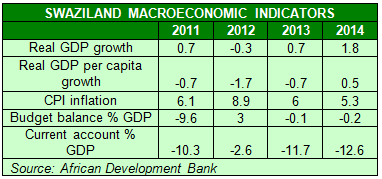
UNSUSTAINABLE TRAJECTORY
The Chatham House report notes that the country's economy is on an unsustainable trajectory.
Corruption, lack of planning and the small population, which is wracked by HIV and AIDS, are significant impediments to growth.
Apart from rationalizing expenditures, including the wage bill, the IMF has recommended a string of budgetary, banking and economic reforms.
"[IMF] directors underlined the importance of increasing the share of targeted social spending in the budget, especially on education, poverty alleviation, youth unemployment and health care."
Swaziland will also need to raise its regulatory regime. The kingdom is ranked 123rd in a survey of 185 states in World Bank's Doing Business 2013 Survey. It ranks especially low at 174th in enforcing contracts, 165th in ease of starting a new business and 156th in securing power.
While government revenues have been shrinking, there seems to be little political will in reforming the public sector wage bill, which has been ballooning. Estimates shows government expenditure will account for 45% of GDP by 2018 if reforms are delayed.
"Corruption, the politicization of the economy, the highest HIV prevalence rate in the world and poor public policy decisions have resulted in extreme poverty and one of the world's highest levels of inequality," said Chatham House.
"The king must recognize that SACU and sugar alone will no longer be able to support the government. The biggest threat to Swaziland's security is economic implosion and collapse."
© alifarabia.com 2013