East African countries have emerged as rising economic stars in the continent with Kenya, Tanzania and Mozambique in the midst of an impressive growth spurt.
But investors should also be wary of serious political risks emerging in the region.
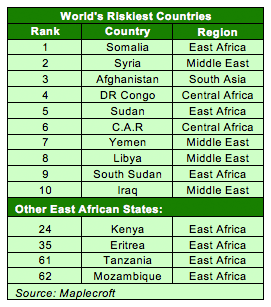
Risk analytics and research firm Maplecroft's Political Risk Atlas 2014 (PRA) identifies East Africa as an emerging flashpoint of geopolitical risks.
The region has been home to a number of political risk incidents over the past year. A terrorist attack on an upscale mall in the Kenyan capital Nairobi, which left 67 people dead, is just one example of the heightened political issues in the region. Kenya, is among the East African countries at risk, according to Maplecroft, and is ranked 24th globally.
Moody's ratings agency concurs that the Westgate shopping mall debacle was a credit negative, especially as Somalia-based Al-Shabaab militants -- which claimed responsibility for the attack -- will continue to look for other opportunities to destabilize the country.
"We expect this high-profile attack to be credit negative and will adversely affect Kenya's growth and fiscal revenues," the agency said.
MORE RISK-PRONE AREAS
Other East African countries also seem to have climbed up in the latest Maplecroft list compared to last year.
Eritrea (ranked 35th in 2014, compared to 43rd in 2013), Tanzania (61st, versus 77th), Mozambique (62nd versus 101st), has meant East Africa has eclipsed Central Africa, as Sub-Saharan Africa's riskiest region.
"Two of these countries saw a change in their risk category, with Eritrea re-categorized as 'high risk', while Mozambique moved from 'low' to 'medium' risk," Maplecroft said in its report.
East Africa is already host to 'extreme risk' Somalia (ranked 5th), Sudan (ranked 6th) and South Sudan (ranked 10th), Maplecroft ranking shows.
More trouble is brewing in already-fractured Sudan, according to the International Crisis Group.
"Various eastern factions now call for toppling the regime and joining the Sudan Revolutionary Front (SRF), an alliance of essentially southern and Darfur-based rebel groups. Renewed armed conflict is more likely, especially given the spreading war in South Kordofan, Blue Nile and Darfur," ICG noted in its latest report on the country.
In addition, the government is permitting local tribal militias to arm, as communal relations deteriorate, leading many locals to worry that eastern Sudan could become the next Darfur.
"Finally, the unpredictable relationship between Sudan and Eritrea and the growing Israeli-Iranian competition around the Red Sea could lead to national, regional and other international actors using aggrieved eastern factions as their military proxies," said the ICG.
The Somali government's hold on the country is tenuous at best, and is largely propped up by support from African Union troops.
RESOURCE NATIONALISM
Foreign investors are eyeing East Africa's resource riches that range from agriculture produce to minerals and hydrocarbons, but there is a danger that governments are tightening their grip on these resources.
In August, Kenya revoked mining licenses issued earlier in the year and raised royalties on a range of metals and mineral resources.
"These unexpected policy shifts signal that mining firms investing in Kenya face an elevated degree of regulatory uncertainty," Maplecroft said, noting that Kenya has risen from 'medium' to 'high risk' on the back of increased regulatory volatility.
Maplecroft's assessment corresponds with a survey from Vancouver-based Fraser Institute which ranked Kenya's as 96th in its annual survey of country's based on its and gas regulations.
One unnamed executive surveyed by Fraser said bluntly: "Kenya is horribly unpredictable. Success in neighboring countries has made them distrusting of investors and they have been too quick to assume they have the leverage to tax operators that have yet to find any resources. They also overstate success stories to back changes in the law. Government officials have little interest in effectively communicating with companies."
Natural gas-rich Mozambique has also raised uncertainty around its resources, with heavier capital tax on sale of assets to foreign firms, Meanwhile, new regulations in Uganda stipulate that foreign oil firms must relinquish 48% of their project stake to local companies.
"Additionally, Tanzania (69th), also 'medium risk', in November 2013 introduced new terms to production sharing agreements, raising the royalty rate from 5% to 7.5% for offshore gas projects and increasing local content requirements," Maplecroft said.
East Africa offers a range of opportunities and could serve as an important gateway to the rest of Africa, especially for Middle East and Asian countries. But if the authorities are not careful in pursuing growth that is inclusive and crafting a business-friendly environment, much of the investor interest may start to wane soon.
© alifarabia.com 2013