The UAE banking sector's outlook has improved considerably over the past few quarters as a spate of new infrastructure and construction projects come on track and strong economic activity helped improve business sentiment in the country.
Loans offered by Dubai banks grew 8% last year alone. The country's retail sector saw faster growth than the corporate sector, with Commercial Bank of Dubai (CBD) registering the highest growth in retail loans (+33%) while Union National Bank witnessing the fastest growth in corporate loans (+22%), according to research by Kuwait-based NBK Capital.
UAE banks also accounted for the highest non-performing loans across the GCC, with major contributions by Emirates NBD (13.9% of NPL in 4Q13). Union National Bank and Abu Dhabi Commercial Bank also reported 4.3% and 4.1% NPL in the fourth quarter alone.
"Going forward, the much-acclaimed Expo 2020 win by Dubai, strong performances from the tourism, retail, and trade sectors, in addition to increasing spending in Abu Dhabi, will add further momentum to growth, in our view," said Aarthi Chandrasekaran, an analyst with NBK Capital in a note to clients.
Some banks also successfully accessed the international debt capital markets, raising not just senior debt but also hybrid Tier 1 capital as a sign of improving view of global investors towards the UAE's financial services sector.
Still, analysts don't expect a massive upswing in loan growth, as many of the infrastructure projects are still at an early stage of the decision-making process in the run up to Expo 2020.
"Additionally, we believe that credit growth will remain in check given the stringent regulatory measures laid down by the Central Bank of the UAE (CBUAE) such as the cap on government-related entities (GRE) lending and lower LTV [loan-to-value] ratios for mortgage lending, NBK said.
Analysts are also cautious in their outlook on retail loan growth in light of the UAE Central Bank's proposed tightening of its regulations targeting lending to retail consumers, which could come as early as the first half of 2014.
Crucially, limitations on exposures to government-related entities (GREs) will also help curtail risk and benefit the sector and the wider economy in the longer term.
MORE LOANS AND FACILITIES REQUIRED
The right to host the Expo 2020 would be a huge bonus for Dubai, which is already on a strong economic recovery path.
It is also a just reward for the city that had poured billions in its infrastructure, even during the tough times, and has created a global economic hub that's ready for major events.
The authorities estimate that the Expo will generate USD 23 billion to the emirate's economy from 2015 to 2021, including total spending by the host, participant and visitors, as well as the impact on the supply chain and consumption.
Standard Chartered Bank expects around 300,000 new jobs being created as a direct result of the Expo, which will last six months, with 90% of the job opportunities occurring between 2018 and 2021.
Majority of the jobs are expected to be in the hotel and restaurant sectors (40%), construction (30%) and others in transportation, logistics, retail and services.
The city is hoping to attract 25 million visitors over the six months, with more than two million tourists from the neighboring Gulf states alone.
While the Expo will provide a major boost to the economy, it also has the potential of raising the emirate's debt, which had spiraled to new heights in recent years.
Amid the backdrop of high indebtedness, the Expo investment will require more loans and facilities.
USD8.4BN FINANCING
Total financing costs are estimated around USD 8.4 billion (8.9% of GDP), of which the Dubai government will commit to fully funding the capital needs of USD 6.8 billion (7.2% of GDP), according to estimates by the Bank of America Merrill Lynch.
The remaining USD 1.6 billion are operating costs, which the government expects to be offset by revenues generated from the event.
However, as these costs will be incurred before the event, they will need to be financed through domestic short-to-medium-term overdraft facilities.
As such, the USD 6.8 billion in capital spending (AED 24.8 billion or 30% of Dubai's gross fixed capital formation) spread over four years (2016-2019) equates to AED 6.2 billion per year in government capex spending (USD 1.7 billion or 1.8% of GDP).
This would double the current government capex in nominal terms back to the levels of pre-financial crisis.
Indeed, the total cost, pace of execution, and financing of Expo 2020 "remains uncertain," noted Bank of America Merrill.
"If not implemented prudently, these projects could exacerbate the risk of a real estate bubble. Moreover, these projects may create additional financial risks for Dubai's government-related entities (GREs) and the banking system in light of the still considerable debt overhang from the 2009 crisis."
BAML analyst, however, believes that Dubai will continue to keep bondholders whole, "given the need of healthy GREs to access international debt markets," and also look to divest from non-core international assets.
THE PROBLEM WITH GRES
International, regional and domestic banks are closely following Dubai's efforts to work through its debt pile, before they open the credit lines for the emirate.
News reports suggest Dubai World is planning new asset sales of as much as USD 4.4 billion as part of a larger plan to work through its USD 25 billion debt.
On March 5, Reuters reported that Dubai World had prepaid USD 284.5 million to creditors, as a sign of the company's commitment to lower its debt.
Debtwire also recently reported that Dubai's Limitless approached lenders for a waiver request for the first amortization payment of USD 400 million due in December 2014 under its 2012 debt restructuring agreement of a USD 1.2 billion loan. The USD 400 million amortization is the first of three equal annual tranches from December 2014 to December 2016.
The newswire also reported that Dubai World had requested proposals to manage USD 4.4 billion in loans maturing in March 2015 and reorganize its USD 10 billion repayment due in March 2018, amid slow progress on asset sales.
"The systemic nature, size and visibility of the Dubai World debt maturities are likely to prove a litmus test for the emirate, in our view," said Jean-Michel Saliba, analyst at Bank of America Merrill Lynch in a note to clients.
If Dubai successfully negotiates this delicate first turn in 2015 against the backdrop of an improved domestic economy and a more liquid banking sector, BAML expects sovereign bonds spreads to compress further.
"However, in our view most of the credit risk re-pricing already occurred. To grow out of its debt overhang, in our opinion Dubai needs a combination of internal cash generation, asset sales, refinancing, decent global outlook and liquidity, as well as potential Abu Dhabi support."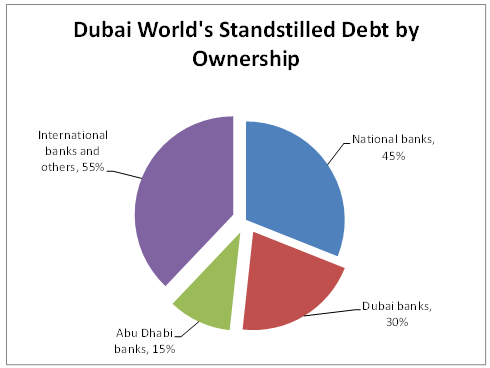
Fitch Ratings also noted in a December report that despite the optimistic outlook for the economy, significant asset quality problems remain, largely relating to the weak real estate.
Problem loans also reflect Dubai GREs and other major corporates that are undergoing restructuring.
"To a certain extent, non-performing loan (NPL) ratios are distorted by the classification of certain restructured lending, which is now performing in line with revised terms, while other loans are still being restructured and may be under-reserved," the ratings agency noted.
"Some rescheduled loans may give rise to further problems if planned asset sales do not materialize. Ultimately, the success of the various plans to restructure these loans will depend on developments in the UAE economy, notably in the real estate markets and realization of the underlying collateral."
LESSONS LEARNED
The emirate's Department of Finance recently published a paper highlighting how Dubai learned from the crash of 2008 that saw real estate prices plummet and government-related entities needed bailouts and support.
Among the lessons was "the expansion of investment and raising the efficiency of operational spending while focusing on investment spending. Dubai benefited from this lesson and worked accordingly, which had a great impact on the speed of economic recovery in the UAE."
But as the UAE economy enjoys a renaissance, there is a danger that the favorable economic environment may lead to exuberance.
This has been most notable in the real estate market where prices shot up more than 20% last year and rents have risen as much as 60% in some cases, even though the government has looked to cool markets with a string of policy measures.
The International Monetary Fund also warned the emirate last year to intervene to prevent a new property bubble that could derail the economy's momentum. 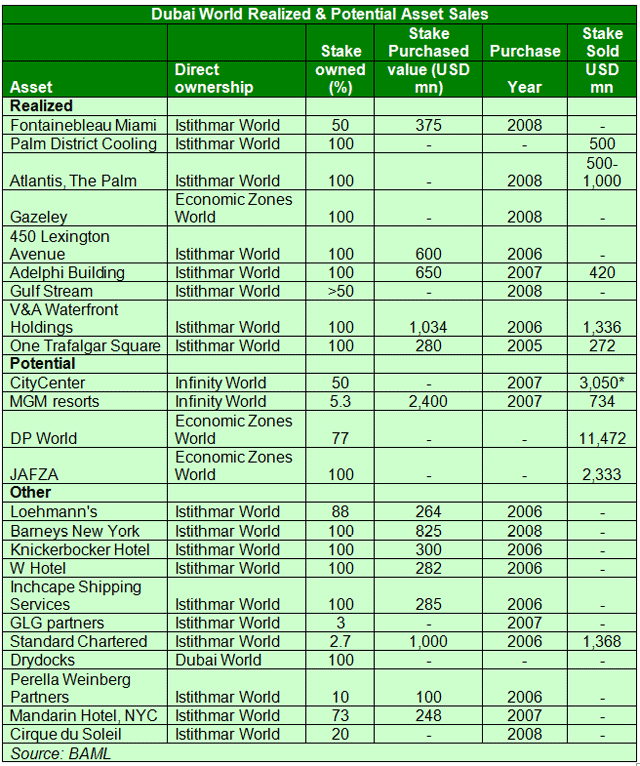
The emirate doubled real estate registration fees from 2% to 4% last October and the IMF recommended that further increases "could be contemplated in case the pace of price increases does not abate sufficiently."
In addition, new rules on loan concentration and real estate exposure for banks will help protect the soundness of the banking system.
"The new loan concentration limits will help contain risks to banks' balance sheets in the context of the newly planned megaprojects," the IMF noted.
Fitch expects UAE banks should remain profitable, despite weak asset quality.
"Core earnings have benefited from lower funding costs. While impairment charges are expected to remain relatively high in 2014, not least due to relatively low loan loss reserve coverage in some cases, Fitch recognizes that pre-impairment operating profit is able to absorb high credit costs, while sound capital ratios provide a solid cushion against any worsening in asset quality." 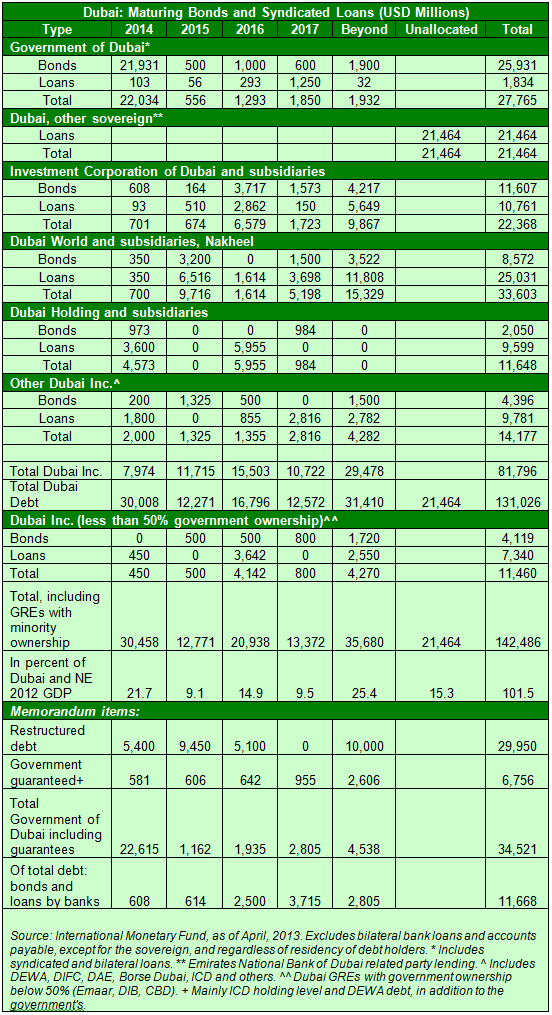
The feature was produced by www.alifarabia.com exclusively for www.zawya.com.
© Zawya 2014