PHOTO
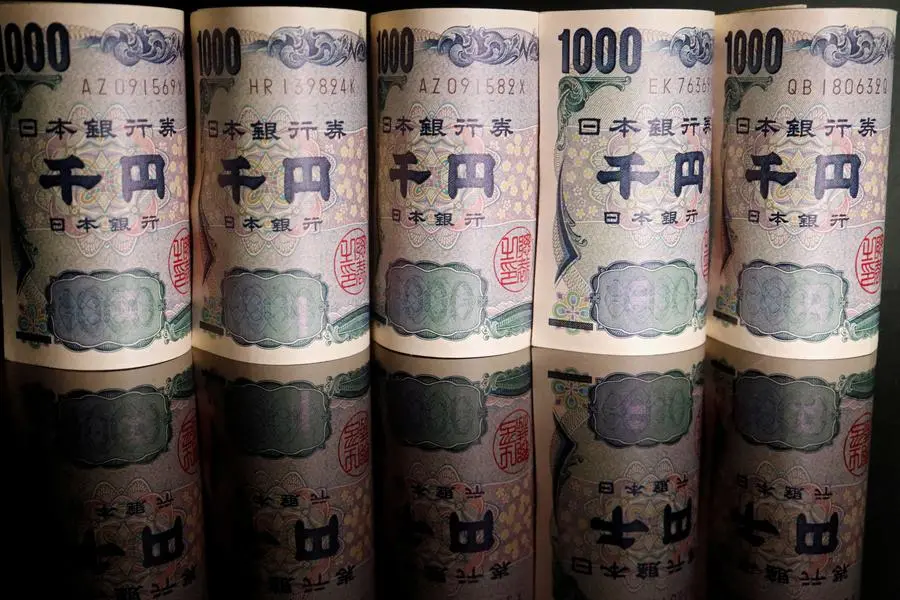
The yen weakened on Tuesday after a report that Japanese Prime Minister Sanae Takaichi had conveyed her reservations about further interest rate hikes to Bank of Japan Governor Kazuo Ueda last week, while investors continued to assess an uncertain trade environment.
The Japanese currency fell 0.83% to 155.93 per dollar , hitting its lowest in nearly two weeks, as the report from The Mainichi Daily also sent Japanese government bond yields lower.
The development injects fresh uncertainty into a complicated policy backdrop for the BOJ, which has been battling a weaker currency that has raised the costs of imported fuel and food for Japanese households.
Before the report, a majority of economists polled by Reuters had expected the BOJ to raise rates to 1% by end-June, while markets had priced in a roughly 70% chance of a hike by April.
"It puts to the test the view that a corner has been turned in the yen," said Kenneth Broux, head of corporate research, FX and rates at Societe Generale.
"If the government is lobbying the central bank, doubts again re-emerge over the independence of the central bank."
Takaichi reiterated in parliament that there are pluses and minuses to a weak currency.
China's export controls on Japanese companies also added to the pressure. The yen slipped more broadly, falling 0.8% to 183.75 per euro.
The currency has been on the radar of U.S. authorities. Nikkei reported that the New York Federal Reserve, acting on behalf of the U.S. Treasury Department, took the lead in conducting so-called rate checks last month to prop up Japan's currency without a request from Tokyo.
"It tells you that Japan is not overly concerned (about the yen), even though they have been intervening verbally to manage the pace of the slide in the yen," Broux said.
ASSESSING UNCERTAIN TRADE ENVIRONMENT
Investors are also digesting an uncertain trade environment.
The Supreme Court ruled on Friday that U.S. President Donald Trump's use of a 1977 emergency law to impose tariffs exceeded his authority. However, the president invoked a different law and imposed a new levy on all imports hours later.
An initial 10% tariff came into effect at a minute past midnight on Tuesday, according to a Customs notice. It is unclear when Trump's promised increase to 15% would take effect.
So far, Trump has only signed an executive order for the 10% tariff.
He also warned countries against retreating from recent trade deals after the Supreme Court struck down his emergency tariffs.
"Now we're back in a very uncertain environment," Ray Attrill, head of currency strategy at National Australia Bank, said on a NAB podcast.
"It's just the uncertainty about what the future trade landscape will look like, just at a point where most countries had signed or were on the cusp of signing trade deals."
The renewed trade uncertainties come as doubts creep into financial markets about the sustainability of massive investments in artificial intelligence and as Federal Reserve policymakers express concerns about elevated inflation.
Traders are also focused on rising geopolitical tensions. The State Department is pulling out non-essential government personnel and their eligible family members from the U.S. embassy in Beirut, a senior State Department official said on Monday, amid growing concerns about the risk of a military conflict with Iran.
EURO SLUGGISH, YUAN CLIMBS
The euro was flat at $1.1785, while sterling was little changed at $1.3487.
The European Parliament decided on Monday to postpone a vote on the European Union's trade deal with the U.S. due to the new import tax.
China's yuan hit the strongest level against the dollar in nearly three years on hopes that Trump's new tariff regime would lower taxes on Chinese exports.
In cryptocurrencies, bitcoin fell 2.1% to $63,254.98, and ether declined 2% to $1,825.81.
(Reporting by Rocky Swift and Niket Nishant; Editing by Sonali Paul, Kim Coghill and Anil D'Silva)