The UAE Central Bank's decision to extend its deadline for commercial banks' to comply with its regulations for another six months comes as a relief to the financial institutions.
National Bank of Abu Dhabi officials told Thomson Reuters that the bank had made the extension in September, but Central Bank officials were not available for comment.
In an April ruling, the Central Bank had tightened lending rules and curb excessive lending to one segment of the economy to reduce risk. While this would go a long way in strengthening the banks, in the short-term it poses challenges for some of the banks.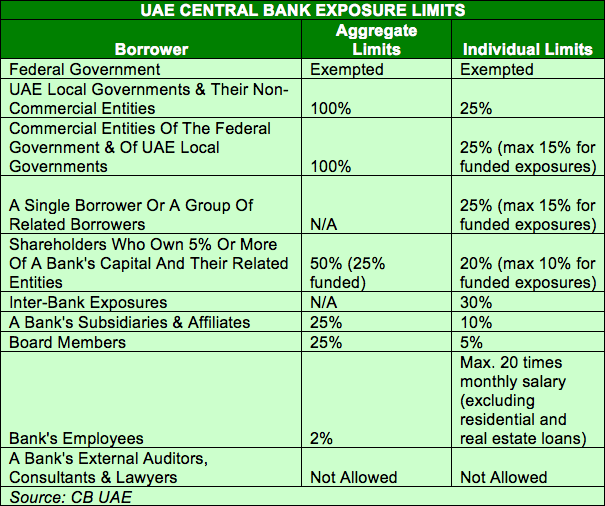
"The Central Bank has set a cap on aggregate lending to both non-commercial and commercial government entities at 100% of a bank's capital base," said Chiradeep Ghosh, an analyst at Manama-based SICO.
"Our preliminary calculations suggest that ENBD's and NBAD's lending exposures are already above this cap. However, we believe that these new regulations will have a stronger impact on future lending than on existing loans, and expect some leeway from the regulator for NBAD and ENBD; when considering the importance to the Emirates' economies and size of these two banks."
Bank of America Merrill Lynch's analyst Jean-Michel Saliba notes that emirates NBD and National Bank of Abu Dhabi appear to be in breach of the Central Bank guidelines.
"Both maintain individual exposure to the government (150% and 60% of capital) that is higher than the maximum allowed (25%)," the analyst said in an October 11 note. "The breakdown of ENBD's loan book also appears to suggest sizeable exposure to government-dominated sectors, while, even excluding bonds, loans to entities controlled by the Abu Dhabi government represent over 140% of capital.
"ADCB's aggregate exposure (loans and bonds) to Abu Dhabi GREs appears close to the 100% threshold. Other banks appear compliant with aggregate exposure limits through we note DIB's large holdings of domestic sukuks and real estate loans could make it breach aggregate exposure limits to GREs."
The Wall Street bank believes while the UAE Central Bank's macro-prudential rules are no panacea for resolving the bank's overexposure to government debt, the regulations may be "more of a prudential rule to control ongoing exposure rather than an uncoordinated tool to force deleveraging, especially if refinancings are structured not to increase exposure."
The bank's analysis of nine UAE banks - which account for 75% of the total banking sector's assets, reveals there are opportunities for growth but not in the traditional avenues.
"Glancing into the aggregate banking sector balance sheet, there appears to be some room to extend credit to the government or GREs, though we suspect classifications may not be fully representative," notes Mr. Saliba. "The high level of inter-bank liabilities to foreign entities highlights a source of vulnerability should the eurozone banking sector deleveraging accelerate or global liquidity dry up."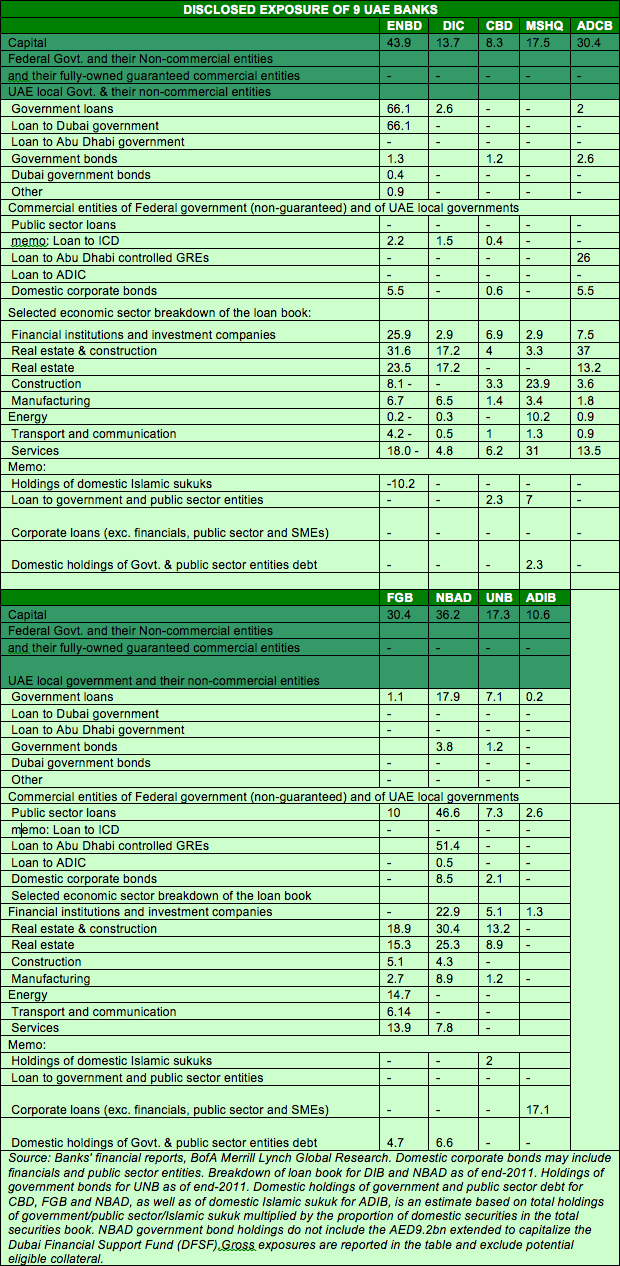
BARCAP'S VIEW
While the UAE's economic prospects have improved tremendously over the past year, continued deleveraging means subdued credit growth of under 4% year-on-year.
Barclays Capital expects similar credit growth next year.
"Challenges remain beyond 2014, when the debt of Dubai Inc. entities, which was restructured in 2010-11 (most notably Nakheel and Dubai World), starts to mature," said Barclays Capital analyst Alia Moubayed. "These entities received significant government support, which helped the creditors and the local economy. We would expect a second restructuring on more commercial terms and without government support to bolster the sovereign's credit outlook by reducing the government's contingent liabilities further."
Here is BarCap's outlook for key banks:
National Bank of Abu Dhabi
NBAD remains one of the UAE banks most exposed to government-related debt, with exposure of 130% of capital. However, the bank is less exposed to MENA countries (less than 9% of total assets) means the bank has escaped regional turmoil. However, it's regional expansion plans may be put on hold until the wider MENA's political stability is restored.
Abu Dhabi Commercial Bank
"ADCB's funding profiles remains weaker than those of its UAE peers (LDR of 110% well above the banking system LDR of 98%)."
Credit quality has improved and but still carry some risks of moving into the NPL category.
First Gulf Bank
Strong domestic franchise but suffers from concentration of credit to Abu Dhabi entities.
"The large credit concentration could pose serious credit concerns during a deep domestic economic downturn," said BarCap. "We remain comforted by FGB's strong capital, which helps to mitigate concentration risk in its loan book."
Emirates NBD
Emirates non-performing loans rose in the aftermath of the Dubai debt crisis in 2009, with its exposure to Dubai World and other Dubai Inc. entities.
"The bank's significant exposures to the Dubai government (ie, 30% of loans), despite its capital-free charges, result in high credit concentration and close association of the bank's risk profile/performance with that of the government. Profitability remains constrained since 2009 by the relatively high provisioning levels, weak loan growth and prevailing low interest rate environment."
MashreqBank
MashreqBank also suffered from non-performing loans during the Dubai financial crisis, but the issue is subsiding thanks to high provision charges over the past two years.
"We expect profitability to start recovering as provisioning expenses drop (compared to the previous three years) and credit growth picks up some steam (as seen so far in 2012)," said BarCap.
Dubai Islamic Bank
Dubai Islamic Bank's exposure to the real estate sector hurt the bank, but BarCap expects prospects to improve as the economy improves. However, DIB's exposure to Tamweel remains a source of 'contingent liability' for the bank.
Abu Dhabi Islamic Bank
ADIB's slow credit growth is reflective of slowing demand. Asset quality is stabilising, and its liquidity indicators remain among the best in the UAE.
"We expect the asset quality profile to remain stable, aided by a favourable domestic operating environment and generous government spending," said Antonie Yacoub, analyst at BarCap.
Union National Bank
UNB's exposure to Abu Dhabi real estate is a cause for concern, affecting credit quality. As a result NPL ratios are higher than the average ratio of 7.2%.
"Significant exposures to the AD government/public sector (which dominate the local business landscape) contribute to a high credit concentration," wrote Mr. Yacoub. "However, we believe this risk is largely mitigated by the bank's high capital levels and the low risk profile currently associated with AD and its related-entities."
CONCLUSION
While the UAE banks have had some respite from the UAE Central Bank's rules, there are bigger issues at hand. Most analysts don't expect the UAE CB to impose harsh rules that could impact the banks negatively, especially in light of the global financial crisis.
The central bank will act in consultation with key banks before it enacts game-changing rules on the financial services sector.
However, the bigger issues facing the UAE banks are exposure to the European Union, as the bloc continues to falter economically. Any major sovereign default in the continent could have a domino effect on global financial markets and business sentiment.
Another key risk for the UAE could come from across the Gulf.
"Further escalation in the confrontation between Iran and Israel, dragging other regional powers into it, would also have a detrimental effect on the UAE," notes BAML.
© alifarabia.com 2012