China's economy is cooling off and that's bad news for Saudi Arabia.
The world's second largest economy saw crude oil imports fell in the first half of 2013 while other non-oil indicators are also showing signs of a slowdown. Indeed, the Chinese economy grew at its slowest pace last year and data shows it may well be slowing down further.
A hard landing in the Middle Kingdom could have a huge impact on countries like Saudi Arabia, especially if oil prices collapse.
Barclays Capital estimates oil could fall to USD 70 per barrel if the Chinese economy continues to unwind.
"We would expect prices to only fall to around USD 70 per barrel and quickly recover to the USD 90s once the Chinese economy shows signs of recovering and it becomes clear OPEC has cut production sufficiently," Barclays Capital analyst Sudakshina Unnikrishnan said.
With Saudi breakeven oil price estimated to be USD 84.5 per barrel this year and USD 87.6 per barrel in 2014, a Chinese slowdown could pose major issues for the Saudi economy.
Saudi Arabia's all-important oil sector shrank 6.3% in the first quarter of the year - its weakest showing since 2010.
The declines meant Saudi Arabia's real GDP in the first quarter grew by 2.1% compared to the robust 4.4% registered in the fourth quarter of 2012.
This was heavily influenced by the move in oil production, which contracted by 7.9% over the same period. Indeed, oil sector's share of real GDP fell to 19.6%, compared with 21.3% during the same period last year.
"North American and Iraqi supply additions represent the main risk to the Saudi oil sector," wrote James Reeve and Andrew Gilmour, senior economists at Samba Banking Group.
NON-OIL SECTOR AFFECTED, TOO
Apart from a major consumer of oil, China is also the kingdom's second largest non-oil trading partner.
Samba economists believe the drift in oil prices will influence the pace of economic activity in the country.
"Activity has already slowed somewhat, and we expect this trend to consolidate as the government trims the pace of capital spending. To be sure, the non-oil economy will continue to expand at a decent rate, just not at the frenetic pace of 2010-12.
"Thus, we see non-oil GDP growth easing from an estimated 4.8% this year to 3.5% in 2015. Price pressures are expected to diminish: the dollar is set to strengthen as quantitative easing begins to be withdrawn, helping to dampen import prices."
The government will once again need to step up to ensure that the non-oil sector carries the day.
Non-oil GDP grew 4.4% year-on-year compared with 6.1% in the previous quarter and 4.8% during the same period last year.
"While private sector was the main driver of the non-oil sector, its contribution and growth level have started to normalize as the impact of the 2011 fiscal stimulus fade away gradually," said Fahad Alturki, head of research at Jadwa Investment Bank.
The HSBC Markit purchasing managers' index - a key indicator of economic confidence - saw its weakest growth in nine months. While new orders grew, it was slower than previous rating.
The kingdom's key non-oil exports such as plastic rose 13.9%, while chemical products saw a 30.8% surged in May alone. Meanwhile, transport equipment exports saw a 145% improvement.
NCB reports that letters of credit (LCs) in May fell by 4.4%, due to a 26.4% decline in machinery, appliances, and building materials by 34.2%, 26.4%, and 23%, respectively.
"Opened LCs recorded SAR 13.4 billion worth of goods to be imported to the kingdom, which is a moderation across the board of categories by 28.9%," said Yasser Al-Dawood, analyst at NCB Capital. "Building materials and machinery nose-dove by 51% and 48.2%, respectively, while motor vehicles and food stuff receded by 34.1% and 37.6%, respectively."
NON-OIL GDP TO SLOW
In addition, while financing is available there are logistical constraints to growth.
This is especially evident in the housing sector where there is lack of buildable land.
"The scarcity of buildable land appears to be the key logjam in the housing situation," said the Samba economists. "Private developers have long complained that the thinly traded and expensive land market is a major constraint, with land currently accounting for around half the cost of building a home."
All things considered, non-oil GDP is expected to grow at a slower pace over the next three years.
"We should stress that this is a deceleration of growth, not a cut to overall output," notes the Samba economists. "And, by historical measures, the 2013-15 average rate of 4.2% is pretty good; nevertheless activity is likely to be far less frenetic than during 2010-12, when average non-oil growth of 7.3% was registered."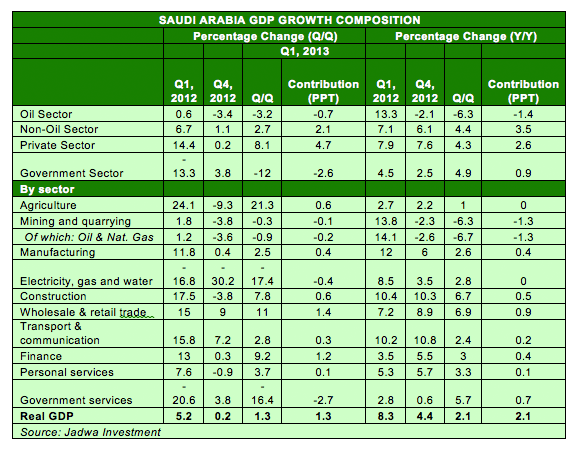
© alifarabia.com 2013