The impact of the United States Federal Reserve's decision to unwind its monetary stimulus program will ripple across the world, and MENA debt markets will be no exception.
The Fed pullback is widely expected to see volatility in emerging markets that could impact MENA fixed-income markets, which have enjoyed some stability especially among Gulf credits. But some analysts believe it is time for riskier ventures.
"We favor the cushion and carry of higher-yielding, lower-quality credits within MENA with low beta, as tapering is likely to be an important EXD market driver over 2014," wrote Jean-Michel Saliba, analyst at Bank of America Merrill Lynch (BAML) in a recent report.
"Though MENA credits remain broadly low beta within broader emerging markets, their defensiveness may not serve as much in relative terms going into 2014, as tapering risk is now better priced and investors appear better positioned to US rates volatility, we think."
The Wall Street bank favors Bahrain, Egypt and Iraq credits on valuation, despite ongoing political risks in each of the three countries.
That's a bold move as Egypt and Iraq were among the 10 riskiest sovereign credits in the third quarter, according to Standard & Poor's Capital IQ's latest report on global sovereign risk.
Egypt was the 7th most likely sovereign to default with 37.91% chance of default, while Iraq was ranked 9th with a 28.88% chance of default, according to S&P data.
IMF LOAN IS EGYPT'S LIFELINE
Gulf funds and loans have helped Egypt stabilize, but the country's political challenges remain unaddressed.
A new constitution is being prepared, which will be the basis for drafting election laws and for holding its first legislative, and then presidential, elections, most likely in the spring of 2014, according to the Institute of International Finance.
"The dominance of the military on strategic issues facing the country, including economic policy, raises questions about the economic policy framework beyond the transition."
Despite the funds flowing in, Egypt's macroeconomic situation remains weak. GDP growth is expected to rise 2.1% this year and 2.7% in 2014, as tourism and other sectors improve their performance, although nowhere near their full potential.
BAML's Saliba believes reviving the stalled negotiations on a USD 4.8 billion loan with the International Monetary Fund would serve as a credible anchor given the GCC has alluded its support is not open-ended.
"The greater the support from the GCC during the interim period, the more stability the outcome of elections bring, the lower the size and conditionality of the IMF package likely to be required, in our view. Stability and progress on reforms could bring in rating upgrades in 2H14," Saliba noted.
IRAQ, LEBANON HOLD POTENTIAL
Iraqi bonds are also attractive as a long-term play given the sheer potential of rapid oil production. Iraq is expected to be the biggest contributor to new barrels of oil output over the next two decades, according to the International Energy Agency, although a host of infrastructure and political issues could hamper progress.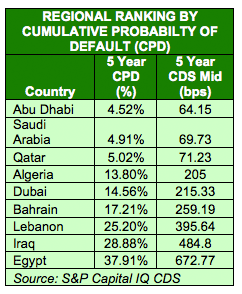
"Parliamentary election uncertainty and our oil price forecasts suggest headwinds in 1Q14, but any pullback should be a buying opportunity as we remain medium weight and constructive on the medium-term macro picture given oil production ramp up," BAML analyst said.
The Middle East's third riskiest sovereign is Lebanon with a 25.20% chance of default, the ratings agency's data shows.
Lebanon has suffered due to the external factors, notably the Syrian war, but some of the economy's fundamentals remain strong.
"We find Lebanon expensive, but keep EXD at market weight as the strong domestic investor base and solid Bank of Lebanon foreign exchange reserves position mitigate deterioration in macro and political fundamentals," BAML said. "Political tensions are likely to remain elevated and closely linked to the outcome of the Syrian civil war, in our view."
HIGH GRADE SPACE
At the other end of the risk spectrum, Abu Dhabi, Saudi Arabia and Qatar are among the safest sovereigns in the world, according to S&P data.
Dubai, which has seen its credit spread contract impressively over the past year, has dropped out of the list of the world's riskiest sovereigns, and is seen as one of the most impressive comeback kids with a string of positive news and developments.
But Dubai also has to manage a USD 20 billion debt due in 2014 which would keep investors at bay, especially as there is little visibility how the emirate will address the debt pile.
BAML expects Dubai to "muddle through its debt re-financings in 2014", and believes investors are better off considering other opportunities such as Qatari bonds.
"After the Qatari curve flattening over 2012 on a long overdue rally of the long end, the curve steepened again at the onset of tapering fears on a marked underperformance of the long-end, leaving the latter at cheap levels compared to other EEMEA sovereigns," BAML said.
© alifarabia.com 2013