Yellow metal investors have seen red over the past few days, as key market makers turned their backs on gold.
Last week Goldman Sachs, the influential Wall Street bank advised to short gold and cuts its forecast from USD 1,610 an ounce to USD 1,545 for 2013, and an even more bearish USD 1,350 per ounce in 2014. Gold was trading at USD 1,374 per ounce on April 15.
"Despite resurgence in euro-area risk aversion and disappointing US economic data, gold prices are unchanged over the past month, highlighting how conviction in holding gold is quickly waning," Goldman said in the note.
"In fact, should our expectation for lower gold prices continue to prove correct, the fall in prices could end up being faster and larger than our forecast, as aggregate speculative net long positions across COMEX futures and gold ETFs remain near record highs."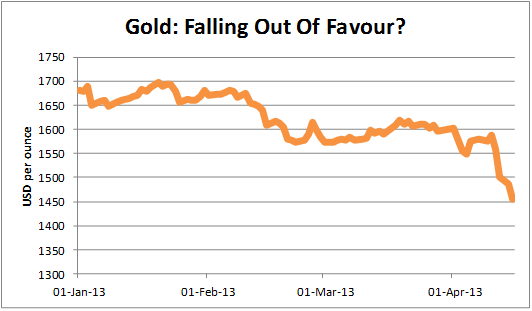
Source: Zawya.com
Indeed, key commodity funds have been looking for the exits since Friday as investors lost their nerves.
"Daily ETP [exchange trade products] outflows have grown and, in our view, continued outflows from ETPs bear a greater downside risk for gold," said Sudakshina Unnikrishnan, analyst at Barclays Capital.
Rumors of Cyprus selling its gold holdings also drove investors away, although the country has denied the report.
Joining the chorus was Société Générale, which believes gold could fall to USD 1,265 per ounce within the next three months.
"Gold broke the multi-year lows at USD 1,522/1,500 therefore broke below the USD 300 range which prevailed from the highs of July 2011," said Stephanie Aymes, the French bank's technical analyst. "This confirmed a major double top, which projects a target of USD 1,265."
The metal has been off USD 200 over the last week, USD 250 over the past month, USD 300 over two months ago, and USD 400 over six months ago.
"Fear has clearly taken the driver's seat, pushing greed completely aside... at least for now," noted Louis James, senior metals investment strategist at
Casey Research, arguing that the Goldman Sachs' analysis is "patently silly".
"What this is all saying is that gold is selling off for the wrong reasons, mostly amounting to speculative momentum-chasing. Simply put: this is panic."
But there is more to it than panic-selling.
Shifting market fundamentals
India raised gold import taxes by 50% to 60% earlier this year, hurting demand in one of the world's most important precious metal markets. As a result, the country's gold imports slid 24% in the first quarter.
Volatile trading in Bitcoin - an online virtual currency - has also impacted gold prices, as investors saw prices peak from USD 266 last Wednesday, only to see it plummet to USD 54 before the week ended.
Many Bitcoin investors are also heavily exposed to gold and the correlation has not hurt the commodity's prospects.
Other analysts such as Julian Jessop, head of commodities research at Capital Economics, say the slump is due to aggressive selling by speculative traders, and expects the yellow metal prices to stage a partial recovery once the markets calm down.
"We are drawn to the reports of some unusually large sell orders on the US gold futures market on Friday [April 12]," said Jessop. "Of course, you would expect plenty of selling in any market when prices are falling sharply, so this is not necessary telling us anything about causation. But it does seem reasonable to conclude that the gold price has been hit by heavy speculative selling, which may only be temporary."
Gold fans are also heartened by the fact that the sell-off was part of a wider commodity rout, rather than a gold-specific event. Oil, natural gas, and metal prices have all taken a hit as most macroeconomic indicators and estimates seem to be trending lower.
Weak US and Chinese economic data should ordinarily strengthen safe haven gold, but it has weakened it, puzzling investors.
"What's more, several previously reliable relationships between gold and other assets appear to have broken down, making us even more wary of rushing to change forecasts on the basis of the latest moves," said Jessop in a note to clients.
"For example, the slump in the gold price has not been accompanied by a surge in the US dollar more generally. The fact that bond yields have remained low is worth reiterating too."
Fool's gold
The more intrepid investors are looking to return to the market if gold prices fall further.
Jim Rogers, the legendary commodity investor who is an ardent gold buff, says he could start buying if the sell-off continues.
"Personally, I will be buying this week," echoed Casey Research's James as well.
For retail investors stuck with gold exposure there might be a few very good reasons not to join the exodus.
The global economy is not out of troubled waters and there is a strong likelihood that a Cyprus-like crisis could engulf the euro zone once again, giving gold prices a boost. Meanwhile, mixed data from the United States and China does not inspire confidence in the global economy either.
"We do not expect the current weakness to be sustained, provided the risk of an escalation of the euro zone crisis remains high and the global recovery is still fragile, thus keeping monetary conditions exceptionally loose," said Capital Economics' Jessop. "In the meantime, gold appears cheap again relative to other assets, including oil and equities."
© alifarabia.com 2013